Local SEO Ranking Tools: The Six Jobs a Stack Has to Cover
"Local SEO tool" describes six different jobs and no product does all six well. Which tool covers which — and the measurement layer most stacks skip.

The Stack, in Six Jobs
- Local SEO isn't one job, it's six — profile management, listings, reviews, keyword research, rank measurement, and reporting. Most "best tools" lists rank products from different categories against each other, which is why no two lists agree.
- The tools that dominate the search results for this term are mostly vendors ranking their own product pages. Localo and BrightLocal hold the top two organic positions with their own commercial pages, not with advice.
- Three incompatible billing models are hiding behind the price tags: per location (BrightLocal, Whitespark), per report or credit (Local Falcon), and per credit pair (Local Optics, formerly Local Viking). Comparing monthly headline prices across those models tells you almost nothing.
- The measurement layer is the one most stacks skip, and it's the only one that tells you whether the other five are working.
- You can assemble a functional local stack for under $100/month. Most of the spend goes to jobs you may not need yet.
Why No Two "Best Local SEO Tools" Lists Agree
Read four articles on this subject and you'll get four different winners, with barely any overlap in the shortlists. That isn't because the writers disagree about quality. It's because they're answering different questions while using the same words.
"Local SEO tools" is a category label stretched over at least six unrelated jobs. A tool that publishes your business hours to forty directories and a tool that draws a heatmap of where you rank are both, technically, local SEO tools. They compete for the same search term. They do not compete for the same slot in your budget, because they don't do the same thing. Ranking them against each other produces a list that reads authoritatively and helps nobody.
There's a second reason, and it's worth naming plainly. Look at who actually ranks for this term. As of early August 2026, the top two organic results are Localo and BrightLocal — both vendor pages, both selling the thing the reader is searching for. Further down, Chatmeter's list features Chatmeter. Semrush's page features Semrush. Every one of those lists is honest about what it sells and quietly generous to itself in the ranking, which is exactly what you'd expect and exactly why the lists disagree.
We should say this up front: we're building a tool in this category too. RankMap is a GeoGrid rank tracker and it is pre-launch as of this writing. We have an interest here. What follows is organised by job rather than by rank, so you can see where each tool actually sits instead of taking our word for who wins.
The Six Jobs a Local SEO Stack Has to Do
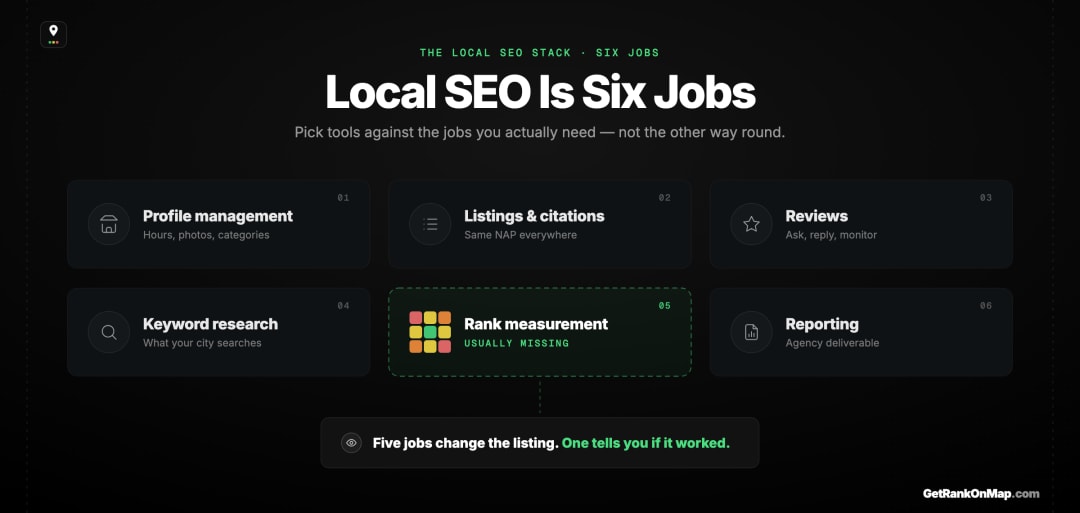
Before you shortlist a single product, it helps to know which of these you're actually trying to solve. Most businesses need three or four, not all six.
1. Google Business Profile management. Posting updates, keeping hours and categories accurate, answering questions, uploading photos, handling the profile's own quirks. This is the highest-leverage and least glamorous work in local SEO.
2. Listings and citations. Getting your name, address and phone number consistent across the directories and data aggregators that feed local search. Largely a fix-once-then-monitor job — which is why paying for it monthly, forever, deserves a second look.
3. Review generation and management. Requesting reviews, monitoring them across platforms, responding. Review signals matter, though not as directly as most owners assume.
4. Local keyword research. Working out which phrases people in your service area actually type. Different from national keyword research, because the volumes are small enough that most mainstream tools report "no data" for terms that convert well. We've covered how to approach local keyword research when the volume tools go quiet.
5. Rank measurement. Finding out where you actually appear — which is the job this site exists for, and the one we'll spend the most time on below.
6. Reporting. Turning all of the above into something a client or a boss will read. Almost exclusively an agency need. If you're a single-location owner, you can skip this entire category and the money that comes with it.
Those six are not our carve-up of the market. They are the list a buyer wrote out for themselves in August 2026 while shopping for one product to do all of it:
I am particularly looking for a platform that can handle Google map grid tracking, organic rank tracking, GMB insights, Review monitoring and review responses, GMB post scheduling and publishing and white label client reporting.
r/localseo, August 2026
They had already tried BrightLocal, Localo, DAXRM, Local Falcon and Whitespark, and were still looking. That is the shape of the problem: six jobs, and no product that does all six well enough to stop the search.
The Tools, Sorted by the Job They Do

For Google Business Profile management
Localo sits at position one for this search term and leans hard into AI-assisted profile work — suggested tasks, generated posts, an optimisation score. Its published pricing as of 2 August 2026 runs $49 and $169 per month depending on tier. It's built for the owner-operator who wants a to-do list rather than a dataset.
Semrush's local offering bundles profile management with listings and a map rank tracker inside its wider suite. That bundling is the point: if you're already paying Semrush for organic SEO, the local module is an add-on rather than a new vendor relationship.
For listings and citations
BrightLocal and Whitespark are the two long-standing names, and both bill per location. That unit matters enormously and we'll return to it. Whitespark also does manual citation building as a service, which is a genuinely different product from software that submits to an aggregator.
The honest note on this category: citation cleanup is mostly a one-time project. Once your NAP data is consistent and the aggregators have propagated it, the ongoing monitoring is worth far less per month than the initial fix. Budget accordingly.
For reviews
Nearly every suite in this list includes review monitoring, so this is rarely a reason to buy a standalone tool. Where the products differ is in whether they'll actually solicit reviews for you — SMS and email request flows — versus simply telling you a new one arrived.
For rank measurement
This is where the category gets interesting, and where the most money gets wasted.
A conventional rank tracker checks one keyword from one location and returns one number. For local search that number is close to meaningless, because Google Maps results change with the searcher's physical position. You can be third from your own office and invisible four miles away, and a single-point tracker will report "position 3" both times. We've written about why one rank number lies at more length.
The fix is grid-based tracking — a GeoGrid — which runs the same search from many coordinates around your business and returns a heatmap instead of a number. If you're new to the idea, start with what GeoGrid rank tracking is.
The tools built around this measurement, rather than bolting it on:
- Local Falcon — scan-on-demand grid audits, metered by report credits. Grid sizes on its pricing page run from 3×3 up to 17×17, with an entry plan listed at $24.99/month as of 2 August 2026.
- BrightLocal's Local Search Grid — sold as an add-on alongside the main subscription, with grid sizes listed from 5×5 up to 21×21.
- Local Optics (the product formerly and still widely known as Local Viking) — plans listed from $39 to $200/month, metered through two separate credit pools, one for keyword tracking and one for GeoGrid scans.
- LocalRank.so — published tiers from $57/month up to $2,997/month, aimed squarely at the agency end.
- Local Dominator — the budget entry in this group, with plans published from $39/month.
For a deeper treatment of just this layer, we maintain a separate comparison of local rank trackers, including the ones we compete with directly.
For reporting
An agency requirement, and the real reason many agencies buy a suite instead of assembling best-of-breed tools. The bill for assembling them compounds quietly. A solo freelancer going through their subscriptions in August 2026 found this:
Between SEMrush, LocalFalcon, reporting software and a couple of other bits and pieces, I'm spending way more than I realised.
r/localseo, August 2026
White-label PDFs and client dashboards are worth paying for when you're presenting to twenty clients a month — and what actually belongs in that report matters more than whose logo is on it. They're worth nothing when you're the only person who reads the output.
The Part the Price Tags Hide: Three Billing Models

Here is the single most useful thing in this article. The headline monthly prices above are not comparable to each other, because the vendors are selling in three fundamentally different units.
Per location. BrightLocal and Whitespark both meter this way. Your cost scales with the number of business locations you track. Predictable, and cheap at one location. An agency at forty locations is doing very different arithmetic from a single dentist, on the same price sheet.
Per report or credit. Local Falcon meters by scan. Every grid you run consumes credits, and a larger grid consumes more of them — a 15×15 grid is 225 individual searches, against 25 for a 5×5. Your cost scales with how often and how finely you look, not with how many locations you own. Run a scan a month and it's inexpensive; run one a week across ten keywords and the arithmetic changes fast.
Per credit pair. Local Optics splits its allowance into separate keyword credits and GeoGrid credits, so a plan can run out of one while the other sits unused. This is a third model again, and the one most likely to produce a surprise mid-month.
Anyone comparing "$39 versus $49 versus $57" across these three models is comparing numbers that don't share a denominator. Work out your own usage first — locations, keywords, scan frequency, grid size — and only then price it. A tool that looks twice as expensive on the pricing page is often cheaper for your actual pattern of use, and occasionally the reverse by a wide margin.
One caution on all of the figures above: they're first-party, read from each vendor's own pricing page on 2 August 2026 — BrightLocal, Local Falcon, Whitespark, Local Viking, Localo, LocalRank.so, Local Dominator, Search Atlas, and they will go stale. Check before you buy. That advice applies to every article on this subject, this one included.
The Layer Most Stacks Are Missing
If you assemble a stack from a typical "best tools" list, you'll end up with profile management, listings, reviews and reporting — and a rank number that's measured from one point.
That gap is the reason so many local SEO efforts feel unfalsifiable. You do the work. You publish the posts, fix the citations, chase the reviews. Rankings appear stable. Calls don't change. And there's no way to tell whether the work landed, because the instrument you're reading was never precise enough to show movement in the first place.
A grid makes it falsifiable. You can see a red zone on the west side of your service area turn yellow over six weeks, and connect it to something you actually did. Or you can see it stay red, and stop paying for whatever wasn't moving it. Both outcomes are worth more than a stable number that means nothing. We've written about how far your Google Maps ranking really reaches if you want to see what that variation looks like in practice.
How to Build a Stack From Zero
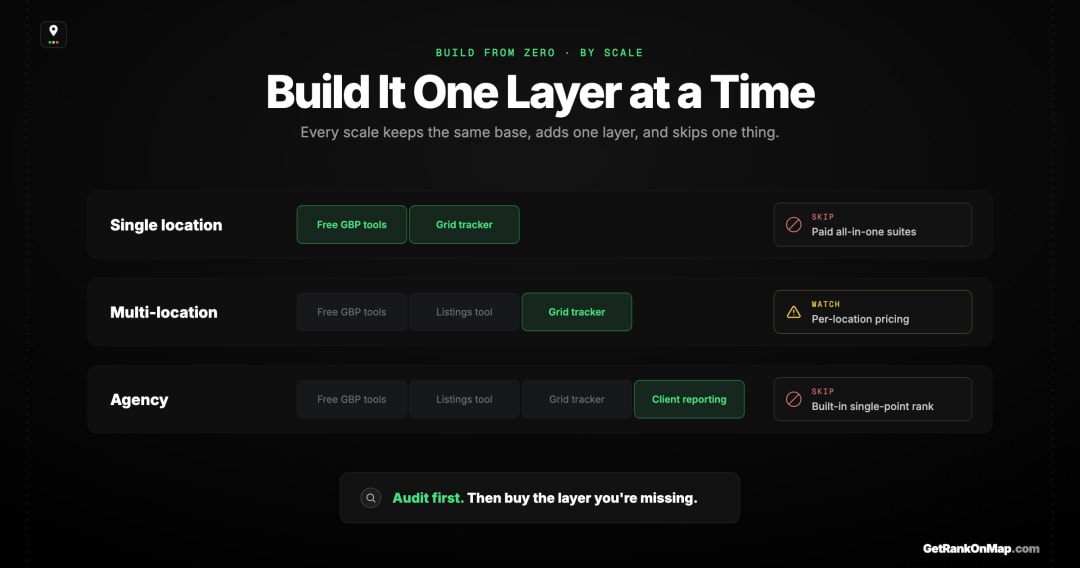
If you're a single-location owner on a tight budget. Start with the free tools: Google Business Profile itself, and Google Search Console. Do the profile optimisation checklist by hand — it costs nothing and it's the highest-return work available to you. Add one grid tracker so you can tell whether any of it worked. Total: under $50/month.
If you're a multi-location business. Listings consistency stops being optional at three or more locations, because that's where the data drift starts to compound. Pair a listings tool with grid tracking, and read our note on tracking multiple locations without paying per location before you sign anything annual.
If you're an agency. Buying for a book of clients is a different exercise — everything trivial at one client compounds at thirty. Reporting is your real constraint, not measurement — but don't let the suite's built-in single-point tracker become the number you show clients. It's the one metric in the report most likely to be flattering and wrong.
Before you buy anything at all, run a local SEO audit. A meaningful share of what these tools automate is work you can do once by hand, and knowing which parts those are is what keeps a stack from quietly becoming five subscriptions you can't justify.
Buy the Job, Not the Leaderboard
The reason this category confuses people isn't that the tools are bad. It's that "local SEO tools" describes six different jobs, and almost every list written on the subject flattens them into one ranking — usually one where the author's own product does well.
Sort by job instead and the decision gets much smaller. Work out which of the six you actually have. Price each against your own usage rather than the headline number, because per-location, per-report and per-credit pricing don't compare. And whatever else you assemble, make sure something in the stack can tell you whether the rest of it is working — because a stack that can't be measured is a stack you'll be renewing on faith.
RankMap is building the measurement layer, so we're not a neutral party here and we won't pretend to be. We're pre-launch and we're not asking you to choose us over anything you're already using. But if the honest answer to "where do I actually rank?" is "I'm not sure," that's the gap we're building for — join the early-access waitlist and we'll show you what we've built when it's ready.
Go deeper
- The Honest BrightLocal Alternative We're Building
- BrightLocal vs Local Viking (2026): Billing, Not Features
- City Rank Tracker: See Your Google Maps Rank Across a City
- Free Google Maps Rank Checker: See Your Rank on a Map
- Geomapy vs BrightLocal (2026): One of These Tools Is Offline
- Geomapy vs Local Viking: Six Things That Separate Grid Tools
- The Honest Local Falcon Alternative We're Building
- Local Falcon vs BrightLocal: The Wrong Question
- The Honest Local Viking Alternative We're Building
- The Honest Localo Alternative We're Building
- The Honest LocalRank Alternative We're Building
- The Honest Whitespark Alternative We're Building
- Whitespark vs BrightLocal (2026): Software vs Labour
- The Google 3-Pack: What It Is and How Businesses Get In
- Local SEO for Multiple Locations: Every Branch Ranks Alone
Frequently asked questions
- 01What are the best local SEO tools?
- There's no single answer, because the products don't share a job. For profile management, Localo and Semrush's local module are the common picks. For listings and citations, BrightLocal and Whitespark. For grid-based rank measurement, Local Falcon, Local Optics, LocalRank.so and Local Dominator. Choose per job, and only for jobs you actually have.
- 02Are there free local SEO tools worth using?
- Yes, and they're underused. Google Business Profile's own dashboard, Google Search Console, and Google's Performance data are free and closer to the source than anything a vendor resells. They won't give you grid-based measurement, which is genuinely hard to do for free at any scale, but they'll take you further than most people expect.
- 03Can I do local SEO myself?
- For a single location, largely yes. The profile work, the review requests and the basic citation cleanup are all manual tasks that don't require software — they require someone doing them consistently. Tools become worth paying for when you're managing multiple locations, when you need to prove results to someone else, or when you need measurement precise enough to tell whether your effort is working.
- 04Does local SEO still work in 2026?
- The mechanics have shifted — AI Overviews now appear on a large share of local-intent searches, which changes how results get surfaced — but the map pack is still where local purchase decisions get made, and it's still ranked on proximity, relevance and prominence. What's changed is that measuring your position has gotten harder, not that position matters less.
- 05Do I need a separate rank tracker if my suite includes one?
- Check what it measures before you decide. If the suite reports a single position from a single location, it's answering a different question from a grid — and for local search, usually the less useful one. If it draws a grid, you may not need a second tool.
- 06How much should a local SEO stack cost?
- A single-location owner can run a functional stack for under $100/month, and often under $50. Above that, you're usually paying for listings management you may only need once, or for reporting features that matter only if you're presenting to clients.
Explore with AI
Share this
Map your real rank across the city.
Free for the first 50 scans. No credit card.
Join the waitlist

