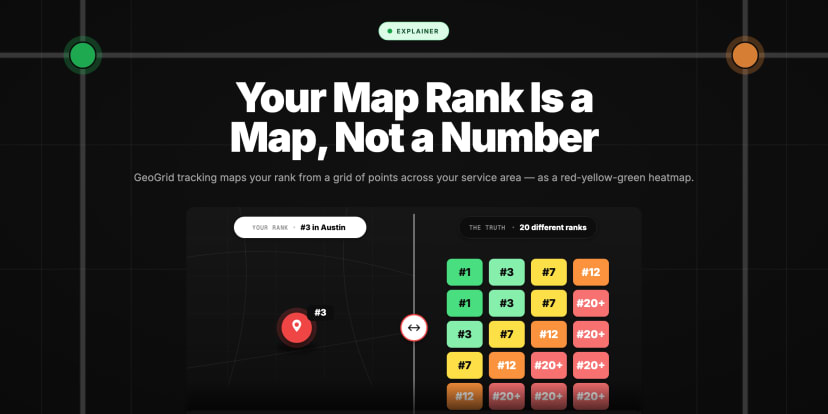
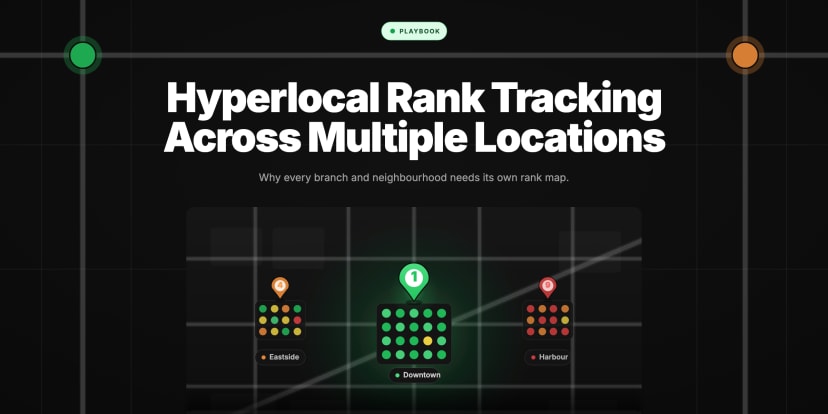
How Far Does My Google Maps Ranking Reach?
Your Google Maps ranking fades with distance. How far your visibility really reaches, what sets that range, and why your catchment isn't the one you assume.

SummaryYour Map Pack visibility is not a single position — it radiates from your location and fades with distance until you drop out of the pack entirely. This covers what sets how far that reach extends, why your real catchment is smaller than the one you assume, and how a GeoGrid heatmap makes the edge visible.
Read moreShow less
How Far It Actually Reaches
-
Your Map Pack ranking isn't a single position — it has a reach — it's strongest near your location and fades as searchers get further away, until you drop out of the pack entirely
-
It fades because Google ranks on distance from the searcher — one of its three local factors — so the further someone is, the harder it is to stay in their pack
-
How far your reach extends depends on your prominence versus the competition around you — a strong profile in a thin market reaches a long way; the same profile surrounded by strong rivals reaches barely past the door
-
Your real catchment is almost never the one you assume — most owners overestimate how far their visibility carries, and lose customers in the gap
-
You can't see your reach by searching from one spot — a single check tells you nothing about range; reach is a question about space, so it needs a spatial answer
-
The only way to see how far your ranking reaches is a heatmap — a GeoGrid maps your visibility across your area so the edge of your reach is visible at a glance
Most advice about ranking on Google Maps stops at "rank higher." But there's a more useful question hiding underneath it, and almost no one asks it: how far does my ranking actually reach? Because your Map Pack visibility isn't the same everywhere — it radiates out from your location and fades with distance, like a signal getting weaker the further you go. Knowing where that signal is still strong, where it's fading, and where it cuts out entirely tells you something a ranking position never can: exactly how big your real catchment is, and where you're losing customers you assume you're reaching. This is about that reach — what it is, what sets its range, and how to actually see it.
Your Ranking Has a Reach — and It Fades
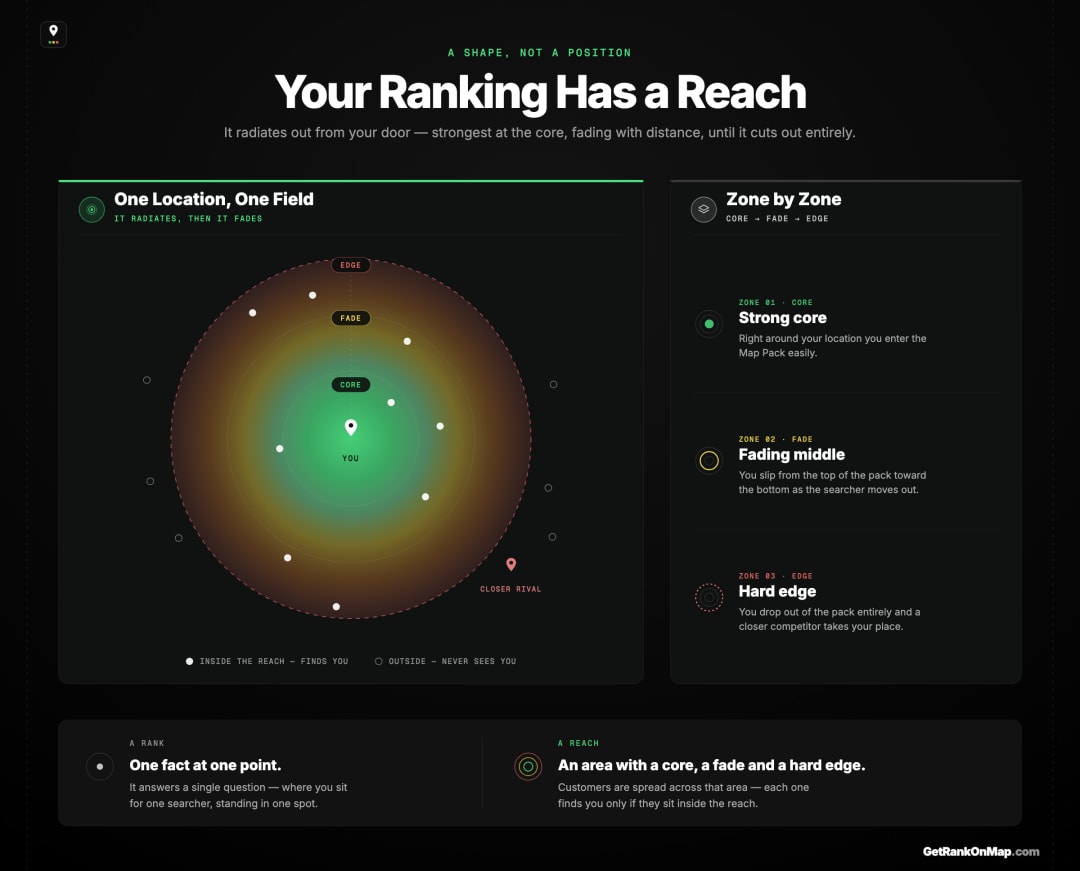
Think of your Map Pack visibility less like a rank and more like a signal radiating from your location. It's strongest at the source, weaker as you move out, and at some distance it cuts out — you stop appearing in the pack. That fade is your reach, and it's the real shape of your local visibility.
Picture your business as a transmitter. Right next to it, your signal is strong — you show up in the Map Pack easily. As a searcher moves away, the signal weakens: you slip from the top of the pack toward the bottom, and at some point you drop out of it altogether and a closer competitor takes your place. That gradient — strong at the centre, fading to nothing at the edge — is what we mean by your ranking's reach.
This is a completely different mental model from "I rank #3." A position is a single fact at a single point. A reach is a shape — an area, with a strong core, a fading middle, and an edge. And it's the shape that actually matters to your business, because customers aren't all standing at your front door. They're spread across an area, and whether each one finds you depends on whether they're inside your reach or past its edge.
Once you see ranking as a reach rather than a number, the important questions change. Not "what's my rank?" but "how far does my strong visibility extend? Where does it start to fade? Where does it cut out — and who's winning the searches just past that line?"
Why It Fades: Distance From the Searcher
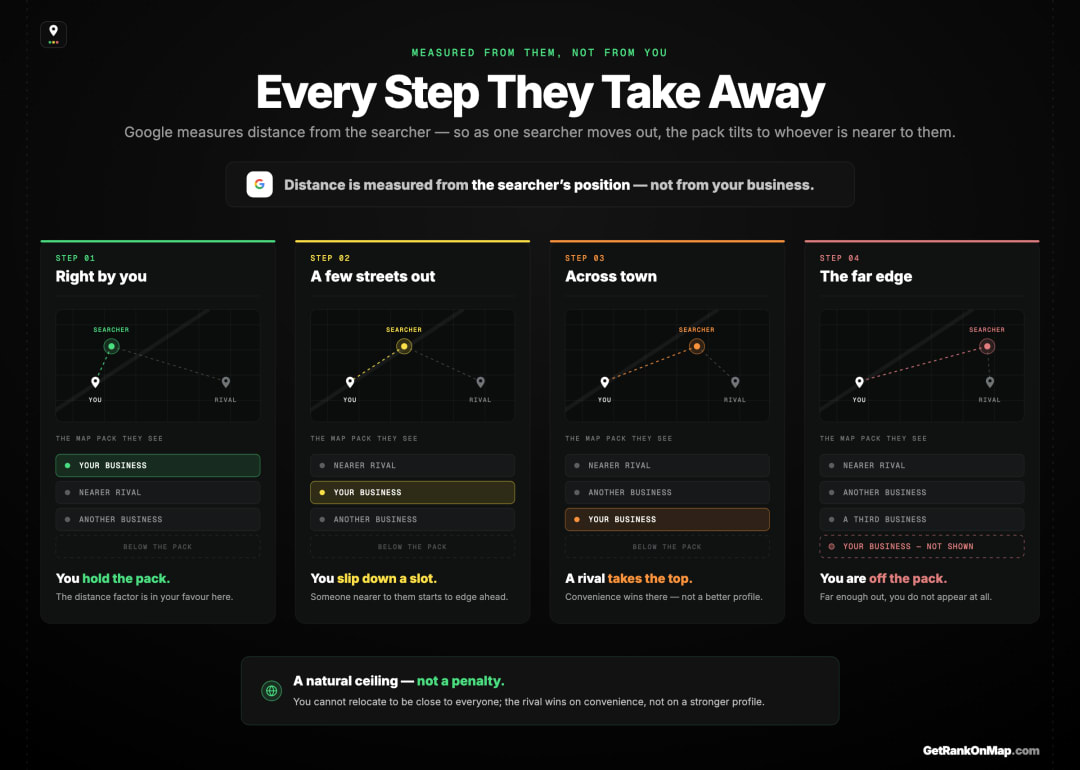
The fade isn't random — it's Google's distance factor at work. Google ranks local results partly on how close you are to the person searching, measured from wherever they are. So the further a searcher is from you, the more that factor counts against you, and the more likely a closer business takes your place in their pack.
The reason your reach fades is the same reason your ranking varies at all: distance is measured from the searcher. Google's three local ranking factors are relevance, distance, and prominence, and distance is literally how far you are from the person doing the search. Here's the full picture of how those factors interact.
So as a searcher moves away from you, the distance factor steadily works against you. Near you, it's in your favour and you rank well. Further out, it tilts toward businesses that are now closer to that searcher than you are — and they start beating you in the pack, not because their profile is better, but because for that searcher they're more convenient. Eventually you're far enough away that you don't appear at all. That's not a penalty and it's not something you've done wrong; it's exactly why Maps ranking varies by location, seen from the angle of distance rather than position.
This also means reach has a natural ceiling you can't simply optimise past. You can't relocate to be close to everyone, so there will always be a distance beyond which your visibility fades — the goal isn't to eliminate the fade, it's to know where it is and push it as far out as the competition allows.
We measured the fade. In our own study of the local pack — 300 grid cells across 12 markets in three Indian cities, July 2026 — we observed 2,590 businesses from every point on a 5×5 grid at 1 km spacing, then counted how often each one appeared as the searcher moved away from it. Because the same business is being watched at every distance, nothing about the business itself changes across the rows below. Only the searcher's position does.
| Distance from the business | Appearance rate |
|---|---|
| under 0.5 km | 96.4% |
| 0.5 – 1 km | 40.5% |
| 1 – 2 km | 11.1% |
| 2 – 3 km | 3.2% |
| 3 – 5 km | 0.9% |
| 5 km and beyond | 0.0% |
The last row is not a rounding artefact. Past five kilometres there were 3,258 opportunities to appear and the businesses in our corpus appeared at none of them. Reach is not a soft gradient that eventually gets thin — it ends. The full corpus and analysis are public.
What Sets How Far Your Reach Extends
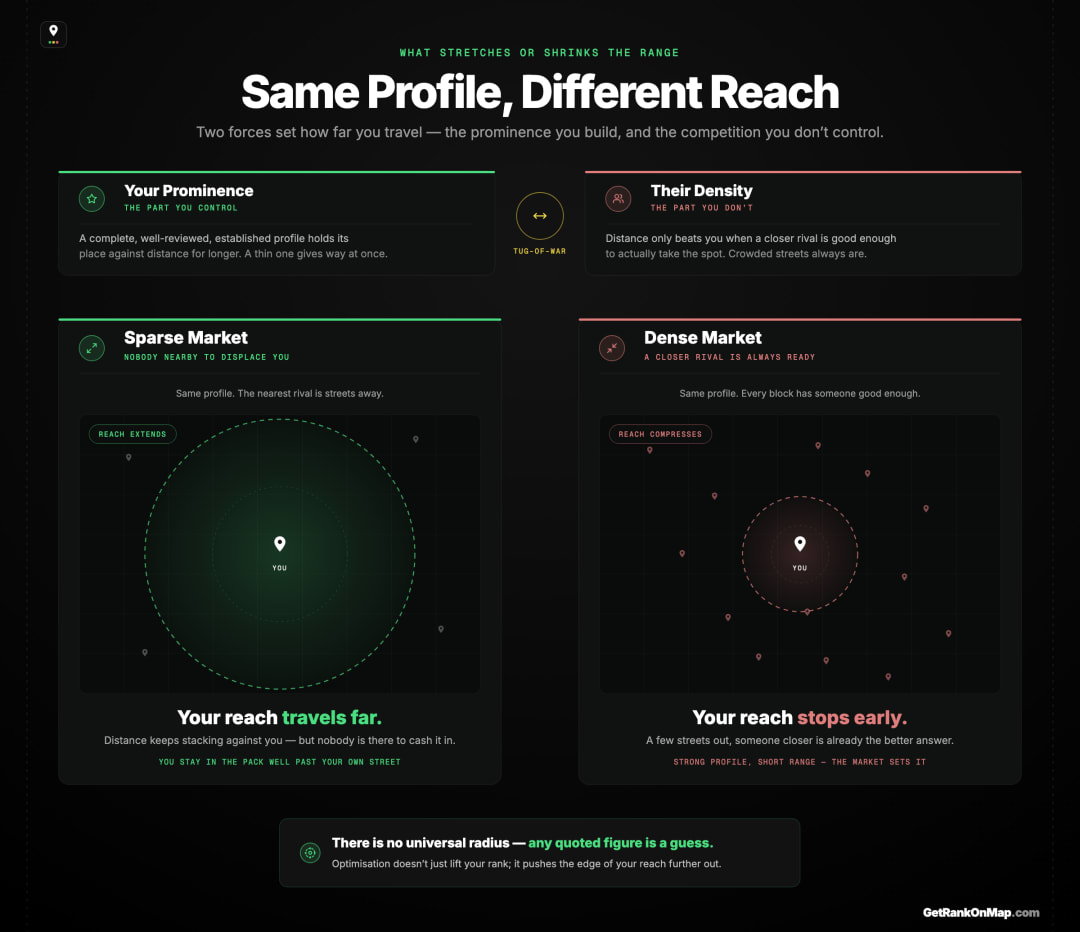
Two profiles in two towns can have wildly different reach. What stretches or shrinks it is the balance between your prominence and the density of competition around you. Strong reputation in a sparse market reaches a long way; the same reputation surrounded by strong rivals reaches barely past your own block.
If distance causes the fade, what decides how far you get before it cuts out? Mostly the tug-of-war between two things:
-
Your prominence and relevance — the strength of your profile. A well-optimised, well-reviewed, established business holds its place in the pack against the distance factor for longer. A thin, new, or incomplete profile gives way almost immediately. This is the part you control, and it's why the optimisation work matters — it doesn't just lift your rank, it extends your reach.
-
The density and strength of nearby competition — the part you don't control. Distance only beats you when there's a closer business good enough to take the spot. In a market with few strong rivals, your reach can extend a long way, because there's no one nearby to displace you. In a dense, competitive area, even a strong profile reaches only a short distance before a closer competitor is also strong enough to win. Same profile, completely different reach, decided by who's around you.
This is why there's no universal answer to "how far should my ranking reach?" — and why anyone who quotes you a specific radius or a tidy figure is guessing. Your reach is specific to your business, your strength, and your competitive surroundings. It's not a number you can look up. It's something you have to measure on your own map.
Your Real Catchment Isn't the One You Assume
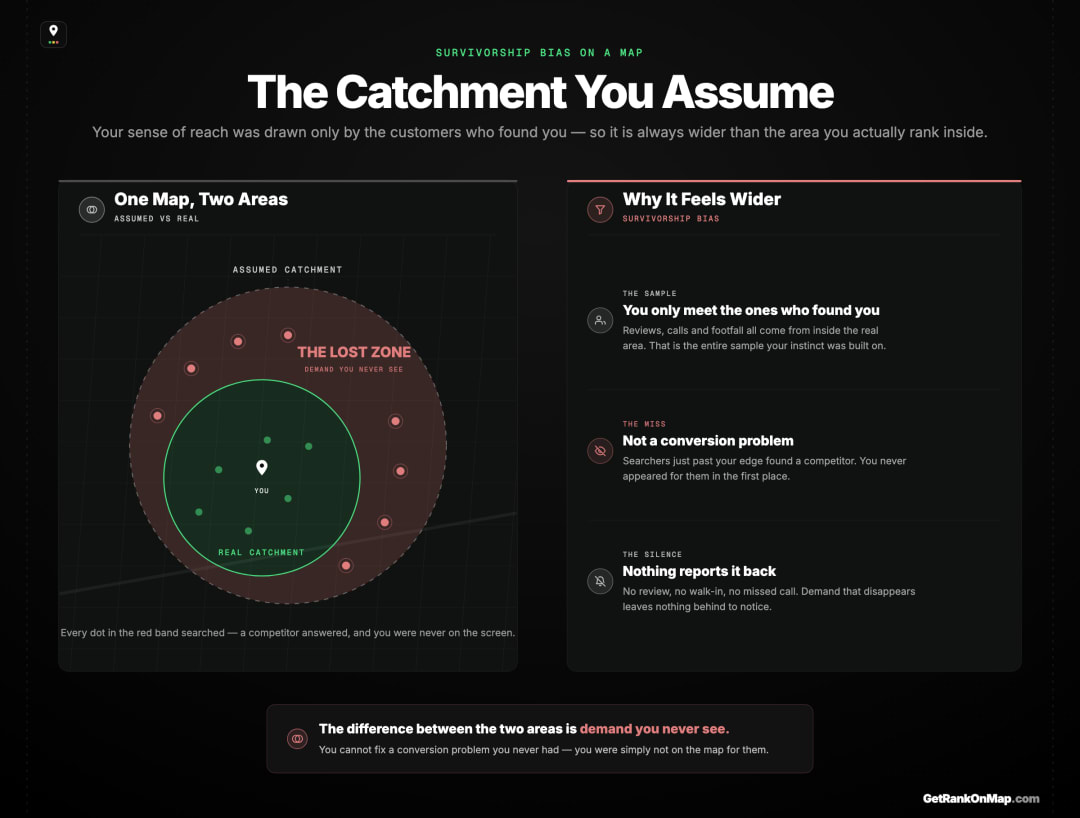
Most owners carry a mental map of the area they "cover" — and it's almost always bigger than their actual ranking reach. The gap between the catchment you assume and the one you really have is where customers quietly go to competitors. Closing that gap starts with seeing it.
Here's why this is worth the trouble. Every owner has a felt sense of their catchment — "we get people from all over this side of town." But that assumed catchment is built on the customers who did find you. It's invisibly survivorship-biased: you never see the searchers a few streets past your real edge who found a competitor instead and never knew you existed. They're not in your reviews or your foot traffic, because they never reached you.
So the assumed catchment is almost always wider than the real one, and the difference is pure lost business — demand inside the area you think you cover, but outside the area you actually rank in. You're not failing to convert those customers; you're failing to appear for them in the first place. And because they're silent, nothing about your day-to-day tells you they're there.
This is the practical payoff of thinking in reach. It reframes growth from a vague "rank higher" into a concrete map question: where's the edge of my real visibility, how big is the gap to the catchment I assumed, and which neighbourhoods just past my edge are worth the work to pull inside it? You can't answer any of that from a ranking position. You can only answer it by seeing your reach drawn out.
How to See Your Reach: The Heatmap
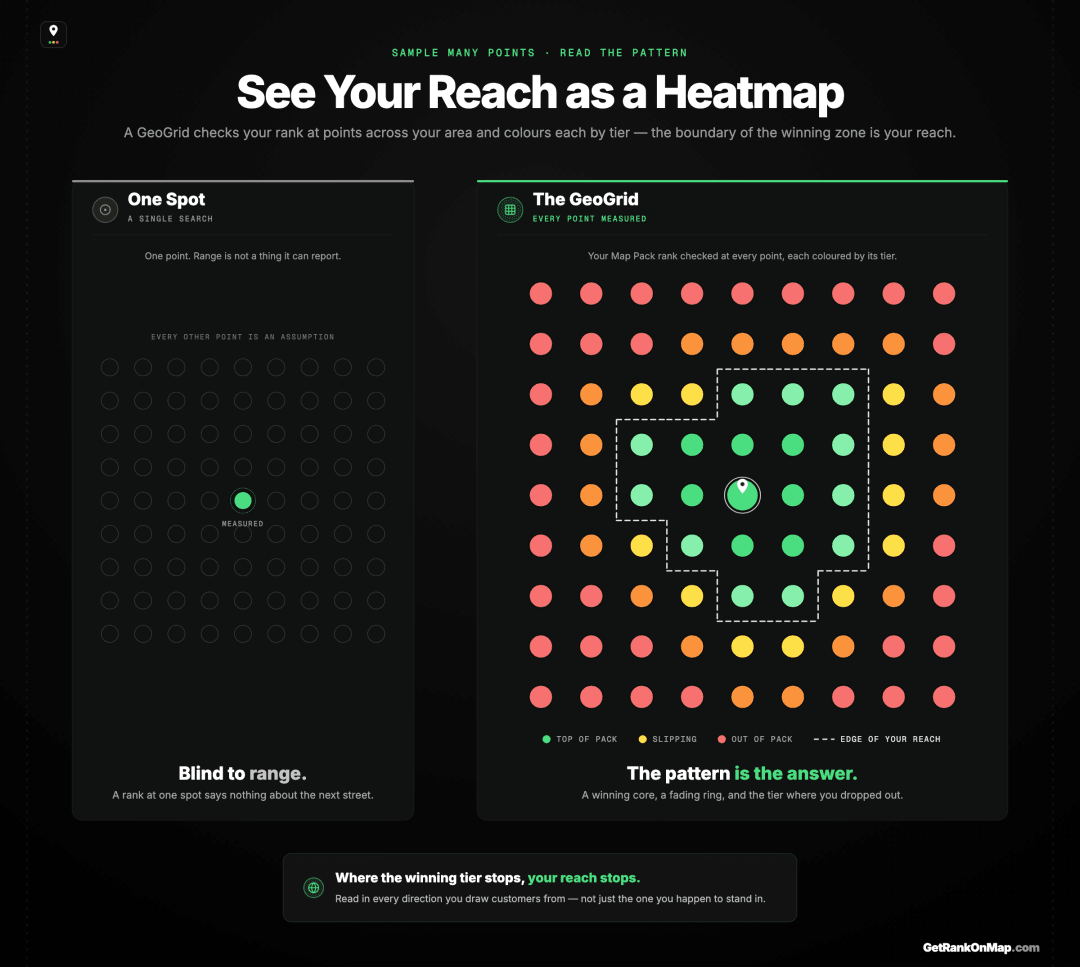
Reach is a question about space, so it needs a spatial answer. A single rank from one spot can't show range. A GeoGrid checks your visibility at points spread across your area and colours them in, so your reach — the strong core, the fading middle, the edge — appears as a heatmap you can read at a glance.
You cannot see reach by searching for yourself, because that's one point — and reach is the relationship between points across distance. A single check is blind to range by definition. To see how far your ranking carries, you have to check it at many distances and directions at once, and look at the pattern.
That's exactly what a GeoGrid produces. It lays a grid of points across your area, checks your Map Pack rank at each one, and draws the result as a colour-coded heatmap — green where you're winning, fading through yellow, to red where you've dropped out. Here's how a GeoGrid scan works. On that map, your reach is simply the green: a strong green core around your location, a yellow ring where you're fading, and the red beyond it where your visibility has cut out and someone else owns the pack. The edge of the green is the edge of your reach — visible instantly, no guesswork. It closes the gap between the catchment you assume and the one you actually have. (Want a first read today? Here's how to check your Maps ranking for free.)
That heatmap of reach is precisely what RankMap is built to show you: how far your Map Pack visibility really extends across every direction you draw customers from, where it fades, and where you're losing people you assumed you had. RankMap isn't live yet — we're pre-launch. If you want to see the true edge of your reach instead of guessing at it, join the waitlist for free early access.
Reach Is a Distance, Not a Number
"How far does my ranking reach?" is a better question than "what's my rank?" — because your Map Pack visibility isn't a position, it's a signal that radiates from your location and fades with distance. How far it carries before it cuts out is set by your profile's strength against the competition around you, which means your real catchment is specific to you and almost always smaller than the one you assume. The gap between the two is where customers quietly slip to closer rivals.
You can't see any of that from a single search, because reach is a question about space. The only honest answer is a map: a heatmap of your visibility with a strong green core, a fading edge, and the red beyond it where your reach runs out. That's the map RankMap is built to draw. We're not live yet, but when we are, you'll see the true edge of your reach — and exactly how much further it's worth pushing. Join the waitlist for free early access.
Frequently asked questions
- 01How far does a Google Maps ranking actually reach?
- There's no single answer — it depends entirely on your business. Your visibility is strongest near your location and fades with distance, but how far it carries before cutting out is set by your profile's strength versus the competition around you. A well-established business in a thin market can reach a long way; the same business in a dense, competitive area reaches only a short distance before a closer rival takes the pack. Anyone quoting you a specific radius is guessing — the only honest way to know your reach is to measure it across your own area.
- 02Why does my ranking get weaker the further away someone searches?
- Because Google ranks local results partly on distance from the searcher, measured from wherever they are. The further a searcher is from you, the more that distance factor counts against you and favours businesses closer to them — so you slip down the pack and eventually drop out of it. It's not a penalty or an error; it's the distance factor working as designed. You can't remove the fade, but a stronger profile holds your place against it for longer, extending how far your reach carries.
- 03Can I extend how far my Google Maps ranking reaches?
- To a degree, yes — by strengthening the factors you control. A more complete, better-reviewed, more relevant profile holds its position against the distance factor longer, which pushes your reach further out. But you can't extend it past where a closer competitor is also strong enough to win, and you can't relocate to be near everyone, so reach always has a ceiling set by your surroundings. The practical goal is to push your edge as far as the local competition allows — and to know where that edge currently is.
- 04Why do I get customers from further than I seem to rank — or closer?
- Your felt catchment is built only on the customers who found you, so it can mislead in both directions. It usually overstates your real reach, because you never see the searchers just past your edge who found a competitor instead and never knew you existed. Occasionally a loyal customer travels from beyond your ranking reach because they already know you — but that's word-of-mouth, not Map Pack visibility. The reliable way to know your true reach is to map it, not to infer it from who happens to walk in.
- 05How do I see how far my ranking reaches?
- With a heatmap, not a single search. Because reach is about how your visibility changes across distance, you need to check your rank at many points spread across your area and look at the pattern. A GeoGrid does exactly that — it checks your Map Pack rank at a grid of points and colours them green to red, so your reach shows up as a green core fading to a red edge. The boundary of the green is the edge of your reach, visible at a glance rather than guessed at.
Explore with AI
Share this
Map your real rank across the city.
Free for the first 50 scans. No credit card.
Join the waitlist