The Honest Local Viking Alternative We're Building
Looking for a Local Viking alternative? What it does well, where per-profile pricing and credit-metered grids pinch, and what we're building instead.

Renting the Grid, Summarised
-
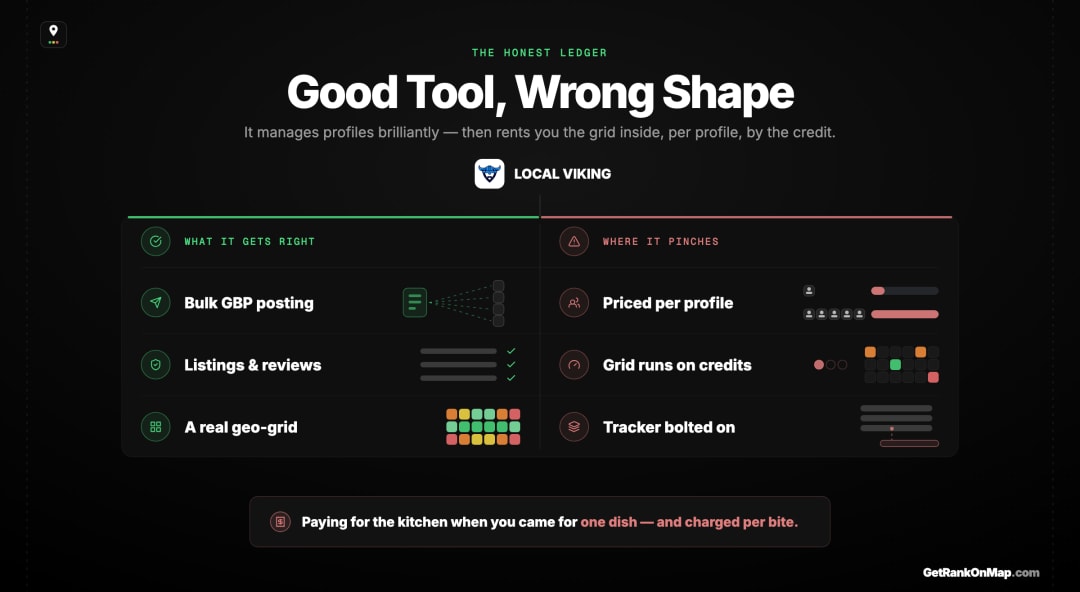
Local Viking is genuinely good at what it was built for — managing a stack of Google Business Profiles from one dashboard. Posting, reviews, bulk edits across locations. That part holds up.
-
The friction isn't the tracking quality — it's that rank tracking is one feature inside a management suite. It's priced per profile, and the geo-grid scans are metered by credits.
-
If what you actually want is to see where you rank across your whole service area — honestly, without a credit meter ticking — the grid shouldn't be the afterthought. It should be the point.
-
That's the gap we're building RankMap to fill. This page is an honest look at Local Viking, the other alternatives, and what we're doing differently. We're pre-launch — join the early-access waitlist.
Why People Search for a Local Viking Alternative
The typical leaver is not unhappy — they are curious. July 2026:
I've been using Local Brand Manager (Local Viking) and run my clients grids weekly which is great but I recently saw Whitesparks video on their Geogrid rank tracker
r/localseo, July 2026
Nobody types "Local Viking alternative" out of idle curiosity. They type it because something started to pinch. From what people actually say, it's usually one of these:
- The per-profile bill. Local Viking prices around $49/month per profile (with a promo closer to $37). One location is fine. Managing fifteen for an agency and the number stops being small — you're paying for management on every profile even if all you really wanted was to track rankings.
- The grid is metered. Geo-grid scans run on credits. So the exact thing you'd check most — how you rank block by block — is the thing you have to ration.
- It's a management tool first, a tracker second. Local Viking grew up as a GBP posting-and-management platform. Rank tracking is bolted on. If tracking is your main job, you're paying for a lot of scheduling machinery you don't use.
- It feels its age. Users mention the occasional Google API connection hiccup and slower support replies — the small frictions of a tool that's been around a while and isn't the newest thing on the block.
None of that makes Local Viking bad. It makes it a particular shape — and if your shape is different, you feel the seams.
What Local Viking Does Well
Local Viking is not a weak product, and treating it as one would waste your time. If you're running many GBP listings, it does real work:
- Bulk GBP management — post scheduling (offers, events, standard), spintax, recurring posts, bulk media uploads across locations.
- Location housekeeping — info syncing, suspension alerts, review management in one place.
- A real geo-grid — mobile and desktop, with the heatmap view you'd expect.
If you're an agency whose day is mostly managing profiles — posting, replying, keeping info clean — and rank tracking is a side dish, Local Viking earns its seat. This isn't "Local Viking is broken, switch." It's "if the grid is your main course, you're eating at the wrong table."
The Real Friction, in One Line
Local Viking sells a management suite and rents you the grid inside it, per profile, by the credit. For a business or agency whose actual question is "where do I rank across my whole service area, and where am I weak?" — that's paying for the kitchen when you came for one dish, and being charged per bite.
Suite-First or Map-First
Before you pick an alternative, it's worth knowing what the actual disagreement is — because it changes what "better" even means.
There are two ways to answer "where do I rank?"
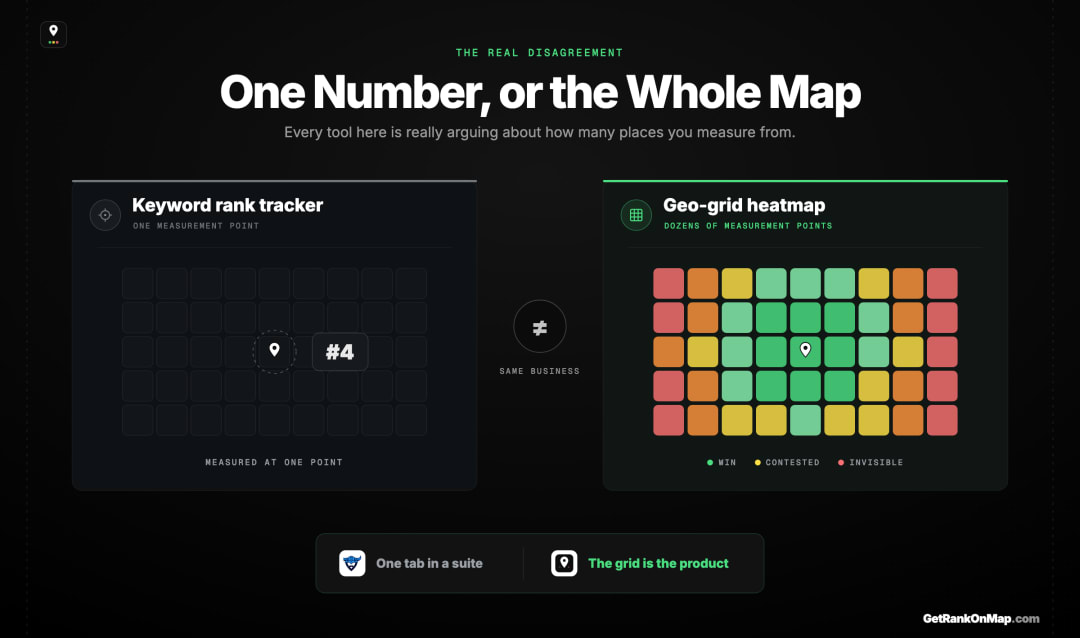
A keyword rank tracker gives you one number. "You're #4 for emergency plumber." Clean, simple, and quietly misleading — because it's measured from one point, usually near your address. Google's local results change with the searcher's location. Move two kilometres and #4 might be #1, or #18. One number can't hold that.
A geo-grid tool answers the honest version. It checks your rank from dozens of points spread across your service area and paints the result as a heatmap — green where you win, red where you vanish. That map is the real answer, because your customers aren't all standing at your front door.
Local Viking knows this — it has a geo-grid, and its own help docs explain the difference. But in Local Viking the grid sits inside a management suite as one tab among many. The tool's centre of gravity is posting, reviews, and listing housekeeping. The grid is a feature.
RankMap's entire argument is that the grid shouldn't be a feature — it should be the point. If the honest answer to "where do I rank" is a map, then the map deserves to be the whole product, not a tab you pay a management fee to reach. Every credit rule in this category follows from that one choice.
The Other Alternatives — and the Catch With Each
If you're shopping, here's the honest landscape, not a rigged list:
| Tool | Starting price | Model | The catch |
|---|---|---|---|
| Local Viking | ~$49 / profile / mo | Per-profile suite + credits | Management-first; grid metered; per-profile cost multiplies |
| Local Falcon | ~$25 / mo | Credits (expire monthly) | Great grids, but unused credits vanish each month — forces upgrades |
| BrightLocal | ~$39 / mo | Per location | All-in-one, but heavy; recurring complaints about data accuracy |
| Local Dominator | ~$39 / mo | Subscription | Solid grids, but pricing climbs at scale and no genuinely free tier |
| localrank.so | ~$49 / mo | Subscription + credits | Newer, clean UI — but still the credit-meter model |
| RankMap | Pre-launch | Focused rank tracker, no per-profile tax | Honest catch: we're pre-launch. You can't sign up today — join the waitlist. |
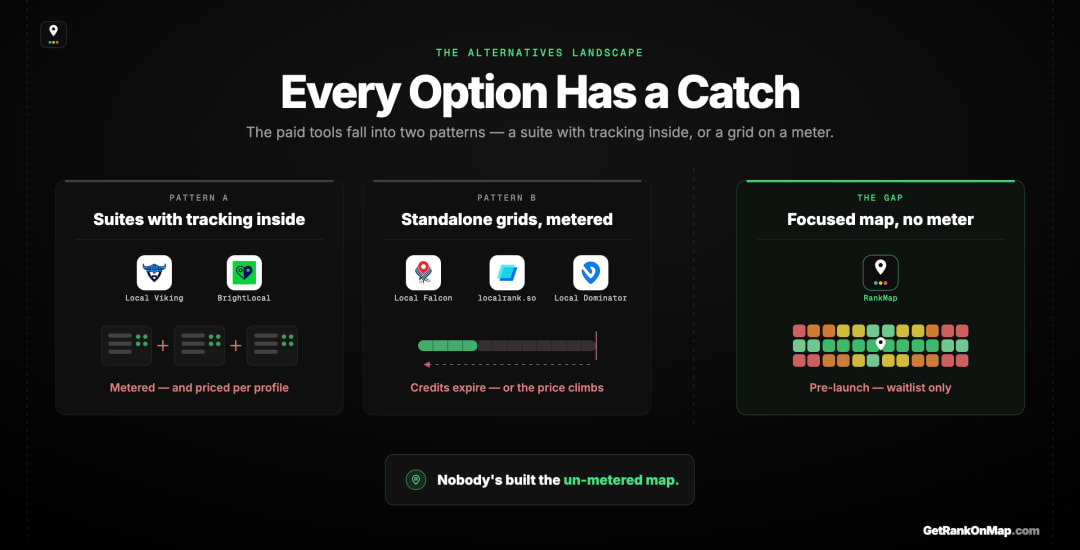
None of these are strawmen — agencies run all of them. The pattern to notice: they're all either management suites with tracking inside or grids on a credit meter. Nobody's just built the honest, focused, un-metered map.
Side by Side With RankMap
Here's the honest side-by-side. Local Viking takes several of these rows outright.
| What you're comparing | Local Viking | RankMap |
|---|---|---|
| Core purpose | GBP management suite | Focused local rank tracker |
| Geo-grid heatmap | Yes — one feature among many | Yes — the whole product |
| Grid scans | Metered by credits | Built to not ration the one thing you check most |
| Pricing model | ~$49 per profile / month | Per usage, no per-profile tax |
| Multi-location cost | Multiplies with each profile | Doesn't punish you for tracking more places |
| Free tier to try | No — refund guarantee only | Yes, a real free tier planned |
| Exports | Reporting built for management | PNG + CSV you actually own |
| Competitor movement alerts | Limited | Planned — tells you when a weak spot appears |
| GBP post scheduling | Yes — strong | No (not our job) |
| Bulk review / listing management | Yes — strong | No (not our job) |
| The measurement worldview | Grid shows position | Built on "one rank number lies" — the whole-area truth |
| Availability | Live today | Pre-launch — waitlist only |
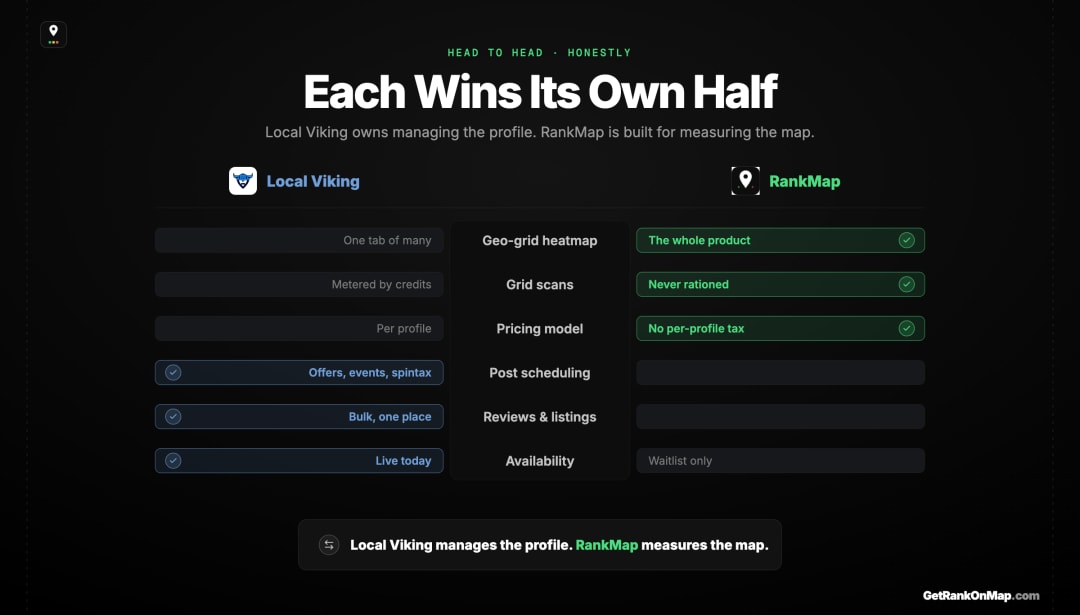
Read that table honestly and the split is obvious. If your day is managing profiles — posting, replying, bulk edits — Local Viking wins the bottom half and you should probably stay. If your day is measuring — where do I rank, where am I weak, is a competitor climbing — RankMap is built for the top half, and Local Viking is charging you for machinery you won't touch.
Who Actually Leaves
Three real shapes of person type "Local Viking alternative" into Google:
- The solo local business. One clinic, one restaurant, one law office. They don't need to schedule posts across fifteen profiles — they need to know if they show up when someone nearby searches. Paying a per-profile management price for a grid they check occasionally feels like buying a van to carry one bag. RankMap's focused, free-to-start model fits them exactly.
- The scaling agency. Ten, twenty, fifty client locations. The per-profile bill is where it hurts — every profile is another management fee, whether or not the client bought management. If tracking is the deliverable, they want a tracker priced like a tracker, not a suite priced per seat.
- The service-area business. Plumbers, cleaners, mobile mechanics — no storefront, ranking spread across a wide area. For them the grid is everything, because a single-point rank is meaningless when your customers are spread across thirty square kilometres. A credit-metered grid is the exact wrong constraint. They need to see the whole map, often, without a meter running.
None of those three leave because something broke. It's that you outgrew its shape.
What Renting the Grid Costs You, and What We Do Instead
Local Viking's grid is a feature inside a management suite, metered per profile by the credit. That is a coherent product — it just means the map is rationed by whatever else the suite is doing that month.
RankMap inverts it. The map is not a feature in the suite; it is the product, so there is no credit budget competing with post scheduling and no per-profile meter deciding how much of your own service area you get to see.
We are pre-launch. Nothing to buy today — the pricing is being set now, and this page exists so you can judge the argument before there is anything to sell.
Join the early-access waitlist — no card, no spam, just a note the day it is ready.
Stop Renting the Grid
Local Viking is a capable GBP management platform, and if managing profiles is your day, it's a fair pick. But if you came looking for an alternative, it's usually because you wanted the grid — the honest, whole-service-area picture of where you rank — without paying per profile or watching a credit meter.
That's the tool we're building. The grid as the point, not the afterthought. If that's the thing you were actually after, join the early-access waitlist and help us build it right.
Comparing it head-to-head rather than leaving it? BrightLocal vs Local Viking puts the two side by side on billing, grid depth and profile management.
Start here: Local SEO Ranking Tools: The Six Jobs a Stack Has to Cover — the full guide this page sits under.
Frequently asked questions
- 01Is RankMap free?
- There'll be a genuinely free tier to try it — not a "refund if you cancel" trial, an actual free plan. We're setting the exact limits now, and waitlist members get a say.
- 02Does RankMap do GBP posting and review management like Local Viking?
- No — and that's deliberate. Local Viking is a management suite; RankMap is a focused rank tracker. If posting and review workflows are your main job, Local Viking is genuinely the better fit and we'll say so. If measuring where you rank is the job, that's us.
- 03How does the pricing compare for multiple locations?
- Local Viking charges roughly per profile, so cost climbs with each location you add. RankMap is being priced around usage, not profile count — the goal is that tracking more places doesn't multiply your bill the same way.
- 04Is the geo-grid limited by credits?
- Local Viking meters geo-grid scans with credits. The whole point of RankMap is that the grid is the product, so we're building it *not* to ration the one thing you'd check most. Final limits are being set now.
- 05Can I export the heatmap?
- Yes — PNG and CSV you own, not a locked PDF. The grid is meant to go into your own reports and client decks.
- 06When can I actually use it?
- Not yet — RankMap is pre-launch. That's the honest catch. [Join the waitlist](https://getrankonmap.com/waitlist) and you're first in when it opens, with input on pricing and what ships first.
Explore with AI
Share this
Map your real rank across the city.
Free for the first 50 scans. No credit card.
Join the waitlist

