Local Falcon vs BrightLocal: The Wrong Question
These two tools aren't really competitors — one is a measurement instrument, the other a management suite. How to tell which problem you actually have.

SummaryThese two tools barely compete. One measures where you rank across a map; the other manages the ongoing local SEO work. How to tell which problem you actually have before paying for either.
Read moreShow less
Instrument or Suite, in Short
-
These two products aren't really in the same category — Local Falcon is built as a measurement instrument, BrightLocal as a local SEO management suite that includes measurement as one part
-
So "which is better" has no answer — the useful question is which problem you actually have: seeing where you rank, or running the ongoing work of local SEO
-
Measurement-first suits you if the grid is the point — you want frequent, detailed visibility maps and you handle citations, reviews and reporting elsewhere or not at all
-
Suite-first suits you if the grid is one job among many — you also need listings management, review workflows and client reporting in one place, and you'd rather have one subscription than several tools
-
We deliberately quote no prices or feature lists here — both vendors change them, and a comparison that hardcodes today's numbers is wrong within months. Check their own pricing pages
-
Disclosure: we're building a tool in this category — RankMap is a pre-launch geo-grid tracker, so read this as a mapped-out decision framework from an interested party, not a neutral verdict
Search "Local Falcon vs BrightLocal" and you'll find a stack of posts declaring a winner, plus a Reddit thread where actual practitioners give a much less tidy answer. The Reddit thread is closer to right. These two tools get compared constantly because they overlap on one visible feature — both can show you a grid of your local rankings — but they're built around different centres of gravity, and choosing between them on a feature table tends to produce a decision you reverse later.
First, the disclosure, because it should shape how you read this. RankMap is a geo-grid rank tracker currently in development, which makes both of these products future competitors of ours. We're not going to pretend otherwise, and we're not going to declare a winner — partly because we're not the right party to do that, and partly because there genuinely isn't one. What we can usefully offer is the decision framework, which is the thing most of these comparisons skip.
Why This Comparison Is Usually Framed Wrong
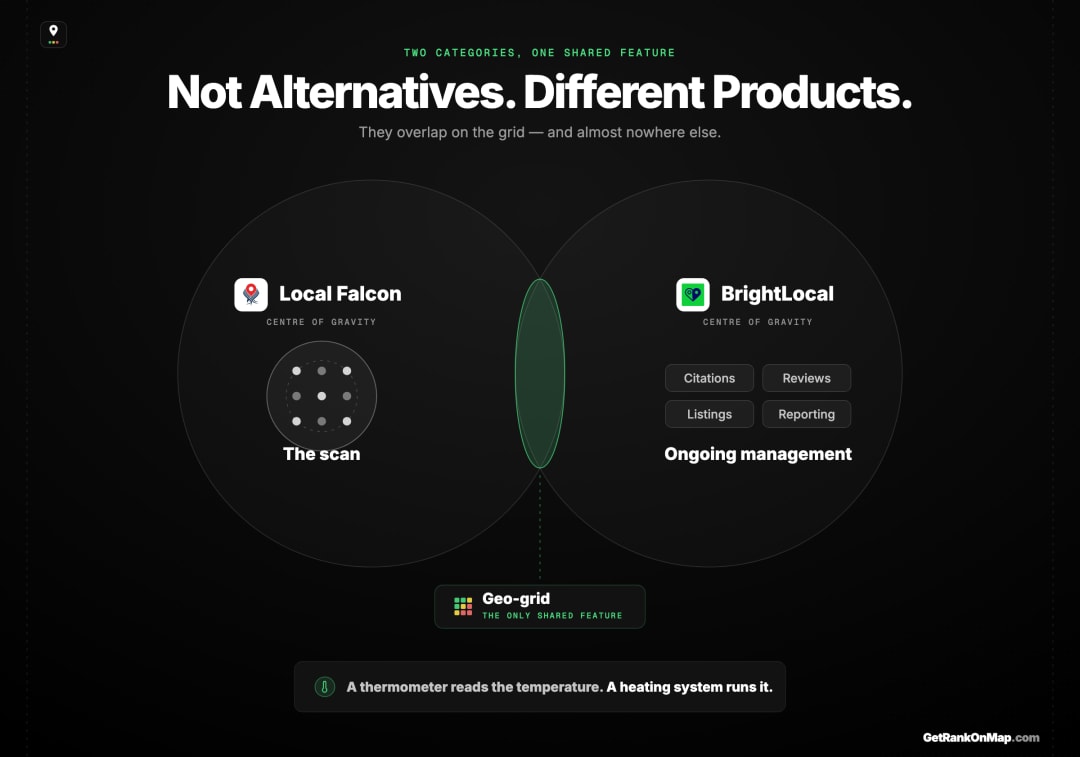
Two products that share one feature aren't necessarily alternatives. Local Falcon is organised around the scan; BrightLocal is organised around the ongoing management of local SEO, with a grid as one module inside it. That difference decides everything downstream.
The overlap is real. Both can render your local rankings as a geographic grid, which is the feature most people are shopping for when they run this comparison. That's why they get set against each other.
But look at what each product is organised around.
Local Falcon is built around the scan. The grid is the product. Its structure, its workflow and its commercial model all centre on running scans and reading the results. Everything else extends from that core.
BrightLocal is built around managing local SEO. Its span covers citation and listings work, review management, reporting for clients, and rank tracking — of which the grid is one component. The product's centre of gravity is the ongoing operational work, not the measurement.
That's not a quality difference and neither is a compromised version of the other. It's a category difference. And it means the question "which is better?" is malformed in the same way as asking whether a thermometer is better than a heating system. One tells you the temperature. The other manages it. Which you need depends entirely on what's currently broken.
The Question That Actually Decides It
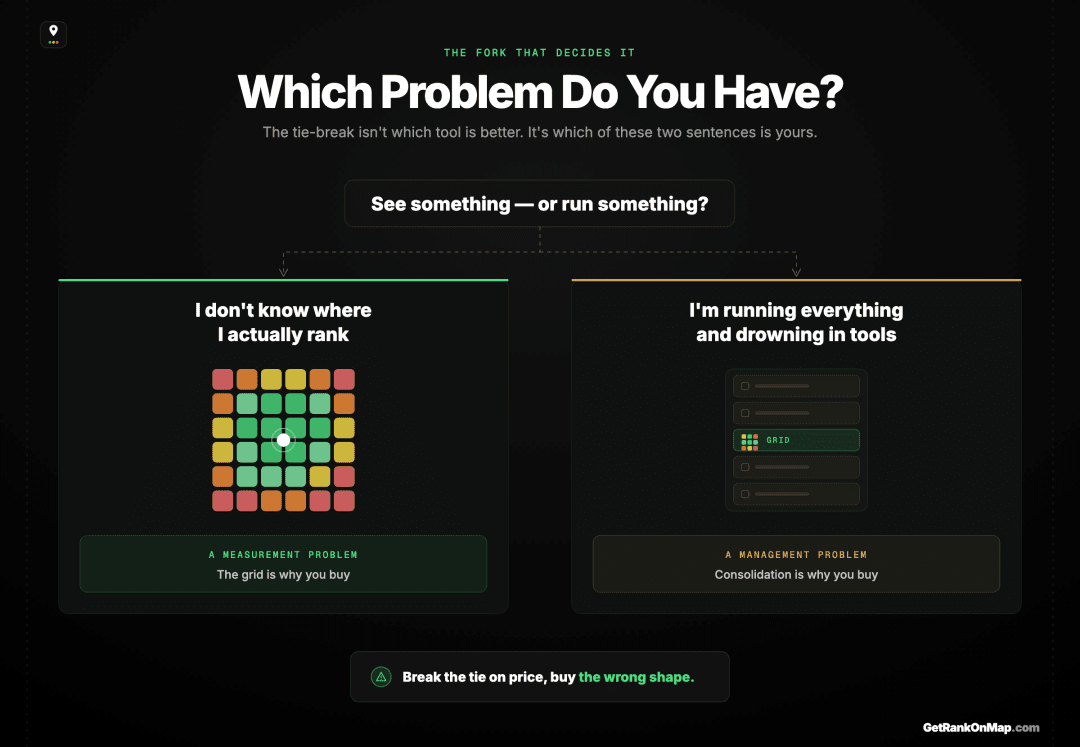
Are you trying to see something, or trying to run something? Measurement problems and management problems feel similar from the inside and lead to completely different tools.
Ask yourself which of these is closer to your situation.
"I don't know where I actually rank." You've done the optimisation work, or someone has, and you can't tell whether it landed. You suspect your visibility varies across your area but you can't see how. You want to look at a map and understand your position — often, in detail, and across different terms. That's a measurement problem, and a measurement-first tool is the natural fit. The grid isn't a feature you'd occasionally use; it's the entire reason you're buying.
"I'm running local SEO across a portfolio and drowning in tools." You're managing profiles, chasing citation consistency, handling review flows, and producing reports for clients or stakeholders. Rank tracking is one thing you need among several, and your real pain is that it currently lives in five places. That's a management problem, and a suite is the natural fit. The grid matters, but it isn't why you're buying — consolidation is.
Most people who agonise over this comparison haven't asked themselves that question first. They compare feature lists, find that both tools can draw a grid, and then try to break the tie on price — which is exactly how you end up with a suite you use one module of, or a scanner you're still doing citation work around.
What Measurement-First Gets You (and Costs You)
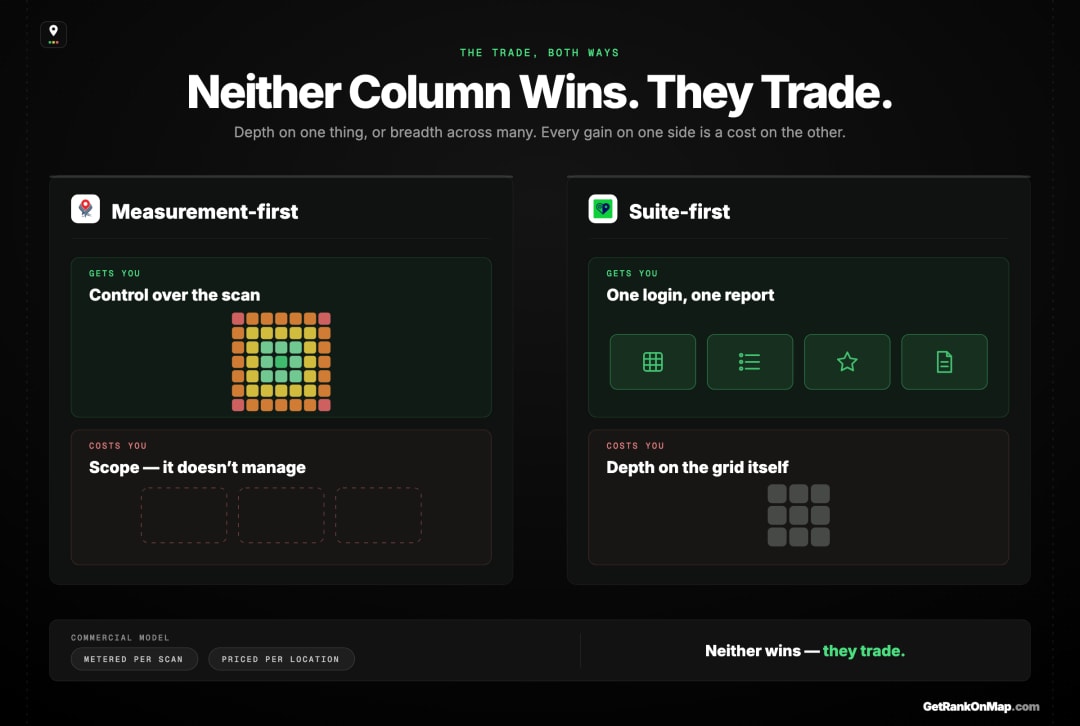
A tool built around the scan gives you depth and cadence on the thing it does. What it doesn't give you is anywhere to do the rest of the work — you'll be running other tools alongside it.
If the grid is the point, a tool organised around it will generally give you more control over the measurement itself — how the scan is configured, how often it runs, how deeply you can interrogate the result, and how much competitive context sits around it.
The trade is scope. It measures; it doesn't manage. Citations, listings, review workflows and client reporting either happen elsewhere or don't happen. For a business that already has those covered — or genuinely doesn't need them — that's not a loss. For an agency running the full stack of local SEO work, it means additional tools and additional subscriptions.
There's also a commercial-model difference worth understanding before you commit, and it's the one people most often get caught by. Scan-based tools typically meter usage in some form, because scans have a real cost per run. Suites more often price per location on a subscription — BrightLocal's published plans meter that way, while Local Falcon's meter by scan credit. Neither model is better in the abstract, but they behave very differently as you grow, and they reward opposite usage patterns: one punishes frequent scanning, the other punishes having many locations you rarely look at. Model this against how you'd actually use it before choosing — and check current terms directly, because this is precisely the kind of thing vendors revise.
What Suite-First Gets You (and Costs You)
A suite consolidates the whole job into one place and one bill. The trade is depth on any single component — including the grid you may have come for.
If your problem is that local SEO work is scattered across too many tools, consolidation has real value that feature tables systematically undersell. One login, one bill, one reporting layer, one place where the citation work and the review workflow and the rank data all live. For an agency, that's often decisive on its own — the reporting layer alone can justify it.
The trade runs the other way. A grid that's one module inside a broad product will generally have less depth than a grid that is the product. If your primary need is detailed, frequent, spatially rich measurement, a suite may leave you wanting — and you'll notice it quickly, because it's the thing you're looking at most.
The honest test: is the grid the module you'll live in, or one of several you'll use weekly? If it's the former, you may be buying a suite for one component and paying for the rest. If it's the latter, the consolidation is doing exactly what you want.
How to Actually Decide
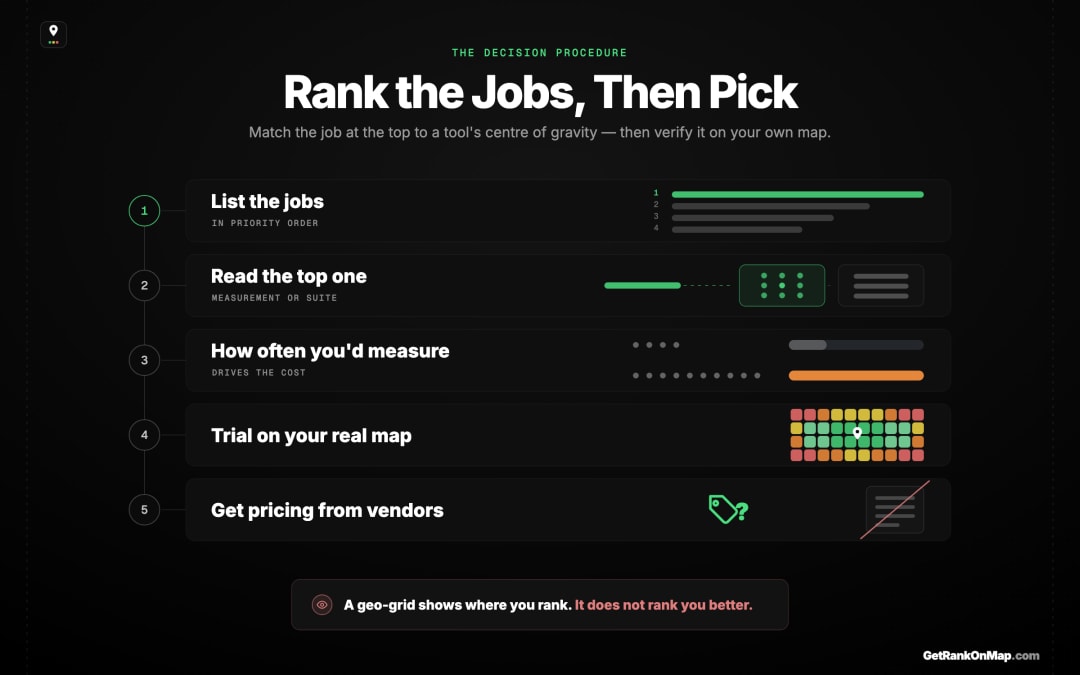
Rank the jobs, work out which tool's centre of gravity matches your biggest one, then verify against your real usage pattern and current pricing rather than a feature table.
Write down the jobs you need done, in priority order. Not features — jobs. "See where I rank across my area." "Keep listings consistent across directories." "Send clients a monthly report." "Chase reviews."
Look at what sits at the top. If it's measurement, weight measurement-first. If your top three include listings, reviews and reporting, weight the suite. If measurement is at the top and you need the rest, be honest that you're likely looking at two tools, and price it that way rather than pretending one will cover it.
Check how often you'd genuinely measure. This drives cost more than anything else and is the most commonly misjudged input. Weekly checks across several terms and locations is a very different commercial proposition from an occasional look, and the two pricing models diverge sharply as that number rises.
Trial both against a real scenario. Not a demo — your actual location, your actual terms, the area you actually serve. The differences that matter show up in whether the output answers a question you had, and that's not visible on a pricing page.
Get current pricing from the vendors directly. We're deliberately not quoting numbers here. Both companies revise pricing, plan structure and what's gated behind which tier, and a comparison article that hardcodes today's figures is quietly wrong within a few months. Most of the posts ranking for this comparison do exactly that — check their publication dates.
And be clear on what any grid tool does and doesn't do. A geo-grid shows you where you rank; it doesn't rank you better. It's a diagnostic. It's also the diagnostic most local businesses are missing, because checking your ranking from one spot tells you almost nothing — but it's worth knowing you're buying visibility into the problem, not a solution to it.
The Billing Unit Decides It
The reason this comparison generates so many confident, contradictory verdicts is that it's usually run as a feature contest between products that aren't in the same category. Both draw a grid, so they get lined up against each other — and the underlying difference, that one is built around measuring and the other around managing, gets lost somewhere in the comparison table.
Recover that difference and the decision becomes much simpler. If you can't see where you stand, buy the instrument. If you can see well enough but the work is scattered across too many tools, buy the suite. If you genuinely need both — and plenty of agencies do — plan for two subscriptions rather than hoping one product will stretch to cover a job it wasn't built for.
And whichever way you go, verify current pricing and features yourself before committing. That's not a disclaimer; it's the single most practical piece of advice in this article, and it applies to every comparison post you'll read on this subject, including this one.
We'll say it once more plainly: RankMap is building in this space, so we have an interest here. We're pre-launch and not asking you to choose us over anything — but if the measurement side is what you're missing, join the early-access waitlist and we'll show you what we've built when it's ready.
If you're weighing BrightLocal against a GBP suite instead, we've written BrightLocal vs Local Viking — different pairing, and the billing arithmetic lands somewhere else entirely.
Start here: Local SEO Ranking Tools: The Six Jobs a Stack Has to Cover — the full guide this page sits under.
Frequently asked questions
- 01Is Local Falcon or BrightLocal better for a single-location business?
- It depends on which problem you have rather than on the location count. If you mainly want to see where you rank across your area, a measurement-first tool fits. If you also need listings management and review workflows in one place, a suite fits. A single-location business can legitimately land either way.
- 02Which one is better for agencies?
- Agencies more often need the full operational stack — client reporting, listings, reviews, multiple locations — which points towards a suite. But agencies whose differentiator is measurement depth, or who already run their reporting elsewhere, frequently prefer a dedicated scanner. Plenty of agencies run both, using one for measurement and one for management.
- 03Can I use both?
- Yes, and it's a common setup: a suite for the ongoing management and reporting, a dedicated scanner for the measurement depth. Whether that's worth two subscriptions depends on how central the grid is to what you do or sell.
- 04Why doesn't this article include a pricing comparison?
- Because pricing, plan structure and feature gating change, and both vendors revise theirs. A hardcoded price table is a maintenance liability that misleads readers the moment it goes stale. The structural difference between the two products is stable; their price lists aren't. Check the vendors' own pages for current figures.
- 05Do these tools improve your rankings?
- No. Both are diagnostic — they show you where you stand and, in a suite's case, help you manage the work. Neither moves your position by itself. That distinction matters when you're weighing the cost, because you're buying visibility into the problem rather than a fix for it.
- 06What if neither fits?
- They aren't the only options. Our roundup of [local rank trackers](https://getrankonmap.com/blog/best-local-rank-trackers-2026) covers the wider field, and we've written specifically about [alternatives to Local Falcon](https://getrankonmap.com/blog/local-falcon-alternative) and [alternatives to BrightLocal](https://getrankonmap.com/blog/brightlocal-alternative) for readers who've already ruled one out.
Explore with AI
Share this
Map your real rank across the city.
Free for the first 50 scans. No credit card.
Join the waitlist

