Whitespark vs BrightLocal (2026): Software vs Labour
Both bill per location, so price won't decide this one. The real split: Whitespark does the work for you, BrightLocal gives you tools to do it.

Software or Labour, in Short
- Both platforms meter per location, so unlike most comparisons in this category, the billing model won't decide it for you. Read first-hand from each vendor's pricing page on 2 August 2026.
- The real division is software versus service. BrightLocal gives you tools and reporting to run local SEO yourself. Whitespark will also do the citation work manually, by hand, as a paid service.
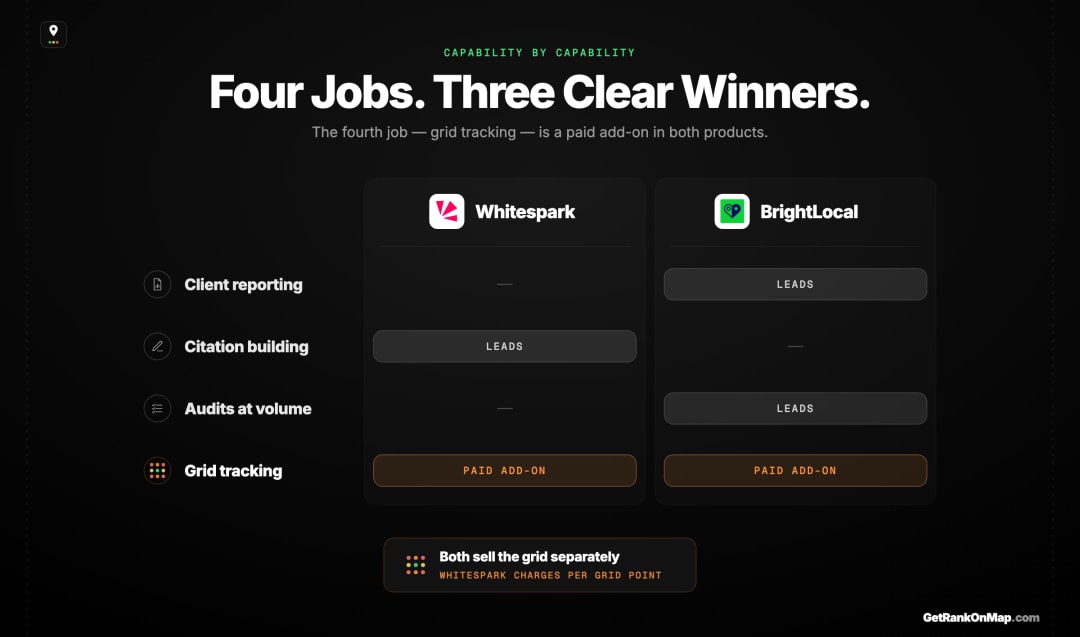
- Whitespark's grid tracking is sold as a separate metered product on top of the subscription — a hybrid model that catches people out. BrightLocal's Local Search Grid is an add-on too, with sizes listed up to 21×21.
- If you're an agency, the deciding feature is almost always white-label client reporting, and that pushes most agencies toward BrightLocal regardless of everything else.
- If citation cleanup is your actual problem — and for a lot of businesses it's a one-time project, not a subscription — Whitespark's done-for-you route can be cheaper than a year of software you'd use once.
Why This One Is Genuinely Close
Most comparisons in the local SEO tooling category are decided by billing structure. One vendor charges per location, another per scan credit, a third splits credits into pools that don't share — and the arithmetic settles it before you've read a single feature.
This comparison doesn't work that way. Both Whitespark and BrightLocal meter per location, read from each vendor's own pricing page on 2 August 2026 (Whitespark, BrightLocal). Your cost scales with how many businesses you're tracking in both cases, both are predictable month to month, and both are frequency-blind — scanning more often doesn't increase the bill at either.
That's unusual and it's why the two get compared so often. They're genuinely in the same shape. Which means you have to decide on something else, and that something else is more interesting than a feature table.
The Real Division: Software vs Labour
The division is visible in how buyers phrase the purchase. They do not ask which tool is better — they ask who to order the work from. July 2026:
My question is there any reason not to just go to bright local or whitespark and order 50 more citations?
r/localseo, July 2026
"Order," not "track." Both brands sell software and both sell hands, and the buyer is often shopping for the second.
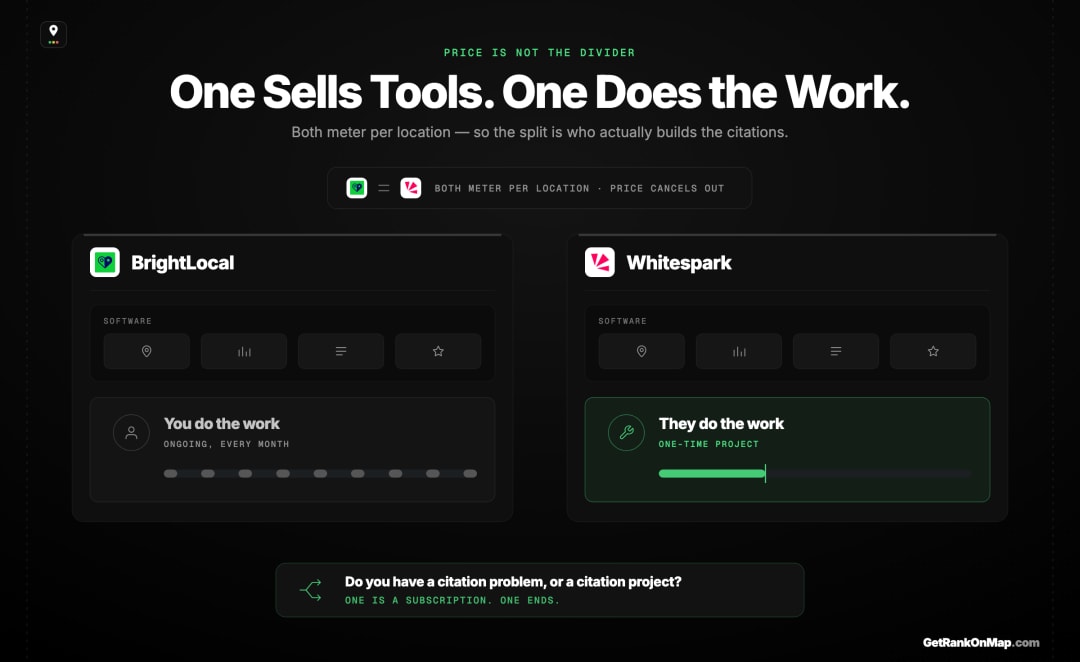
BrightLocal is a software company. You subscribe, you get tools — citation and listings management, review monitoring, local audits, rank tracking, client reporting — and you operate them. The product is the platform. Its centre of gravity is agency workflow: the reason agencies stay isn't any single tool, it's that the white-label reporting turns a month of scattered work into something a client will actually read.
Whitespark sells software and labour. It has the tools, but it also has a long-standing manual citation building service where humans submit and clean up your listings by hand. That's a fundamentally different offering from software that pushes data to an aggregator and hopes it propagates.
This distinction has real consequences, and the biggest one is about the nature of citation work itself. Citation cleanup is mostly a one-time project. Once your name, address and phone data are consistent across the directories and the aggregators have propagated it, the ongoing value is monitoring — which is worth far less per month than the initial fix was worth once.
So the honest question isn't "which platform has better citation tools." It's: do I have a citation problem, or a citation project? If it's a project, paying humans once to fix it properly can cost less than twelve months of software you'd stop opening in March. If it's genuinely ongoing — because you're an agency onboarding new clients every month — then you want the software and the workflow around it.
Where They Differ in Practice
Client reporting
BrightLocal's territory, and for agencies it's usually decisive. White-label reports, client dashboards, scheduled delivery. If the output of your month has to carry someone else's logo, this is the feature you're buying and everything below is secondary.
Worth checking before you subscribe: white-label reporting is gated by plan tier rather than included everywhere. If it's your reason for buying, confirm it's on the tier you're pricing.
Citation building
Whitespark's territory, and the manual service is the thing BrightLocal doesn't have an equivalent to. If you've inherited a business with genuinely messy listings data — multiple old addresses, a phone number from two owners ago, duplicate profiles — a human doing that cleanup is worth more than a tool that reports how messy it is.
Rank tracking and the grid
Both track local rankings. Both offer grid-based map tracking. Neither treats it as the centre of the product.
The important structural detail at Whitespark is that the grid is sold as a separate product from the subscription tracker, metered by grid point rather than included. That's a hybrid model — per-location for the platform, per-pin for the grid — and it surprises people who assumed the heatmap came with the plan. Budget it separately.
BrightLocal's Local Search Grid is likewise an add-on layer, with grid sizes listed from 5×5 up to 21×21.
The practical read on both: if grid tracking is what you actually came for, you're looking at the wrong two products. Both bundle it onto a platform built for something else, and you'll be paying for the platform. We've compared the measurement-first tools separately, including our own position in that field.
Audits
BrightLocal's local SEO audit tooling is more developed and more automated. If you're running audits at volume — agency onboarding, monthly client checks — that's a real time difference. If you're auditing one business occasionally, you can do most of it by hand with our local SEO audit walkthrough and skip the line item entirely.
Who Should Pick Which
Pick BrightLocal if you're an agency, if client reporting is part of your deliverable, if you run audits regularly, or if you want the widest single-subscription coverage of the local SEO workflow.
Pick Whitespark if citations are your actual problem and you'd rather pay someone to fix them than learn a tool, if you value the manual service model, or if you're a local SEO practitioner who already has a reporting workflow and doesn't need to buy one.
Pick neither if what you actually need is to know where you rank across your service area. Both of these are management platforms with measurement attached, and the measurement is an add-on in both cases. That's a legitimate thing to buy — just be clear you're buying a suite, not an instrument. If you've already ruled one out, we've written on alternatives to BrightLocal and alternatives to Whitespark.
The Thing Both Comparisons Miss
Nearly every article on this pairing — including the ones ranking above this one — compares citation databases, audit features and report templates. All useful. All downstream of a question nobody asks first.
How will you know whether any of it worked?
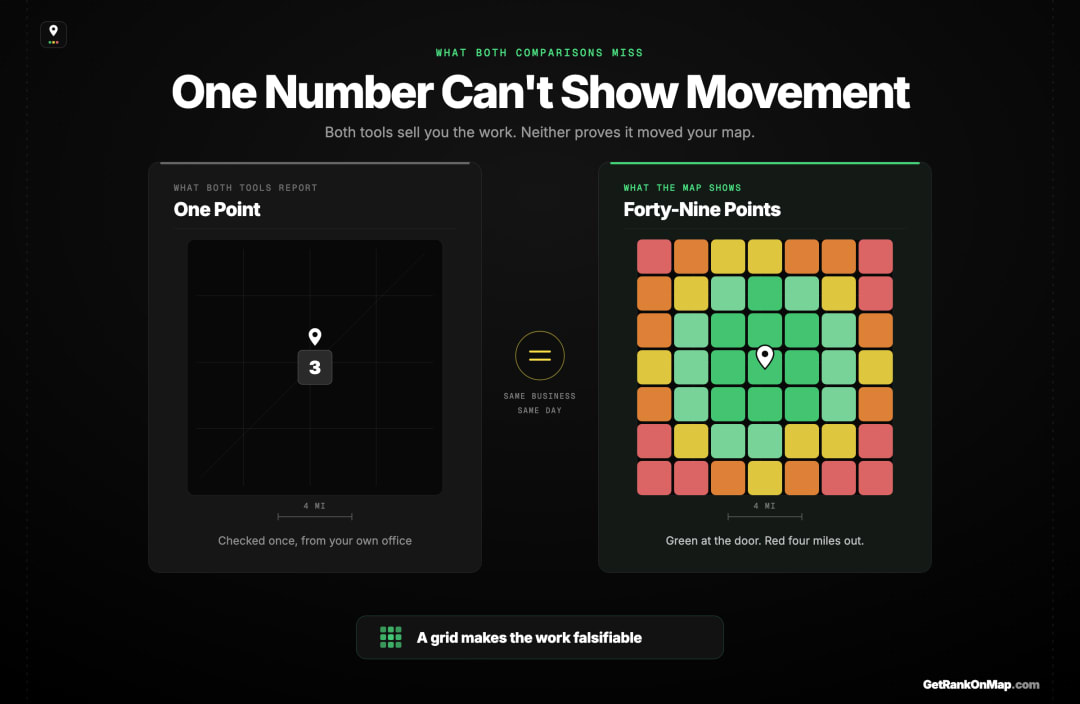
Both platforms will show you a rank number. If that number comes from a single location, it's close to meaningless for local search, because Google Maps results shift with the searcher's physical position. You can rank third from your own office and be invisible four miles away, and a single-point tracker reports "position 3" in both cases. That's why grid-based tracking exists, and it's why both vendors sell a grid as an add-on rather than pretending the base number is enough.
This matters more than it sounds when you're choosing between two platforms that both promise to improve your local visibility. You'll do the citation work, the review work, the profile work — and then you'll read a number that isn't sensitive enough to show whether it landed. Six months later you'll be renewing on faith rather than evidence.
Whichever platform you pick, make sure something in your stack can answer that question properly. It doesn't have to be the same vendor.
Software or Labour — Pick the Problem
The reason this comparison stays close is that the two products are the same shape. Same metering unit, overlapping feature sets, similar buyer. A feature table will show a lot of matching checkmarks and won't help you decide.
The split that does help is software versus labour. BrightLocal hands you a well-built platform and expects you to operate it, with reporting good enough that agencies organise their month around it. Whitespark will hand you tools too, but it will also do the citation work by hand — which is worth a great deal if that's your bottleneck and nothing at all if it isn't.
Work out which of those you are. Then check, before you sign anything annual, that whatever you end up with can actually show you whether the work is landing — because both of these sell you the doing, and the measuring is an add-on at both.
Our disclosure, as on every page here: RankMap is building in the measurement layer and we're pre-launch, so we're not neutral. We're not asking you to choose us over either of these — they solve problems we don't. But if "did any of this work?" is the question you keep failing to answer, join the early-access waitlist and we'll show you what we've built when it's ready.
Frequently asked questions
- 01Which is better, BrightLocal or Whitespark?
- For agencies needing client reporting, BrightLocal. For businesses whose real problem is messy citation data they'd rather hand to someone else, Whitespark. They're closer in price and structure than most pairings in this category, so the decision comes down to whether you want tools or want the work done.
- 02How much does BrightLocal cost for agencies?
- It's metered per location, so there's no single agency number — your cost is a function of how many client locations you track, and feature tiers add on top of that. Model it against your actual client count rather than reading the headline entry price, which describes a very different customer from you.
- 03Does either offer a free plan?
- Neither offers a meaningful free tier for ongoing use. For a one-off look at where you stand, our guide to [free Google Maps rank checking](https://getrankonmap.com/blog/free-google-maps-rank-checker) covers what genuinely exists at no cost.
- 04Is Whitespark's grid included in the subscription?
- No — it's sold as a separate metered product on top of the tracker subscription, priced by grid point. That's the detail most likely to produce an unexpected bill, so confirm the current terms before you plan around it.
- 05Do I need both?
- Some agencies genuinely run both — Whitespark for citation work, BrightLocal for reporting — and that's a defensible stack rather than a mistake. It's also two subscriptions, so it should be a decision rather than something you drift into.
- 06Which one is better for a single-location business?
- Often neither, in full. A single-location owner can do the [profile optimisation](https://getrankonmap.com/blog/google-business-profile-optimization-checklist) by hand for free, pay once for citation cleanup if the data is genuinely messy, and spend the rest of the budget on measurement. Suite pricing is hardest to justify at exactly one location.
Explore with AI
Share this
Map your real rank across the city.
Free for the first 50 scans. No credit card.
Join the waitlist

