What Makes a Local SEO Analyser Useful: It Compares, Not Scores
A useful local SEO analyzer compares a profile with the businesses beating it in each area. A score out of 100 can't say if 40 reviews is strong or weak.
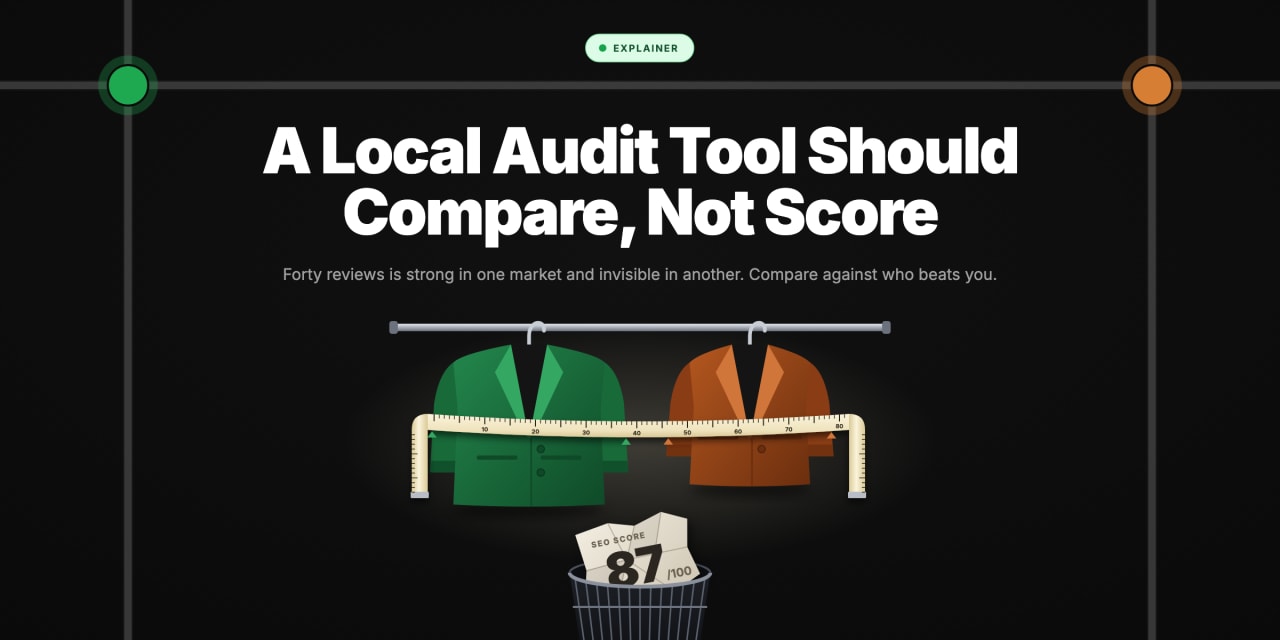
A local SEO analyser (or analyzer) is useful when it compares a Google Business Profile with the businesses that beat it for the same search, in the same part of town. A score against a fixed checklist is much less useful, because most local ranking factors only mean something next to a rival. Forty reviews is strong in one market and invisible in another. Our own study of the Google Maps map pack shows why: across 10,890 pairs of nearby businesses, the one with more reviews ranked higher 66.9% of the time, but only against its close neighbours. For an agency or business owner choosing an audit tool, the test is simple. Does the report name who wins, where, and by how much? This holds as of November 2026.
Quick answer
- Compare, don't score. A useful analyser sets each factor against the businesses in the top 3 for the client's main search.
- A checklist shows what exists. It can't show what is missing relative to the winners, which is the part that decides rank.
- Practitioners who audit daily already work this way. The most useful audit post we found framed every finding against a competitor.
- The comparison set changes by area. In our study, a business appeared in 96.4% of searches within 500 m of it and in none beyond 5 km, so each area has its own winners.
- Distance has to be held fixed. Across our whole dataset, reviews looked almost useless until we compared only close rivals.
- Review count matters more than stars. Between close rivals, more reviews won 66.9% of matchups and a higher rating won 52.7%.
- A score sends work to the wrong place. It rewards filling every field, whatever each one is worth.
- Most tools miss the same five things. Category against the winners, review count against the local median, complaint replies, visibility by location and profile state.
- Ask for the gap, biggest first. The report should rank fixes by how far behind the winners the client is.
What a useful local SEO analyser actually does
A useful analyser answers one question: what does the business that beats this client have that the client doesn't? Everything else is setup for that answer. A score out of 100 answers a different question, "how many boxes are ticked?", and the two can point in opposite directions.
On 22 July 2026 someone asked r/localseo which metrics and reports matter most during audits, and "what do these tools usually miss?" The thread drew 13 replies. The question is common because most audit tools hand back a score, and a score doesn't tell an agency what to do on Monday.
| question the agency asks | checklist score | comparison report |
|---|---|---|
| Is 40 reviews enough? | Passes if reviews exist | Depends on the top 3: weak if they have 300, strong if they have 15 |
| Which category should we use? | Checks one is set | Shows the primary category the winners use |
| Where are we losing? | One number for the whole profile | Names the areas where a rival holds the top 3 |
| What do we fix first? | Lowest-scoring box | Biggest gap to the businesses that win |
Read the last column as the job description. Each answer needs a competitor and a location before it means anything. That is also why a weaker-looking profile can still rank first, a pattern covered in why a competitor ranks higher with worse reviews.
A checklist tells you what exists, not what's missing
A checklist is a list of things a profile should have, and every item on it is sensible. The trouble is that none of them is measured against anything. An August 2025 r/localseo post titled "How to audit GBP properly?" lays out a typical one:
- Business information: name, address and phone consistent across the profile, website and citations, plus hours and duplicate checks.
- Categories: a primary category and secondary categories for related services.
- Description, photos and media: a unique description, recent photos, video if possible.
- Reviews and reputation: "consistently getting new reviews" and responding to them.
- Posts, services and products: a posting rhythm and every service listed.
"Consistently getting new reviews" passes whether the business gets two a month in a market where the leaders get twenty, or twenty where the leaders get two. The checklist can't tell those apart, and they call for opposite advice.
A tool that turns that checklist into a score inherits the same blind spot. A profile scoring 92 can lose to one scoring 70 if the 70 sits closer to the searcher and has three times the reviews. The score measured the profile on its own. Google ranked it against its neighbours.
Practitioners who audit daily frame everything against a competitor
The practitioners whose audits read as useful write them as comparisons. A March 2026 r/localseo post comes from someone who says they "audit service businesses every single day". Its first finding is comparative from the first sentence:
First, your reviews aren't comparable to competitors.
r/localseo, March 2026
Each point after that keeps the comparison. A half-finished profile is set against "your competitor who has all their services listed, posts weekly, and has 50+ photos". Links are "zero backlinks from local sources and your competitor has 30". That is the report an analyser should produce: the client's number, the winner's number, and the gap.
We counted how often each audit names a rival. We took the cached text of the two posts and counted the word "competitor" in each. The cached text may be cut off, so treat this as a small sample, not a rate.
TWO AUDIT POSTS, "COMPETITOR" COUNTED
┌──────────────────────┬───────┬────────────┐
│ post                 │ words │ competitor │
├──────────────────────┼───────┼────────────┤
│ GBP audit checklist  │  178  │     0      │
│ daily auditor's list │  187  │     3      │
└──────────────────────┴───────┴────────────┘
r/localseo · cached post text · 9 Nov 2026
Two posts prove nothing on their own. They do show the difference in shape. One lists what a profile should have. The other says what the profile lacks next to the business that wins.
Which competitors to compare against: the ones winning each area
The right comparison set is whichever businesses hold the top 3 where the client's customers search, and that can be a different set in each part of town. Comparing against "the competition" in general doesn't help, because Google ranks local results partly on distance from the person searching.
Our scans show how sharply that works. In our local pack GeoGrid study, a business appeared in 96.4% of searches made within 500 metres of it and in none beyond 5 km. So the businesses a client competes with on the north side of town may never appear on the south side.
SAME KEYWORD, A DIFFERENT TOP 3 BY AREA
┌─────────────┬─────────────┬─────────────┐
│ north side  │ centre      │ south side  │
├─────────────┼─────────────┼─────────────┤
│ A, B, C     │ A, You, D   │ D, E, F     │
└─────────────┴─────────────┴─────────────┘
illustration: compare with A, B, C up north
and with D, E, F down south
An analyser that picks one "main competitor" for the whole city compares the client with a business it may only meet in one area. It needs a location dimension first: a grid of search points across the area, and the top 3 at each one. Only then can it say who the client is really up against, and where.
Why the comparison only works between close rivals
A comparison only shows what matters if it holds distance fixed. Without that, distance swamps every other signal and the report draws the wrong lesson.
Our raw numbers said reviews barely mattered. Across our whole dataset, the correlation between review count and rank was −0.095, close to zero. When we held distance fixed, the same correlation moved to −0.377, about four times stronger. Established businesses with many reviews tended to sit further from the average search point, so distance and reviews cancelled each other out until we separated them.
Close-rival comparisons show the real order. We took every pair of businesses within 100 metres of each other, in the same grid cell and the same search, and asked which ranked higher. That gave 10,890 matched pairs across 12 markets, collected in July 2026. Both results are on the study's findings page.
| factor | close-rival pairs won | what an analyser should show |
|---|---|---|
| Higher review count | 66.9% | The client's count against the local top 3, as a gap |
| More complete profile | 61.9% | Fields the winners filled that the client didn't |
| Higher star rating | 52.7% | Barely better than chance, so a low priority unless very low |
Read the middle column as a priority order for the report. Review count was the strongest lever we measured between close rivals, and star rating was close to a coin flip. A tool that scores the average rating as heavily as the count is weighting a weak signal like a strong one.
An outside data set points the same way. In August 2026 a poster on r/smallbusiness pulled Google review data on 136 home-service contractors in Phoenix, Atlanta and Dallas. The median company had 4.9 stars, and the poster called rating "a hygiene factor". The median review count was 53, against a mean of 605. Stars barely separated those businesses. Counts separated them a lot.
A score pushes the wrong work
A checklist score shapes what gets done next, and that is where it costs the most. It rewards filling every field and keeping every habit, whatever each one pays back. Weekly profile posts are the usual example.
stopped telling clients to post on gbp every week. the ones who skip it rank the same. the ones who respond to reviews within a few hours rank better.
r/localseo, July 2026
That is one practitioner's observation, not a test, and we haven't tested posting frequency ourselves. But it shows the risk. A tool that scores posting will send a small client's limited hours to posts. A comparison with the winners might have sent the same hours to reviews, where our data found the strongest edge between close rivals.
The score also hides the size of each gap. Being 10 reviews behind and 250 reviews behind can both cost the same points on a checklist. They are different problems with different timelines. One is a month of asking. The other is a year-long plan, or a reason to pick a narrower keyword.
What local SEO analysers usually miss
Most analysers miss the same five checks, and each one only makes sense as a comparison or a map. These come from the audit posts above and from our own work on local profiles.
| often missed | why it matters | how to check it |
|---|---|---|
| Primary category against the winners | Decides which searches the profile enters | Look up the top 3's primary category for the main keyword |
| Review count against the local median | Stars barely vary, counts vary a lot | Set the client's count beside each top-3 rival's |
| Replies under complaints | What prospects read before they call | Open the lowest-rated reviews and check for an answer |
| Visibility by location | One rank number hides the map | Scan a grid of points, not one address |
| Profile state | A suspended or restricted profile can audit as healthy | Search the business name and its category from outside the office |
The first two rows are the comparison problem. The fourth is the location problem. A single rank check from the client's office misses all of these:
- The areas where a rival leads. These are usually a short drive away, and the office check never looks there.
- Whether the gains are landing. Close contests sit away from the office, and that is where review gains have room to show.
- Whether the tool itself is consistent. If the settings change between runs, the comparison changes with them.
That last point is easy to overlook. In our own zoom test, the same nine points overlapped 0.698 between neighbouring points at zoom 13 and 0.405 at zoom 16, from one setting change. We went through what that means for buyers in why no local SEO tool is 90% accurate. An analyser should keep its settings fixed between runs and show them on the report.
What to ask a local SEO analyser before you pay
Ask whether the tool can produce a comparison report without you building it by hand. Most of the work in a good audit is picking the right rivals and the right areas, so a tool that leaves those to you saves less time than its feature list suggests.
- Does it pick the comparison set for you? It should take the businesses in the top 3 for the client's main search, area by area.
- Does it show each factor against that set? Categories, review count, services and photos should sit beside the winners' numbers, not a fixed standard.
- Does it map visibility by location first? A grid of search points should come before any recommendation.
- Does it flag profile state before scoring? A suspended or restricted profile needs fixing before anything else.
- Does it rank fixes by the gap to the winners? The biggest gap should come first, with its size shown.
- Does it keep settings fixed between runs? Grid size, spacing, centre point and zoom should stay the same, or the comparison breaks.
If you'd rather run the audit by hand first, how to do a local SEO audit walks through the step most checklists skip. Many practitioners start from free Google data anyway, as our count of the tools local SEOs open every day found. For paid options sorted by the job they do, see the best local SEO tools.
Bottom line
A local SEO analyser earns its place when it compares the client with the businesses that win the same search in the same area. A checklist score can't, because a number like 40 reviews only means something next to a rival's number. Our data shows why the comparison has to be local: visibility drops off within a few kilometres, and reviews only show their real weight between close rivals, where more reviews won 66.9% of matchups. Ask for the winners, the areas and the gaps, ranked biggest first.
RankMap is built around that comparison: your ranking as a map, with the businesses that hold each area. We're pre-launch. Join the waitlist for free early access.
Frequently asked questions
- 01What makes a local SEO analyser useful?
- It compares the business with the ones beating it for the same search in the same area, and shows the gap on each factor. A checklist score can't tell whether 40 reviews is strong or weak, because that depends on what the top 3 have. A useful report names the winners, the areas where they win, and ranks the fixes by the size of each gap.
- 02What do local SEO audit tools usually miss?
- Five checks come up again and again: the primary category against the winners, review count against the local median, replies under complaints, visibility by location, and whether the profile is suspended or restricted. Each of these needs either a competitor or a map to mean anything. A tool that checks one address against a fixed list will miss all five, even when its score looks high.
- 03Which competitors should a local audit compare against?
- The businesses in the top 3 for the client's main search, area by area. That can be a different set in each part of town, because Google ranks local results partly on distance from the searcher. In our study, businesses appeared in 96.4% of searches within 500 metres and in none beyond 5 km, so a rival on one side of town may never meet the client on the other.
- 04Is a local SEO score out of 100 worth anything?
- It's useful as a reminder of fields you haven't filled, and not much more. The score measures the profile on its own, while Google ranks it against nearby rivals. A profile scoring 92 can lose to one scoring 70 that sits closer to the searcher and has more reviews. Use the score to catch gaps, then judge priorities by comparing with the businesses that win.
- 05Why do reviews look unimportant in some audit reports?
- Because distance hides their effect when every business is compared at once. In our data, the link between review count and rank was −0.095 across all businesses, close to zero. Comparing only close rivals moved it to −0.377, about four times stronger. A report that doesn't hold distance fixed can wrongly conclude that reviews don't matter in a market.
- 06Can I run a competitor comparison audit by hand?
- Yes, for one or two clients. Search the main keyword from several points across the area, note the top 3 at each, then put the client's category, review count, services and photos beside each rival's. It takes time and the results shift with where and how you search. That is why a tool that does it on a fixed grid, with fixed settings, saves most of the work.
Sources
Primary data, collected by us
- Local pack GeoGrid study
- collected July 2026, 12 markets. Appearance by distance: 96.4% within 500 m, 0% beyond 5 km. Matched pairs within 100 m in the same cell: review count won 66.9%, profile completeness 61.9%, star rating 52.7% of 10,890. Review count vs rank correlation −0.095 overall, −0.377 with distance held fixed. Zoom calibration: overlap 0.698 at zoom 13 vs 0.405 at zoom 16, zoom 16 adopted. Published on our research page, linked twice in the body above.
- Audit-style count
- the word "competitor" counted in the cached text of two r/localseo audit posts: a checklist (0 in 178 words) and a daily auditor's diagnosis (3 in 187 words). Cached text may be cut off. First counted 21 September 2026, recounted 9 November 2026.
- Search Console query pull
- the query that showed this page in Google, 90 days to 9 November 2026: "local seo analyzer", 4 impressions at position 50.0. Pulled 9 November 2026.
Cited Accessed November 2026.
- r/localseo, 22 July 2026, what makes an analyser useful for local SEO reddit.com. Supports the question; what tools miss; 13 replies.
- r/localseo, 30 August 2025, how to audit GBP properly reddit.com. Supports the checklist items.
- r/localseo, 25 March 2026, one of these 4 things is wrong reddit.com. Supports the comparative framing; the quoted line; 50+ photos and 30 local links.
- r/localseo, 17 July 2026, things I stopped doing reddit.com. Supports weekly posts vs review replies, as observed.
- r/smallbusiness, 17 August 2026, review data on 136 contractors reddit.com. Supports median 4.9 stars; median 53 reviews vs mean 605.
- Google Business Profile Help, tips to improve your local ranking support.google.com. Supports local results ranked partly on distance from the searcher.
Explore with AI
Share this
Map your real rank across the city.
Free for the first 50 scans. No credit card.
Join the waitlist