Scraping Google Maps for Leads: A Short List Beats a Big One
A bigger Google Maps lead list rarely wins clients. Sort by review count and visibility, check Google's terms, and send one map to a short list.

For a local SEO agency, a bigger list of Google Maps businesses is rarely what holds back new clients. The first message is. As of November 2026, names, phones and ratings are easy to pull. A reason for this one business to reply is not. One agency reported 5,000 cold emails for 2 closed deals, about 0.04%. Star ratings don't sort prospects either: in one pull of 136 contractors the median was 4.9. A short list chosen by review count and real map visibility gives you something specific to say. Before you automate any of it, read what Google's own terms say about copying Maps content.
Quick answer
- The list is the easy part. Several tools return business name, phone, website, rating and owner details from Maps in one export.
- Star ratings don't qualify anyone. In one pull of 136 home-service firms, only 10 sat under 4.0 stars.
- Review count does. In the same pull the top 5 firms held 69% of all reviews, and the bottom half held 1.7%.
- Count also ranks. In our study of close rivals, more reviews won 66.9% of matchups and a better rating won 52.7%.
- Visibility is the missing column. No scraper tells you where a business shows up for its main search across its town.
- One check from the shop misleads. Businesses appeared in 96.4% of searches within 500 m of them in our scans.
- Google's terms limit bulk copying. Its Maps terms bar mass downloads and bulk feeds of Maps content.
- Send one map, not an audit. A specific, checkable picture of one search is the message to lead with.
Why agencies still scrape Google Maps by hand
Agencies scrape Google Maps by hand because the other routes are expensive or fragile, not because hand-copying works well. On 13 July 2026 a poster in r/localseo asked whether agencies still scrape Maps by hand for client leads. They described three routes. Some agencies search Maps and copy-paste the results into lead tools. Some pay "$40-$80 per lead" on lead marketplaces, only to have the same lead sold to five competitors. Others build their own n8n or Make workflows and say "maintenance is a nightmare."
The poster then said they wanted to understand the problem "before developing a solution." That turned out to be the pattern. We counted the threads about Maps lead lists in our cached r/localseo corpus for July and August 2026 and classified who posted each one.
 MAPS LEAD-LIST THREADS IN R/LOCALSEO, JUL-AUG 2026
 ┌──────────────────────────────────────┬─────┐
 │ about scraping Maps or lead lists    │  4  │
 │ posted by a tool builder/researcher  │  3  │
 │ posted by an agency wanting leads    │  1  │
 └──────────────────────────────────────┴─────┘
 post bodies only · our count, 21 Sep 2026
Three of the four came from people building or researching a tool. Only one came from an agency asking where to get leads, and that one wanted a dental leads database for cold outreach in the USA. The sample is small, so read it as a pattern, not a rate. Still, the supply side of this problem is crowded. The people selling lists outnumber the people asking for them.
What a scraped Google Maps list gives you, and what it leaves out
A scraped list gives you contact details and public profile numbers. It does not tell you which businesses need help. On 16 July 2026 one builder listed the fields their upgraded Maps tool returns:
- Business basics. Name, website, phone number, address and category.
- Profile numbers. Google ratings and reviews.
- Owner details. Owner name, LinkedIn profile, email and phone, plus an API to automate workflows.
Another r/localseo post, from 7 July 2026, asked what people do with Google Maps, Outscraper or Apify exports before loading them into outreach tools. The problems it named were duplicates, dead websites, missing emails, directory URLs and "rows that probably shouldn't be contacted." So even a clean export needs a second pass before anyone sends anything.
| column | does a scraper give it? | does it show who needs help? |
|---|---|---|
| Name, phone, website | Yes, in most exports | No, it only says how to reach them |
| Star rating | Yes | Weakly, most firms sit near 4.9 |
| Review count | Yes | Yes, when compared with the local median |
| Where it ranks across town | No | Yes, this is the gap you can show |
The table reads left to right as a warning. The columns every tool supplies are the ones that sort prospects worst. The one column that leads to a pitch is the one no export contains. When a whole class of tools competes to hand you the same spreadsheet, the spreadsheet can't be what sets your agency apart. What you do with each row can.
Star ratings won't qualify a Google Maps prospect
Star ratings are a poor filter because nearly every established local business has a high one. In August 2026 a founder posted live Google data on 136 home-service companies across Phoenix, Atlanta and Dallas: roofers, HVAC, plumbers, electricians and landscapers. They had been building a prospect list for something else. The median rating was 4.9 stars, and only 10 of the 136 were under 4.0.
Rating isn't a differentiator in this industry anymore, it's a hygiene factor.
Review counts told a very different story in the same data.
| measure, 136 contractors | value | what it tells you |
|---|---|---|
| Median star rating | 4.9 | Rating barely separates firms |
| Firms under 4.0 stars | 10 of 136 | A low rating is rare |
| Median vs mean review count | 53 vs 605 | A few firms hold most reviews |
| Top 5 firms' share of reviews | 69% | The leaders are far ahead |
| Bottom half's share (68 firms) | 1.7% | Most firms have a visible gap |
The mean was eleven times the median, which only happens when a handful of firms sit far above everyone else. For prospecting, that is the useful part. A business with 20 reviews in a market whose leaders have thousands has a gap the owner can see on their own phone.
Our own data points the same way for ranking, not just for looks. In our local pack GeoGrid study, collected July 2026, we compared 10,890 matched pairs of businesses within 100 metres of each other. The one with more reviews ranked higher 66.9% of the time. Profile completeness won 61.9%. The better star rating won 52.7%, close to a coin flip. So sorting a list by review count against the local median does two jobs at once. It finds the owners who are behind, and it finds a gap that plausibly costs them rank. The full breakdown is in whether reviews improve Google Maps ranking.
Visibility is the qualifier that leads to a pitch
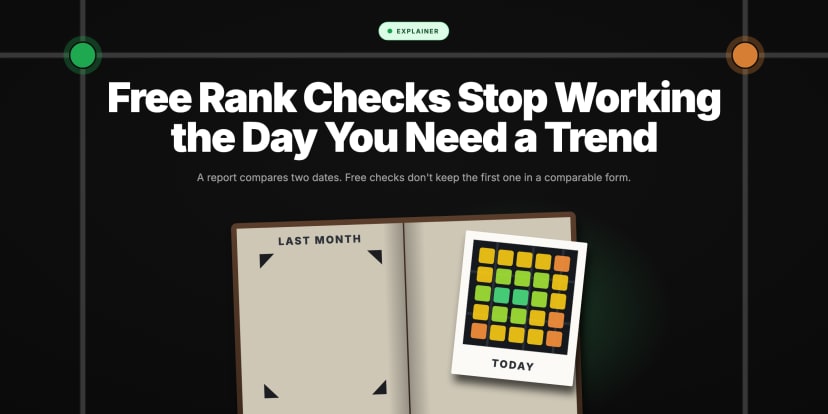
The most useful qualifier is where the business actually appears for its main search across its own area. No scraper returns that column. A business that ranks well next to its own address and fades a few streets away has a problem you can show it on one map. A business that ranks well everywhere probably doesn't need you.
The catch is how you check. A single search from the business's own street will almost always look fine. Our study found businesses appeared in the local pack in 96.4% of searches made within 500 metres of them, and in 0% of searches beyond 5 km. The detail is on the research page. If you check a prospect from its front door, nearly everyone passes and your filter does nothing.
 WHERE YOU CHECK A PROSPECT FROM
 ONE CHECK FROM THE SHOP    A GRID ACROSS THE TOWN
 within 500 m: in pack      beyond 5 km: 0% in pack
 96.4% of searches          (our study, July 2026)
 → "looks fine, skip"       → shows where it fades
A grid of searches across the town shows where visibility stops, which is the thing an owner can't easily see for themselves. That is also why one rank number misleads when you report to clients, and the same logic applies before they are clients. If you haven't used one, here is what geo-grid rank tracking is.
This view also changes the first message. "Free audit" now reads as spam to many owners, as covered in why a scan beats an audit in a cold pitch. One specific map of one search, dated, can be checked in seconds against the owner's own phone. We haven't measured reply rates for this approach. Choosing prospects by visibility is our reasoning, not a tested result.
 TWO WAYS TO BUILD A LEAD LIST
 LIST-FIRST                 QUALIFY-FIRST
 scrape 1,000 rows          one trade, one town
      │                          │
 one template email         sort reviews vs median
      │                          │
 send to everyone           grid-check, keep ~30
      │                          │
 5,000 emails = 2 deals     one map + one line each
 (one agency, Dec 2025)     (reply rate not measured)
The 5,000-to-2 figure comes from one practitioner's December 2025 post listing where their clients came from. Email came last. Their own profile ranking first in their city, LinkedIn, search ads and word of mouth all came ahead, and they called word of mouth their "best closings". It is one agency's result, not a benchmark.
What Google's terms say about scraping Google Maps
Google's terms limit bulk copying of Maps content, so check them before you automate a scraper. Two documents matter, and they cover different people. We are not lawyers, and this is not legal advice. It is what the documents say, read in November 2026.
| document | who it covers | what it says |
|---|---|---|
| Google Maps Additional Terms of Service (last modified 27 Jan 2026) | Anyone using Google Maps | No mass downloads or bulk feeds of the content |
| Google Maps Platform Terms of Service (last modified 26 Aug 2026) | Businesses using Google's Maps APIs | No exporting, extracting or scraping Maps content for use outside the services |
The end-user terms list prohibited conduct as a condition of your licence to use Google Maps. You may not "mass download or create bulk feeds of the content (or let anyone else do so)." They also bar using Google Maps "to create or augment any other mapping-related dataset (including a mapping or navigation dataset, business listings database, mailing list, or telemarketing list)" for use in a service that substitutes for Google Maps. Note that last clause is tied to a substitute service. Read the full wording rather than a summary of it.
The Maps Platform terms, which apply to API customers, are blunter. Under "No Scraping" they say the customer "will not export, extract, or otherwise scrape Google Maps Content for use outside the Services." One of their examples is that the customer will not "copy and save business names, addresses, or user reviews."
What this means in practice:
- Volume changes the picture. Copying a few businesses by hand for a named town is a different activity from harvesting a metro by automation.
- The risk sits with whoever runs the scraper. If a tool pulls the data for you, read that tool's terms and ask where its data comes from.
- Using the API doesn't make saving lists fine. The Platform terms name saving business names, addresses and reviews as an example of scraping.
- Other laws may apply too. We haven't reviewed privacy or anti-spam law for this page. Check the rules for the country you send to.
A smaller list that earns replies
A short, qualified list asks less of you and of the owner. These steps are in order because each one narrows the list for the next.
- Pick one trade and one town. Twenty to thirty businesses is enough for a first batch.
- Clean the rows. Drop duplicates, dead websites, directory URLs and anything that isn't a real local business.
- Sort by review count against the local median, not by stars.
- Check each one's visibility for its main category search across the town, not from its address.
- Keep only those with a visible, fixable gap. A firm already in the pack across its area doesn't need you yet.
- Send one map and one sentence. Name the search, the date and one true thing about the result. Ask one question.
- Count replies per message, not messages sent.
Grid checks for prospects are a sales cost, not a client-reporting cost. Budget them separately, as we suggest in white-label local SEO reporting, so a client's report doesn't carry your prospecting.
What to look for once the checks are in:
- A review count far below the town median. The gap is easy to show and easy to explain.
- Visibility that stops close to the address. The owner sees the pack at the shop and assumes it's the same everywhere.
- A strong profile that ranks nowhere for its main term. Often a category or relevance problem worth one sentence.
- A clear leader nearby. Naming the business that wins the area gives the owner something concrete to compare with.
Where this breaks
This approach has limits, and some of them are plain gaps in what we know.
- The thread counts are small. Four threads over two months is a pattern, not a measure of the market.
- The 136-contractor data is one person's pull. It covers three US metros and home-service trades only.
- The 0.04% close rate is one agency's report. Other agencies may do far better or worse with email.
- Reply rates for one-map pitches are not tested by us. The case for them is reasoning, not a result.
- Our study measures rank, not sales. A visibility gap is a reason to talk, not proof the owner will buy.
Bottom line
A Google Maps lead list is cheap and crowded, so it can't be your edge. Star ratings won't sort it, because most firms sit near 4.9. Review count against the local median and real visibility across the town will, and our study shows review count also tracks rank among close rivals. Check prospects with a grid, not one search from their door, and send one specific map to a short list. Read Google's Maps terms before you automate any copying, since they bar bulk downloads and API scraping.
RankMap is built to show that map: where a business appears for one search across every part of its town. We're pre-launch. Join the waitlist.
Frequently asked questions
- 01What is the best way to find local SEO leads on Google Maps?
- Build a small, qualified list rather than a big scraped one. Pick one trade and one town, and aim for twenty to thirty businesses. Sort them by review count against the local median, then check where each one appears for its main search across the town. Contact only the ones with a visible, fixable gap, with one map and one sentence each.
- 02Are Google star ratings a good way to qualify local SEO prospects?
- No. In one August 2026 pull of 136 home-service companies across three US cities, the median rating was 4.9 stars and only 10 were under 4.0. Review counts varied far more: the top 5 firms held 69% of all reviews. In our study of close rivals, more reviews also won 66.9% of matchups, while a better rating won 52.7%.
- 03Is scraping Google Maps allowed?
- Google's terms limit it. The Google Maps end-user terms bar mass downloading or creating bulk feeds of Maps content. The Maps Platform terms for API customers say not to export, extract or scrape Maps content for use outside the services, including saving business names, addresses or reviews. We are not lawyers. Read both documents and any scraping tool's own terms before you automate.
- 04Why does a prospect look fine when I check their ranking?
- You are probably checking from near their address, where almost every business ranks. In our study, businesses appeared in the local pack in 96.4% of searches within 500 metres and in none beyond 5 km. A single check from the shop hides where visibility fades. A grid of searches across the town shows the gap you can actually pitch.
- 05How many cold emails does it take to win a local SEO client?
- There is no reliable benchmark. One agency reported 5,000 emails for 2 closed deals in December 2025, about 0.04%, and listed email last among its client sources. Its own top-ranking profile, LinkedIn, search ads and word of mouth all did better. Treat that as one result. Track replies per message on your own list to know your real rate.
- 06What should the first message to a Google Maps lead say?
- Keep it short and checkable. Send one map of one search the business cares about, across its own town, with the date. Add one true sentence about what it shows and ask one question. Avoid calling it an audit, since many owners now read that word as spam. We haven't measured reply rates for this, so test it on your own list.
Sources
Primary data, collected by us
- Local pack GeoGrid study: collected July 2026. Appearance in the local pack 96.4% within 500 m of the business, 0% beyond 5 km. Across 10,890 matched pairs within 100 m of each other, review count won 66.9%, profile completeness 61.9%, star rating 52.7%. Published on our research page, linked twice in the body above.
- Maps lead-list thread count: 4 r/localseo threads (July to August 2026) about scraping Maps or building lead lists, classified by poster. 3 from people building or researching a tool, 1 from an agency asking for a leads database. Post bodies only. Counted 21 September 2026.
- Search Console query pull: no queries showed this page in Google in the 90 days to 9 November 2026. Pulled 9 November 2026.
Cited Accessed November 2026.
- Google Maps Additional Terms of Service google.com. Supports no mass downloads or bulk feeds; the business listings database, mailing list and telemarketing list clause; last modified 27 January 2026.
- Google Maps Platform Terms of Service cloud.google.com. Supports section 3.2.3(a) "No Scraping", including not saving business names, addresses or reviews; last modified 26 August 2026.
- r/localseo, 13 July 2026 reddit.com. Supports copy-paste, $40-$80 per lead, n8n/Make upkeep, "before developing a solution".
- r/localseo, 16 July 2026 reddit.com. Supports the field list a Maps scraping tool returns.
- r/localseo, 7 July 2026 reddit.com. Supports duplicates, dead sites, directory URLs, rows not to contact.
- r/localseo, 11 August 2026 reddit.com. Supports the agency asking for a dental leads database.
- r/smallbusiness, 17 August 2026 reddit.com. Supports 136 contractors: median 4.9 stars, 10 under 4.0, median 53 vs mean 605 reviews, top 5 = 69%, bottom half = 1.7%, quoted line.
- r/localseo, 6 December 2025 reddit.com. Supports 5,000 emails = 2 closings; client sources and "best closings".
Explore with AI
Share this
Map your real rank across the city.
Free for the first 50 scans. No credit card.
Join the waitlist