Local SEO Tools With AEO Built In: Five Checks Before You Pay
An AEO feature is worth paying for only if it asks customer questions, from the client's town, several times, and records every business named.
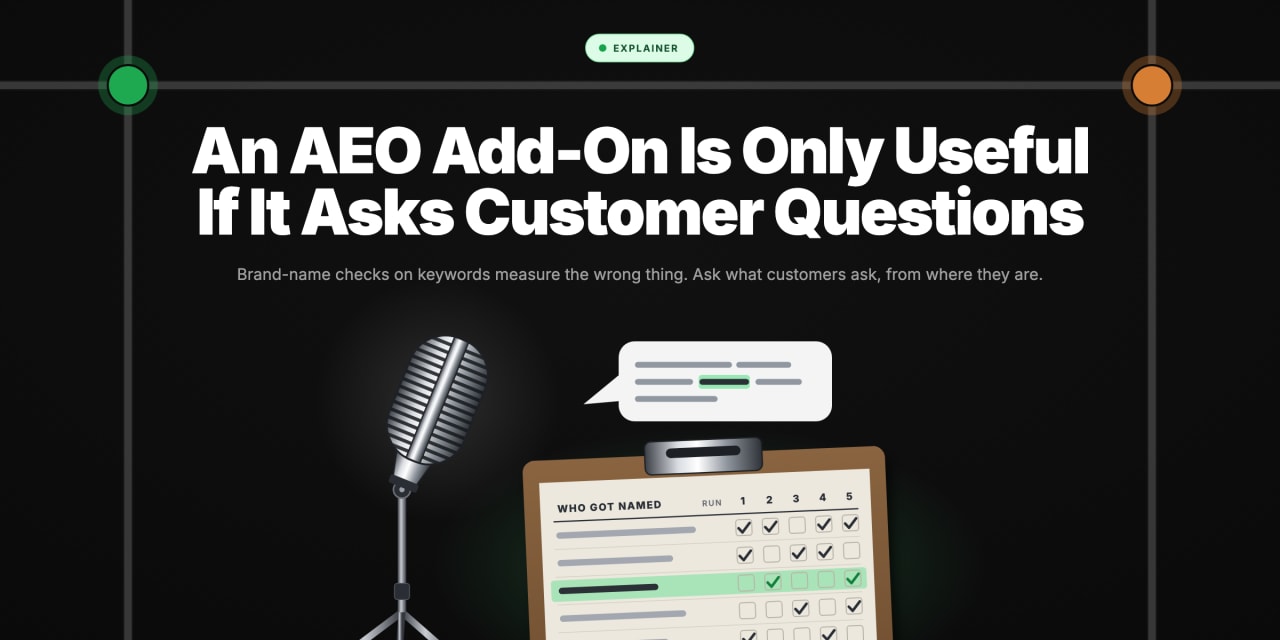
An AEO feature in a local SEO tool is worth paying for only if it does five things. It asks AI assistants the questions customers ask, from the client's town, several times per question, and records every business named, next to the Google Maps map pack for the same search. A feature that checks whether a brand appears for a keyword list measures a query no customer typed. For an agency, the useful number is the share of runs that name the client, and who got named instead. As of November 2026, BrightLocal, Local Falcon and Search Atlas all list AI visibility tracking on their own pages.
Quick answer
- AEO means answer engine optimisation. It is the work of getting a business named when people ask ChatGPT, Gemini or Google's AI features.
- Ask questions, not keywords. Customers type full questions, and the assistant rewrites them into several searches of its own.
- Ask from the client's town. Local answers depend on place. In our map pack study, appearance fell from 96.4% within 500 m to 0% beyond 5 km.
- Run each question more than once. AI answers vary between runs, so one check is an anecdote.
- Record every business named. The competitors the assistant prefers are where the work starts.
- Compare with the map pack. The same search in Maps and in an assistant can name different businesses.
- Ranking well is not enough. Ahrefs found only 37.9% of AI Overview citations also rank in Google's top 10.
- Three suites list it today. BrightLocal, Local Falcon and Search Atlas all advertise AI visibility tracking. We have not tested any of them.
- Ask to see the raw runs. A dashboard that can't show its questions, places and answers is packaging, not measurement.
What "AEO built in" should mean for a local client
An AEO feature is a scheduled test, not a score. It should tell you, for a given client, which questions were asked, where from, how many times, and who the assistant named. Anything less is a number you can't check.
Agencies already work inside AI assistants. We counted tools named in 912 cached r/localseo posts from August 2025 to August 2026, one count per post. ChatGPT appeared in 37 posts and BrightLocal, the most-named paid local suite, in 28. AI Overviews came up in 27, Gemini in 20, Perplexity in 12 and Local Falcon in 7. Practitioners already ask assistants things by hand every day. A paid module has to measure something they can't get by typing the question themselves.
The demand is real. On 9 July 2026 a small local SEO agency asked r/localseo for one tool for all its clients, with a "primary use case helping them improve Google and ChatGPT visibility". It wanted a simple interface, analytics and automation. The thread drew 55 replies.
Here is the difference between a feature that helps and one that only looks like it does:
| property | useful feature | weak feature |
|---|---|---|
| What it asks | Questions written the way customers talk | The agency's keyword list |
| Where it asks from | The client's town, stated | No location, or the vendor's server |
| Runs per question | Several, reported as a share | One, reported as yes or no |
| What it records | Every business named, with dates | "Brand mentioned: yes or no" |
| What it compares with | The map pack for the same search | Nothing |
Read the right-hand column as a warning list. A tool that sits in that column on two or more rows can produce a nice chart while telling you nothing about what a customer in the client's suburb would see.
For where AEO fits in the wider stack of rank trackers, audit tools and review tools, see the best local SEO tools, sorted by the job they do.
Customers ask questions, and the assistant rewrites them
A keyword check tests a query the assistant may never send. Google says its AI Mode uses a "query fan-out" technique, "issuing multiple related searches concurrently across subtopics". The customer's words go in, and a set of the assistant's own searches comes out.
  ONE CUSTOMER QUESTION, MANY SEARCHES
  ┌──────────────────────────────────────┐
  │ "who's a good physio near me for a   │
  │  bad back, open saturdays?"          │
  └──────────────────┬───────────────────┘
                     │ assistant rewrites
        ┌────────────┼────────────┐
        ▼            ▼            ▼
   physio back   physio open   physio
   pain <town>   saturday      reviews
                 <town>        <town>
        └────────────┼────────────┘
                     ▼
     answer names 2 to 4 businesses
The example above is ours, drawn to show the shape. Google describes the technique but does not publish the exact searches for any question.
What that means for an AEO feature:
- Your keyword list is the wrong input. "Physio
" is a search an agency types. Customers ask about their problem, their day and their street. - The question carries the constraint. "Open Saturdays" or "takes my insurance" can change who gets named. A keyword list drops it.
- Prompts must be editable. The tool should let you write the client's real customer questions, not only pick from its suggestions.
The answer depends on where the customer stands
A local AI answer checked from nowhere is not the answer a customer gets. Local results are built around place, and the map pack shows how sharp that edge is.
In our local pack GeoGrid study, a business appeared in the map pack in 96.4% of searches run within 500 m of it, and in 0% of searches run more than 5 km away. That is the map pack, not an AI assistant. We have not measured how much AI answers change with the searcher's position. That part is not tested by us.
The safe rule follows anyway. If the assistant is answering "near me" for a customer, the test has to stand where the customer stands. A tool should tell you how it sets location: a city name in the prompt, a set of coordinates, or a grid of points. If the vendor can't say, assume it doesn't.
- City in the prompt. Cheap and simple, but every suburb gets the same answer.
- One fixed point. Better, but it only speaks for one street.
- A grid of points. Closest to how customers are spread across a service area, and the most expensive to run.
One run is an anecdote, so count the share
A single check that says "mentioned" or "not mentioned" is a coin toss reported as a fact. Local Falcon's own AI visibility page says AI answers vary between asks, and that it collects many samples to show how consistently a brand is named. That is the right instinct, whoever sells it.
The number to track month by month is a share. Out of ten runs of "best physio near me" from the client's suburb, how many named the client, and who got named instead? Local Falcon calls its version Share of AI Voice, "the percentage of points where AI mentions your brand". BrightLocal reports a mention rate and share of voice against competitors.
- A share can move. A yes-or-no can only flip, which hides slow progress and slow decline.
- A share needs a fixed setup. Same questions, same places, same assistants, same number of runs, every month.
- A share has a margin. Five runs is a rough read. Treat a move of one run in five as noise.
- A share comes with names. The businesses named instead of the client are the real report.
Keeping the setup fixed is harder than it sounds. We wrote up what drifts between runs in running the same AI test the same way.
Ranking well on Google no longer means being cited
Organic rank and AI citation have drifted apart. Ahrefs studied 863,000 keyword results and 4 million AI Overview URLs, published 2 March 2026. It found that 37.9% of URLs cited in AI Overviews also appeared in the top 10 for the same query, down from about 76% in July 2025.
So a client can rank on page one and still be left out of the AI answer. For a local business the gap is wider still, because the map pack is its own system with its own signals. The two lists of businesses often don't match, as we explain in why AI answers and the map pack pick businesses differently.
| what you check | what it tells you | what it can't tell you |
|---|---|---|
| Organic rank | Where the website sits for a keyword | Whether an assistant names the business |
| Map pack rank | Whether the profile shows in Maps, by place | What an assistant says for the same need |
| AI answer share | How often an assistant names the client | Why, or what to fix first |
Each row covers a gap the others leave. That is why an AEO feature is most useful inside a local SEO tool, next to the map pack data, rather than as a separate dashboard.
Which local SEO tools have AEO built in, by their own pages
Three suites that agencies already use list AI visibility tracking on their own pages, as of November 2026. Everything in this table comes from the vendor's page. We have not tested any of these features, and we can't say how well they work.
| tool | assistants listed | prompts and location | competitors |
|---|---|---|---|
| BrightLocal | ChatGPT, Google AI Overviews, Google AI Mode | Up to 20 prompts per location, "anchored to a specific location" | Mention rate, share of voice, average position |
| Local Falcon | ChatGPT, AI Overviews, AI Mode, Gemini, Grok | Same query from a grid of 9 to 441 points | Lists "every brand AI named" with its share |
| Search Atlas | ChatGPT, Gemini, AI Mode on Growth; adds Copilot, Perplexity, Claude on Pro | Not stated on the pricing page | Not stated on the pricing page |
Read across the rows against the five checks. BrightLocal's page says prompts are tied to a location and competitors are detected for you. Local Falcon's page describes the grid approach it already uses for Maps. Search Atlas lists AI visibility on every plan, but its pricing page doesn't say how location is set, so ask before you buy.
The pricing models differ too. BrightLocal says the tracker is included in its subscriptions. Local Falcon runs AI scans on the same credits as its Maps scans. Search Atlas sets AI visibility credits per plan. For how BrightLocal and Search Atlas differ overall, see BrightLocal vs Search Atlas.
Put the AI check next to the map pack
The AI share means more when it sits beside map pack data for the same service and town. Without it, you can't tell whether the assistant is following the map pack or ignoring it.
  SAME NEED, SAME TOWN, TWO CHECKS
  ┌───────────────────┐  ┌───────────────────┐
  │ MAP PACK          │  │ AI ASSISTANT      │
  │ "physio <town>"   │  │ "good physio near │
  │ from each point   │  │  me, bad back?"   │
  │ on a grid         │  │ several runs      │
  └─────────┬─────────┘  └─────────┬─────────┘
            ▼                      ▼
     who ranks where        who gets named
            └──────────┬───────────┘
                       ▼
         same names?  different names?
When the names match, map pack work is probably carrying the AI answer too. When they differ, look at what the assistant can read about the businesses it does name.
Raw numbers can hide a real effect. In our study, review count looked almost unrelated to map pack rank across all searches, with a correlation of −0.095. Once we held distance fixed, the same figure was −0.377, as our research page shows. Distance was masking the review effect. An AI share pooled across a whole city can mislead the same way, so compare like with like: same need, same place.
The map pack side of this is measured with a GeoGrid scan, a grid of points over the area with the keyword run from each one.
The skeptics have a point about dashboards
Some AI visibility tools are thin wrappers, and practitioners say so. In September 2025 an r/bigseo post with 85 upvotes, titled "GEO/AIO is essentially just a scam", put it bluntly:
Most of these tools are either glorified prompt engineering or completely delusional about what they actually accomplish, yet they're charging enterprise prices for basic automation that you could build yourself over a weekend.
That is a fair warning about packaging. It isn't an argument against measuring. The five checks are how you tell the two apart: a real measurement can show you its questions, its places, its run count and the exact answers. A dashboard that can't is selling you a score.
What to ask before buying a tool with AEO built in
Put these to the vendor, or test them in a trial, before the feature goes in a client report.
- Can I write my own customer questions? Suggestions are fine as a start. You need to edit them.
- How does it set the client's location? City name, point or grid. Ask which.
- How many runs per question, and does it report a share? A yes or no is not enough.
- Does it record every business named, with the date? You need the competitors, not only the client.
- Can I see it beside the map pack for the same search? If not, you'll be matching two exports by hand.
- Can I read the raw answers? If you can't, you can't check the score.
Getting named is only part of the job. Whether the assistant recommends the client, or mentions it and steers people elsewhere, is a separate measure we cover in counting who gets recommended, not who gets cited.
Bottom line
An AEO feature in a local SEO tool earns its price when it behaves like a test you could repeat yourself. It asks customer questions, from the client's town, several times each, records every business named, and sits next to the map pack for the same search. BrightLocal, Local Falcon and Search Atlas all list AI visibility tracking today. We haven't tested them, so judge each one against those five checks in a trial before it goes into a client report.
RankMap is being built around the map pack side of this comparison. We're pre-launch. Join the waitlist for free early access.
Frequently asked questions
- 01What should an AEO feature in a local SEO tool actually do?
- It should ask AI assistants the questions real customers ask, from the client's town, several times each. It should record every business named, with dates, and show the result next to the map pack for the same search. A yes-or-no brand check on a keyword list measures a query customers rarely type and an answer that may change on the next run.
- 02Which local SEO tools have AI visibility tracking built in?
- As of November 2026, BrightLocal, Local Falcon and Search Atlas all list AI visibility tracking on their own pages. BrightLocal names ChatGPT, AI Overviews and AI Mode. Local Falcon adds Gemini and Grok. Search Atlas adds Copilot, Perplexity and Claude on its Pro plan. We have not tested any of these, so check them in a trial.
- 03Does ranking well on Google mean ChatGPT will recommend the business?
- Not reliably. Ahrefs found in March 2026 that only 37.9% of URLs cited in Google's AI Overviews also ranked in the top 10 for the same query, down from about 76% in July 2025. For a local business, the map pack adds another separate list. Check the AI answer directly instead of assuming rank carries over.
- 04Why do AI visibility tools show different results each time?
- AI assistants don't give the same answer to the same question every time, and Local Falcon's own page says so. That is why a useful tool runs each question several times and reports how often the business is named. Keep the questions, places and assistants fixed between months, or the change you see may come from the setup.
- 05Does an AEO check need to be run from the client's location?
- For local questions, yes. In our map pack study a business appeared in 96.4% of searches within 500 metres and none beyond 5 km, so place decides a lot in local search. We have not measured how much AI answers shift by location. Ask each vendor how it sets location before trusting its local numbers.
- 06Can I track AI visibility by hand instead of paying for a tool?
- Yes, for a few clients. Write ten customer questions, ask each one in two assistants several times from the client's area, and log every business named in a sheet. It is slow, and fixing location by hand is hard. A tool earns its fee when it does the same thing on a schedule and keeps the history.
Sources
Primary data, collected by us
- Tool ledger
- tools named in 912 cached r/localseo posts, 19 August 2025 to 19 August 2026, one count per post, title and body. ChatGPT 37, BrightLocal 28, AI Overviews 27, Gemini 20, Perplexity 12, Local Falcon 7.
- Local pack GeoGrid study
- collected July 2026, 300 grid cells across 12 markets. Map pack appearance 96.4% within 500 m, 0% beyond 5 km. Review count vs rank correlation −0.095 overall, −0.377 with distance held fixed. Published on our research page, linked twice in the body above. It measures the map pack only, not AI answers.
Cited Accessed November 2026.
- Google, AI Mode in Search, 5 March 2025 blog.google. Supports the "query fan-out" technique, quoted.
- Ahrefs, AI Overview citations and the top 10, 2 March 2026 ahrefs.com. Supports 37.9% of AI Overview citations in the top 10, about 76% in July 2025; 863K keyword results, 4M URLs.
- BrightLocal, Local AI Visibility Tracker brightlocal.com. Supports chatGPT, AI Overviews, AI Mode; 20 prompts per location; location-anchored queries; competitor mention rate and share of voice; included in subscriptions.
- Local Falcon, AI search visibility localfalcon.com. Supports chatGPT, AI Overviews, AI Mode, Gemini, Grok; 9 to 441 grid points; answers vary between asks; Share of AI Voice; competitor report; shared credits.
- Search Atlas, pricing searchatlas.com. Supports AI visibility on every plan; ChatGPT, Gemini, AI Mode on Growth; Copilot, Perplexity, Claude added on Pro; credits per plan.
- r/localseo, 9 July 2026, best tool for local agencies, with AEO reddit.com. Supports the agency request; Google and ChatGPT visibility use case; 55 replies.
- r/bigseo, 18 September 2025, GEO/AIO is essentially a scam reddit.com. Supports the quoted line; 85 upvotes.
Explore with AI
Share this
Map your real rank across the city.
Free for the first 50 scans. No credit card.
Join the waitlist