Local SEO Tools for a Small Agency: Start Free, Add One Tracker
A new local SEO agency needs Google's free tools plus one map pack tracker, from $10 a month. Add suites only as clients grow. Prices checked 9 Nov 2026.

A new local SEO agency needs Google's free tools plus one paid map pack tracker, and nothing else until its client count grows. Search Console, GA4 and the Google Business Profile Performance report cover the website and the profile's own numbers. None of them shows where a business ranks in the map pack across its area, so that is the one job worth paying for first. Published grid prices started at $10 a month for Whitespark and $24.99 for Local Falcon when we checked on 9 November 2026. All-in-one suites come later. Practitioners who went looking for one platform report trying five and still switching between tools. This holds as of November 2026.
Quick answer
- Start with five things. Search Console, GA4, the profile's Performance report, a spreadsheet and one map pack tracker cover a first client.
- Pay for one job first. Map pack rank by location is the only job on a beginner's list that free tools can't do.
- Rank depends on where the searcher stands. In our GeoGrid study, a business appeared in 96.4% of searches within 500 m of it and in none beyond 5 km.
- A tracker can be cheap. Whitespark's Local Ranking Grids start at $10 a month and Local Falcon Starter is $24.99, checked 9 November 2026.
- Watch what expires. Whitespark's grid credits expire after each billing period, and Local Falcon's monthly credits expire at month end.
- No tool writes the recommendations. That judgement is what the client pays the agency for.
- The all-in-one search rarely ends. A freelancer with 8 to 10 clients had tried five platforms and was still looking.
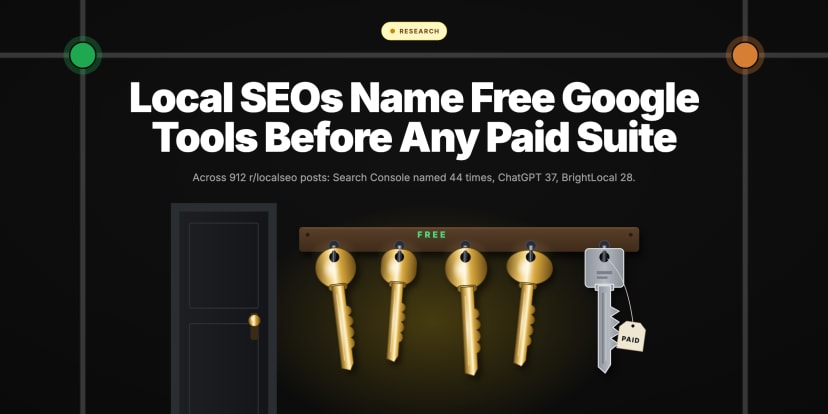
- Free tools lead in practice. In our count of 912 r/localseo posts, Search Console was named 44 times and BrightLocal, the top paid local suite, 28.
- Add tools by stage. Call tracking and citation tools at 4 to 10 clients, a suite or white-label reports past 10.
The case: six jobs on a limited budget
A beginner's tool list usually has six jobs on it, and only one of them needs a paid tool at the start. On 3 August 2026 a beginner running a small social media agency in India asked r/localseo which tools to use. They had just taken on a physiotherapy clinic and wanted to add Google Business Profile work and local SEO. The thread drew 26 replies.
Their list of use cases is a fair picture of what any new agency thinks it needs:
- Profile audits, checking the Google Business Profile against what it should be.
- Local SEO recommendations, deciding what to fix first.
- Competitor analysis, seeing who ranks and why.
- Keyword and rank tracking, knowing where the clinic shows up.
- Citation management, keeping the business listed the same way across directories.
- Client reporting, showing the clinic what changed.
They named Localo, BrightLocal, GMB Everywhere, PlePer and Whitespark as the tools they had seen. They also said the budget was "quite limited" and that they were open to a paid tool later as the agency grew. That is the right instinct. The question is which job deserves the first paid tool.
Free tools cover five of the six jobs
At one clinic, free tools and your own time handle five of the six jobs. Only rank tracking by location needs paying for from day one.
| Job | Stage-one answer | Paid tool needed now? |
|---|---|---|
| Profile audit | the profile itself, compared with the top 3 by hand | No, a spreadsheet does it |
| Recommendations | your own judgement | No tool supplies this |
| Competitor analysis | read the top 3 profiles for the main search term | No, at one client |
| Rank tracking by location | one map pack tracker on a fixed schedule | Yes, nothing free holds location steady |
| Citations | a manual check of the main directories | Not until listings are messy |
| Client reporting | a plain monthly summary of calls, bookings and coverage | No, a document does it |
Read the last column. Five rows say no. The one yes is there because a hand check depends on where you're standing when you search, and no free Google tool repeats the same search from many points on a schedule.
Google's free tools report Google's own numbers. Search Console's Performance report gives clicks, impressions, click-through rate and average position from Google Search. The Business Profile's performance view counts calls, website clicks and direction requests from the profile. Those are the numbers a clinic owner cares about, and no paid tool has better ones.
The free layer has one blind spot. Performance tells you people called. It doesn't tell you where on the map the clinic showed up for them. Our count of the tools local SEOs open every day found the same split: free Google data first, then one paid tool per weekly job.
Why rank tracking is the job to pay for
Map pack rank is the one number a hand check gets wrong, because it changes with where the searcher stands. Search from the clinic's car park and it may rank first. Search from three kilometres away and it may not appear at all.
We measured how fast visibility falls off. In our local pack GeoGrid study, a business appeared in the map pack for 96.4% of searches made within 500 metres of it. Beyond 5 km it appeared in none. A single search from one spot can't show that shape. A grid of searches, repeated on a schedule, can.
For a physiotherapy clinic, that matters in plain terms:
- Patients search from home or work, not from the clinic's door.
- The owner checks from the clinic, where the result looks best.
- A grid scan shows the gap between those two views, point by point.
A small grid is enough at one clinic. Most of the useful answer sits inside a few kilometres, so a 5×5 grid on three to five search terms covers it. Here is what that costs in grid points:
ONE CLINIC, ONE MONTH
1 location x 5 terms x 4 weekly scans x 25 points
                                = 500 grid points

Local Falcon Starter: 7,500 credits, 1 per point
500 of 7,500 used               = under 7%
On Local Falcon one credit is one grid point, so the cheapest plan covers this with plenty to spare. Our page on what local rank trackers charge for runs the same sum for every billing model.
What a first tracker costs
A first map pack tracker costs $10 to $41 a month on the published prices we read on 9 November 2026. The catch is that each vendor bills a different unit, so the cheapest headline price may not be the cheapest for you.
| Tool | Entry price, checked 9 Nov 2026 | What the bill counts | What expires or limits it |
|---|---|---|---|
| Whitespark Local Ranking Grids | from $10 a month | grid credits, up to 225 points per grid | credits expire after each billing period |
| Local Falcon Starter | $24.99 a month | 7,500 credits, 1 per grid point | monthly credits expire at month end |
| Local Optics Single (formerly Local Viking) | $39 a month | 1,600 keyword and 7,500 GeoGrid credits, separate | the two pools don't share |
| Local Dominator Lite | $39 a month | 5,000 credits, 1 profile | page doesn't say credits per grid point |
| BrightLocal Track | $41 a month, 1 location, billed monthly | number of locations | geo-grid maps for up to five keywords |
| Localo | $39 or $149, billed annually, plus VAT | plan limits in Business Profiles | annual commitment |
Read the third and fourth columns before the price. Expiring credits are money spent whether you scan or not, so a plan sized for a busy month wastes money in a quiet one. Whitespark sells its rank tracker separately, from $14 to $200 a month. If the grid is why you're buying, price the grid product, not only the tracker.
We have not tested these tools side by side. The table compares billing, not accuracy or features.
Pick by how you'll scan. One clinic scanned weekly suits a small credit plan. Several clinics scanned often may suit per-location billing, where scan frequency is free. The agency-scale version of this choice is in local rank tracking for agencies.
Recommendations are the job no tool does
The job agencies most hope a tool will do is the one no tool does well: deciding what to fix first. A tool can list gaps. It can't weigh them against what this business can actually change.
A tool shows the numbers, not the choice. It can show that a clinic has 30 reviews and the top three average 140. It can't tell you whether this clinic can realistically ask more patients for reviews. It also can't tell you whether the real gap is a primary category that files it under the wrong kind of practice.
Our study shows which numbers deserve the weight. Across 10,890 matched pairs of nearby businesses in our GeoGrid study's findings, the one with more reviews ranked higher 66.9% of the time. A more complete profile won 61.9%, and a higher star rating won only 52.7%. A tool that scores a profile out of 100 treats those as roughly equal. They aren't, and spotting that is the agency's job.
The parts of recommendations that stay human:
- Which gap is fixable. A clinic can ask for reviews. It can't move closer to a suburb.
- What the owner will actually do. A plan the front desk won't follow is worth nothing.
- What the business really is. The right primary category comes from what the clinic sells, not from what a tool suggests.
- What to leave alone. Some scores look bad and cost nothing in calls.
That judgement is what the client pays for. It's also why a cheap tracker plus your own thinking beats an expensive suite that offers a to-do list.
The all-in-one search rarely ends
Practitioners who went looking for a single local SEO platform describe trying several and still switching between them. For a beginner with one client, that points one way: don't try to solve the platform problem yet.
One freelancer had tried five. In August 2026 a freelancer managing 8 to 10 small businesses listed what they wanted in one tool: map grid tracking, organic rank tracking, profile insights, review monitoring and replies, post scheduling and white-label reports. They had already tried BrightLocal, Localo, DAXRM, Local Falcon and Whitespark.
Each has some good features but I am still trying to find the setup that works best for managing multiple small business clients without having to jump between different tools.
Another built their own. In October 2025 a practitioner shared a budget stack: a custom Looker Studio dashboard over GA4 and Search Console, a self-hosted rank tracker, a site crawler, GMB Everywhere for profile audits and several AI writers. They had used Ahrefs, SE Ranking and Semrush. They later updated the post to say they had built their own platform because nothing fit.
A third cut the suites. In May 2026 a practitioner with six small clients paying $100 to $150 a month each said they cut BrightLocal after three months and SE Ranking after two. White-label reports were the main value of one of them, and their clients didn't need them:
my clients don't need polished reports, they need their phone to ring more.
Three people, a dozen tools, and no single platform that satisfied any of them. A staged stack avoids paying for that search.
Add tools by stage, not by wish list
Add a paid tool only when a specific job outgrows the free way of doing it. Client count is a good proxy for when that happens.
STACK BY STAGE
add a tool only when a job outgrows the free way

1-3 clients
  Search Console + GA4 + profile Performance
  + a spreadsheet + one map pack tracker
        |
        v  proving calls by hand gets slow
4-10 clients
  + call tracking where calls matter
  + a citation tool if listings are messy
        |
        v  reports take a day a week
10+ clients
  + a suite or white-label reporting
Each step has its own trigger:
- Call tracking earns its place when a client's results are phone calls and the profile's call count isn't enough to show where they came from.
- A citation tool earns its place when a client has old addresses or duplicate listings spread across directories. One clinic with clean listings doesn't need one.
- A suite or white-label reporting earns its place when reports for ten or more clients eat a working day. Before that, a plain monthly document does the job.
Our tool count backs the order. In 912 r/localseo posts from August 2025 to August 2026, we counted which tools practitioners named:
| Tool | Posts naming it (of 912) | Free or paid |
|---|---|---|
| Google Search Console | 44 | free |
| BrightLocal | 28 | paid, per location |
| Semrush | 23 | paid |
| Whitespark | 14 | paid |
| Google Analytics / GA4 | 7 | free |
| Local Falcon | 7 | paid, per credit |
Read it as a count of mentions, not of happy users. Search Console leads because everyone uses it. Grid trackers are named less because they do one narrow job that suites and free tools don't. Cutting tools later follows the same test: cut every tool that doesn't answer a client question.
Budget outside the US
Most local SEO tools price in US dollars, and several price per location. For an agency billing clinics and salons in India, a tool priced for the US market takes a bigger share of each client's fee than it would in the US.
Put the tool in the fee. Divide each tool's monthly cost across the clients who use it, and add it to what you charge. A $24.99 tracker spread over three clinics is about $8.33 each. A $41 per-location plan is $41 for each clinic you add.
Size the plan to the month, not the hope. Credits that expire at the end of each billing period, as Whitespark's and Local Falcon's do, punish plans bought for growth that hasn't arrived. Start on the smallest plan and move up when you run out.
The fee side of this arithmetic is covered in what to charge a small local client, which sets a floor from your hours and tools.
A starting stack for one clinic
Set this up in the first week, and change it only when a job outgrows it.
- Connect Search Console, GA4 and the profile's Performance report on day one, and note a dated baseline.
- Add one map pack tracker for three to five search terms on a 5×5 grid, scanned on a fixed day each week.
- Audit the profile against the top three by hand, in a spreadsheet.
- Write the recommendations yourself, starting with reviews, category and profile completeness.
- Report monthly in plain terms: calls, bookings and where the clinic shows up on the map.
- Add a tool only when a job outgrows your time.
One disclosure. RankMap is building a GeoGrid rank tracker and is pre-launch as of November 2026, so advice to pay for one map pack tracker comes from an interested party. The test on this page applies to our tool as much as anyone's: pay only for a job free tools can't do.
Bottom line
A small local SEO agency should start with Google's free tools and one map pack tracker, and add the rest by stage. Free tools cover the website and the profile's own numbers. They don't show where a business ranks across its area, which is why the tracker is the first thing worth paying for, from $10 a month as of 9 November 2026. Recommendations stay your job at every stage. If you want to see the tracker we're building, join the waitlist for free early access.
Frequently asked questions
- 01What tools does a new local SEO agency need?
- For the first one to three clients: Google Search Console, GA4, the Business Profile Performance report, a spreadsheet and one map pack tracker. The free tools cover the website and the profile's own numbers. The tracker covers where the business ranks across its area, which free tools can't show. Add call tracking, citation tools and suites only as client count grows.
- 02Is there one all-in-one local SEO tool for a small agency?
- Not one that practitioners agree on. In August 2026 a freelancer managing 8 to 10 small businesses had tried BrightLocal, Localo, DAXRM, Local Falcon and Whitespark and was still switching between tools. Another practitioner gave up and built their own platform. For one to three clients, a staged stack of free tools plus one tracker usually costs less and covers more.
- 03Why pay for a map pack tracker when Google's tools are free?
- Because map pack rank changes with where the searcher stands, and free tools don't measure that. In our GeoGrid study, a business appeared in 96.4% of searches within 500 metres and in none beyond 5 km. Search Console and the Performance report show clicks and calls, not where on the map the business appeared. A tracker repeats the same search from many points.
- 04Which is better for a first client: Whitespark, Local Falcon or Localo?
- We haven't tested them side by side, so compare billing. On 9 November 2026, Whitespark's grids started at $10 a month with credits that expire each billing period. Local Falcon Starter was $24.99 for 7,500 credits, one per grid point. Localo was $39 or $149, billed annually. Work out locations, terms, scans and grid points first.
- 05When should a small agency add a suite like BrightLocal?
- When reporting or listings work for many clients starts eating your week, usually past ten clients. BrightLocal bills per location, from $41 a month for one location on Track, billed monthly, as of 9 November 2026. That suits an agency with many active clients. At one to three clients, a cheaper single-job tracker and a plain monthly report usually do the same work.
- 06Do US-priced local SEO tools make sense for agencies in India?
- Only when one tool does a job you need every week. Most local tools price in US dollars, often per location, so they take a bigger share of a fee billed in India. Divide each tool's cost across the clients using it and add that to your fee. Start on the smallest plan, because expiring credits waste money in quiet months.
Sources
Primary data, collected by us
- Tool ledger
- tools named in 912 cached r/localseo posts, 19 August 2025 to 19 August 2026, title and body, one count per post. Search Console 44, BrightLocal 28, Semrush 23, Whitespark 14, Google Analytics/GA4 7, Local Falcon 7. Counted 21 September 2026, re-run 9 November 2026 with the same totals.
- Local pack GeoGrid study
- collected July 2026. Appearance 96.4% within 500 m of the business, 0% beyond 5 km. Across 10,890 matched pairs within 100 m, higher review count won 66.9%, profile completeness 61.9%, star rating 52.7%. Published on our research page, linked twice in the body above.
- Vendor pricing reads
- each vendor's own pricing page, read 9 November 2026, the same reads as our local rank tracker pricing post. Whitespark grid credits expire after each billing period.
- Arithmetic
- 1 × 5 × 4 × 25 = 500 grid points; $24.99 ÷ 3 ≈ $8.33.
- Search Console query pull
- queries that showed this page in Google, 90 days to 9 November 2026: "local seo tools" 15 impressions at position 33.5, "local falcon" 7 at position 7.6, "localo" 3 at position 4.7, "whitespark" 2, "brightlocal" 2. Pulled 9 November 2026.
Cited Accessed November 2026.
- r/localseo, 3 August 2026 reddit.com. Supports the case; India; physiotherapy clinic; six use cases; limited budget; tools named; 26 replies.
- r/localseo, 15 August 2026 reddit.com. Supports 8–10 clients; five tools tried; quoted line.
- r/localseo, 17 October 2025 reddit.com. Supports the budget stack; suites used; built their own platform.
- r/localseo, 12 May 2026 reddit.com. Supports six clients at $100–150; BrightLocal and SE Ranking cut; quoted line.
- Search Console Help, Performance report support.google.com. Supports clicks, impressions, CTR and average position from Google Search.
- Business Profile Help, performance and insights support.google.com. Supports calls, website clicks and direction requests.
- Whitespark pricing whitespark.ca. Supports grids from $10, up to 225 points; rank tracker $14–$200.
- Local Falcon pricing localfalcon.com. Supports starter $24.99, 7,500 credits, 1 per point, monthly expiry.
- BrightLocal pricing brightlocal.com. Supports track $41 for 1 location, billed monthly; five geo-grid keywords on Track.
- Local Optics pricing app.localoptics.com. Supports single $39, separate keyword and GeoGrid credits.
- Local Dominator pricing localdominator.co. Supports lite $39, 5,000 credits, 1 profile.
- Localo pricing localo.com. Supports $39 and $149, billed annually, plus VAT.
Explore with AI
Share this
Map your real rank across the city.
Free for the first 50 scans. No credit card.
Join the waitlist