Cutting SEO Tool Subscriptions: Keep What Free Tools Can't Do
Cancel any SEO tool that answers no client question Google's free tools can't. For small local clients, that leaves one map pack tracker. Checked Nov 2026.
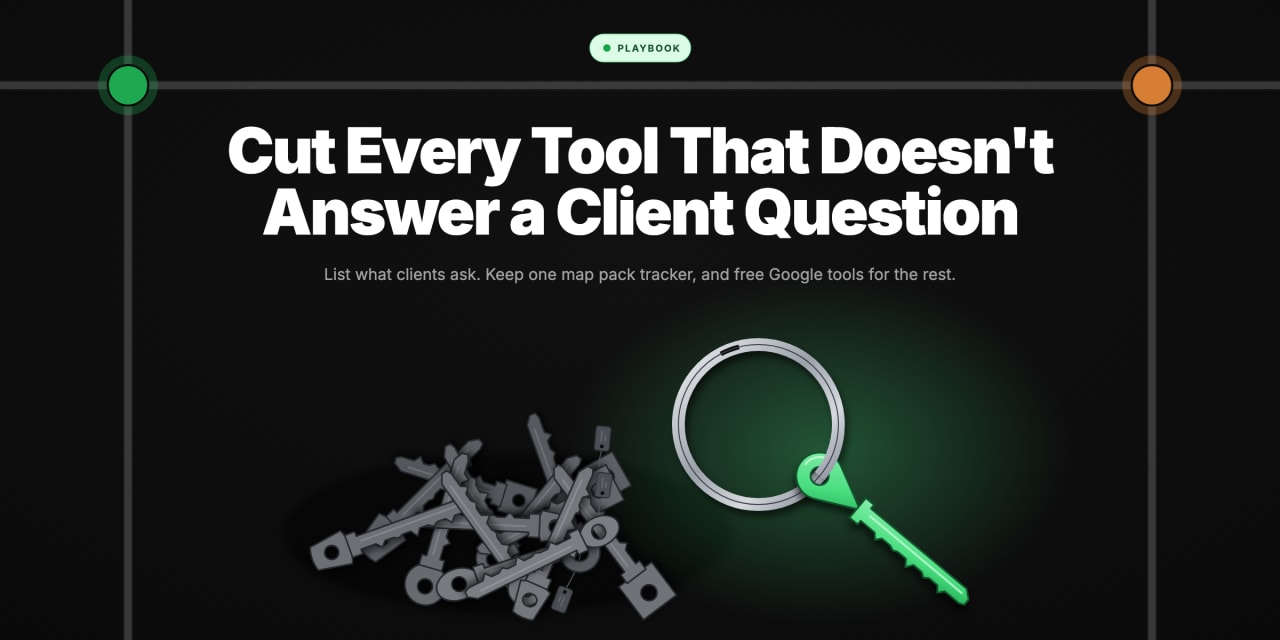
To cut SEO tool subscriptions without hurting client work, list the questions your clients actually ask, then keep only the tools that answer one Google's free tools can't. For a freelancer or small agency with small local business clients, that usually leaves one paid tool: a tracker that shows where each business appears in the Google Maps map pack across its area. Search Console, GA4 and the Business Profile Performance report cover most of the rest at no cost. Divide what's left by your active clients. A $120 tool across six clients is $20 each, against fees of $100 to $150. This holds as of November 2026.
Quick answer
- Start from client questions, not features. A tool that answers nothing a client asks is a cost with no job.
- Free Google tools answer most questions. Search Console, GA4 and the Business Profile Performance report cover the site and the profile's own calls and clicks.
- Map pack rank by location is the gap. No free Google tool repeats the same search from many points across a service area.
- Reporting software is usually the first cut. It reformats numbers you already have.
- Two overlapping suites rarely help. They estimate the same things and often disagree.
- Price every tool per client. Monthly cost divided by active clients shows what each client really carries.
- Shrink the grid before you drop the tracker. In our GeoGrid study, no business appeared in the map pack from more than 5 km away.
- Check what expires before you downgrade. Whitespark grid credits expire each billing period, and Local Falcon's monthly credits expire at month end.
- Try before you re-subscribe. BrightLocal has a 14-day trial, Local Falcon gives 100 free credits on sign-up and Whitespark gives 200 trial credits.
The case: a subscription audit that came as "a bit of a shock"
Most freelancers who cut tools start the way this one did, by adding up the bills. On 10 August 2026 a solo practitioner posted on r/localseo that going through their monthly subscriptions "was a bit of a shock". The thread drew 19 replies. They listed what they were paying for:
Between SEMrush, LocalFalcon, reporting software and a couple of other bits and pieces, I'm spending way more than I realised.
r/localseo, 10 August 2026
Most of their clients were small local businesses. They asked two questions: what's actually essential for a solo freelancer, and what had people cancelled and not missed.
That second question is the right one. Nobody misses a tool that never answered anything they needed. The usual mistake is judging each tool on whether it's good. Most of them are. The useful test is narrower: does this tool answer a question my clients pay me to answer, and does nothing free answer it already?
If you are building a stack from nothing rather than trimming one, the order is different, and the starting stack for a small local SEO agency covers it. This page is for the person who already pays for too much.
Match every tool to a client question
Small local clients ask a short list of questions, and Google's free tools already answer most of them. Write the list down first. Then put each subscription next to the question it answers.
| client question | free answer | pay only if |
|---|---|---|
| Are we showing up on Google Maps, and where? | none that holds location steady | always, one map pack tracker |
| Are people finding the website? | Search Console | rarely |
| Are people calling or clicking from the profile? | Business Profile Performance | call tracking, if you must attribute each call |
| What do visitors do on the site? | GA4 | rarely |
| Are our listings consistent? | a manual check of the main directories | many locations or messy listings |
| What do competitors have that we don't? | read their profiles by hand | you need link data at scale |
Read the last column. Only the first row says "always". Every other row has a free answer that works for one small business, and a paid tool only earns its place when the client count or the mess grows.
The table also gives you a cancel test you can run in a few minutes:
THE ONE-QUESTION TEST
┌──────────────────────────────────┐
│ a tool on your card statement    │
└────────────────┬─────────────────┘
                 ▼
  Does it answer a question a
  client actually asks?
        no  ──────────────► cancel
        │ yes
        ▼
  Does a free Google tool
  answer it already?
        yes ──────────────► cancel
        │ no
        ▼
  keep it, then price it per client
A tool that fails either step goes. A tool that passes both stays, but it still has to justify its price, which the per-client section below covers.
Free Google tools already cover most of the list
Free tools are the ones practitioners name most often in our count of forum posts. We counted the tools named in 912 cached r/localseo posts from August 2025 to August 2026, one count per post. Google Search Console was the most-named tool, in 44 posts. BrightLocal came next with 28, Semrush had 23 and GA4 had 7.
Each free tool answers a fixed set of questions:
- Search Console reports clicks, impressions, click-through rate and average position from Google Search, straight from Google.
- The Business Profile Performance report counts calls, website clicks and direction requests from the profile itself.
- GA4 shows what visitors do once they reach the website.
For a small local client, those are the numbers that matter most, and no paid suite has better versions of them. A paid tool that estimates traffic is estimating something Search Console already measures for your client's own site.
The free layer has one blind spot. The Performance report tells you people called. It doesn't tell you where on the map the business showed up when they searched. That is the question every local client asks first, and it is the one free tools can't answer.
Map pack rank by location is the one gap worth paying for
The map pack is the one result that changes with where the searcher stands, which is why a hand check from your desk can't stand in for a tracker. Google ranks local results partly on distance from the person searching. Search from your office and you see the result for your office, not for a customer three suburbs away.
The effect is steep. In our GeoGrid study of 300 grid cells across 12 markets, collected July 2026, a business appeared in 96.4% of searches made within 500 metres of it and in none made beyond 5 km. One check from one spot tells you about one spot.
A tracker repeats the same search from many points on a schedule, so the result doesn't depend on where you happen to be sitting. That is the job nothing free does reliably, and why it survives the cancel test for almost every local client. The longer version of where free checks stop is in where free rank tracking stops working.
A suite's rank tracker may already do this job. Check before you add a second tool. Many suites track a keyword from one location, which is a different thing from a grid of points across a service area. If yours only does the first, it doesn't answer the "where" question.
One practitioner's cuts, and what survived
The clearest public record of a cut-down stack comes from a practitioner with six small clients. In May 2026 they described on r/localseo how they ran local SEO for six small service businesses, most paying "$100-150/month" for their time. The post drew 36 replies.
Two tools went:
- BrightLocal, cut after 3 months. The per-location pricing added up, and the grid tool was useful but not worth "$50-60/month" at six small businesses.
- SE Ranking, cut after two months. Its main extra was white-label reporting, which their clients didn't need.
Their reason for dropping the reporting tool is the whole case for cutting reports:
my clients don't need polished reports, they need their phone to ring more.
r/localseo, 12 May 2026
One tool survived. They kept rank tracking on Semrush's lowest plan, which they put at $120 a month, their largest line item. They had tried cutting it twice, and "both times I missed it within a month". That is the cancel test in practice: the tool they kept was the one that answered a question nothing free could.
Price what's left per client
Once the list is short, divide each tool's monthly cost by the clients actually using it. That number, not the plan price, decides whether a tool fits your fees.
WHAT THE STACK COSTS EACH CLIENT
six clients, each paying $100-150 a month
──────────────────────────────────────────
stack               per client  share of fee
one $120 tool          $20         13-20%
three $120 tools       $60         40-60%
──────────────────────────────────────────
per client = monthly tools / active clients
One $120 tool takes a fifth of a $100 fee at most. Three tools at the same price take up to 60% before any work is done. At small fees the question is whether a tool answers something the client pays you for, not whether it's good.
Dedicated map pack trackers can cost far less than a suite. We checked these entry prices on each vendor's own pricing page on 9 November 2026. We haven't tested these tools side by side ourselves.
| tracker | entry price | what happens to unused credits |
|---|---|---|
| Whitespark Local Ranking Grids | from $10 for 2,000 credits, 1 per grid point | expire each billing period |
| Local Falcon | Starter $24.99 a month | monthly credits expire at month end; top-ups at $0.05 never expire |
| Local Dominator | $39, $59, $97 or $197 a month | no $0 tier; free trial |
| Local Optics | $39, $59, $99, $149 or $200 a month | not tested by us |
| BrightLocal | $41, $54 or $65 a month for one location | per-location plans, no scan credits |
| Localo | $39 or $149 a month, billed yearly | plan tier |
Read the right-hand column before the price. Two $39 plans can buy very different amounts once you count grid points, keywords and runs. Whitespark's $10 plan, for example, covers about one client tracked on a 7×7 grid for five keywords every week. The full sum is in what one local rank tracker scan costs.
Reporting software is usually the first cut
Polished reporting tools cost money every month and answer no new question. They take numbers that Search Console, the profile's Performance report and your tracker already produce, and lay them out more nicely.
For small local clients, a plain monthly summary of three things does the job better:
- Map pack coverage, from your tracker, compared with last month.
- Calls and website clicks, from the Business Profile Performance report.
- Booked jobs, from the client, because that is what they pay for.
The last line matters most, and no reporting tool can fetch it. How to build that summary around outcomes is in showing ROI as booked jobs.
Agencies with many clients are the exception. When you send dozens of reports a month under your own brand, the hours a reporting tool saves can cover its price. Our page on white-label local SEO reporting covers when that point arrives.
Two overlapping suites are usually one too many
Paying for two SEO suites usually buys two estimates of the same numbers, and they often don't agree. In July 2026 a practitioner asked r/localseo why Semrush and Ahrefs showed such different figures for the same client site. They wrote that "almost every metric is different": traffic estimates, keyword rankings, backlink counts and referring domains.
For a small local client, that disagreement is a reason to keep one suite, or none. Traffic and rankings for the client's own site come from Search Console, measured by Google. A suite earns its place when you need data Search Console can't give, such as competitor backlinks at scale. One suite usually covers that. A second one mostly adds a second opinion you then have to explain to the client.
Shrink the grid and check expiry before you cancel the tracker
If the tracker is the expensive line, cut how much you scan before you cut the tool. Grid trackers that charge per point bill you for every point in the grid, and on a big grid most of the outer points record nothing.
Our own data shows why. In our GeoGrid study, no business appeared in the map pack from more than 5 km away. A wide grid around a small local business spends credits on points where it can't appear. Grid sizes vary by vendor: BrightLocal runs from 3×3 to 15×15 and Local Falcon from 3×3 to 21×21.
Before you downgrade or cancel, check three things:
- Expiry rules. Whitespark grid credits expire each billing period, and Local Falcon's monthly credits expire at month end. Credits you don't use before a downgrade are gone.
- Credits that last. Local Falcon's top-up credits cost $0.05 each and never expire, which can suit a client you scan only now and then.
- Trials for a re-test. If you're unsure you need the tool, run a trial before you re-subscribe: 14 days on BrightLocal, 100 free credits on Local Falcon, 200 trial credits on Whitespark.
An audit pass for your subscriptions
You can run the whole audit in under an hour, with your card statement and a spreadsheet.
- List every tool and its monthly cost, then divide each by your active clients.
- Write the client question each tool answers. If you can't name one, cancel it.
- Check whether a free Google tool answers it. Search Console, GA4 and the Performance report often do.
- Keep one tool for map pack rank by location. Nothing free covers it reliably.
- Cut the grid to the area the business can win before you cut the tracker.
- Note every expiry date, and use the credits before you downgrade.
- Repeat the audit when your client count changes, because the answer for 3 clients isn't the answer for 30.
For the wider field of tools by job, if you later need to add one back, see the best local SEO tools, sorted by job.
Where this advice breaks
The one-question test holds best for a solo practitioner with a handful of small local clients. It bends in three places:
- Many clients. Past a few dozen, time saved by reporting and listing tools can outweigh their cost.
- Many locations per client. Per-location pricing gets expensive fast, but so does doing listings by hand.
- Link-heavy work. If clients pay you for competitive link building, a suite's backlink data answers a real question.
Our interest, stated. RankMap is building a map pack tracker, so advice to keep one comes from an interested party. The test on this page, whether a tool answers a client question that free tools can't, applies to our tool as much as anyone's.
Bottom line
Cut every SEO tool that doesn't answer a question your clients ask, and every tool whose question a free Google tool already answers. For small local clients, that usually leaves Search Console, GA4, the Business Profile Performance report and one map pack tracker. Price what's left per client, cut the grid before the tracker, and use credits before they expire. RankMap is pre-launch and built for that one job. Join the waitlist to see it when it opens.
Frequently asked questions
- 01Which SEO tool subscriptions should a freelancer cancel first?
- Start with reporting software and any second SEO suite. Reporting tools reformat numbers Search Console, the Business Profile Performance report and your tracker already give you. Two suites mostly estimate the same traffic and rankings, and often disagree. Then cancel anything you can't link to a question a client actually asks. A map pack tracker is usually the last tool to go, because nothing free replaces it.
- 02How do I tell if a local SEO tool is worth keeping?
- Ask two questions. Does it answer something a client actually asks, such as where they show up on Google Maps? And does a free Google tool answer it already? If the answer to the first is no, or to the second is yes, cancel it. If it passes both, divide its monthly cost by active clients and check it fits your fees.
- 03Can I drop paid rank tracking and check Google Maps by hand?
- Not reliably. A hand check shows the map pack for the spot where you search, and local results change with the searcher's distance. In our GeoGrid study, businesses appeared in 96.4% of searches within 500 metres and in none beyond 5 km. One check from your desk misses most of a client's area. A tracker repeats the same search from many points.
- 04Do I need both Semrush and Ahrefs for small local clients?
- Usually not. Both estimate traffic, rankings and backlinks from their own data, and one practitioner reported that almost every metric differed for the same site. For a small local client, the site's real traffic and rankings come free from Search Console. Keep one suite only if you need data it can't give, such as competitor backlinks at scale.
- 05What should I check before downgrading a rank tracker plan?
- Check when your credits expire and use them first. Whitespark grid credits expire each billing period, and Local Falcon's monthly credits expire at month end, as of November 2026. Local Falcon's top-up credits never expire, which can suit occasional scans. Also shrink your grids first, since smaller grids use fewer credits and may let you drop to a cheaper plan.
- 06How do I work out what my SEO tools cost per client?
- Add up every tool's monthly price, then divide by the number of active clients using it. A $120 tool shared by six clients is $20 each. Three tools at that price are $60 each, which is 40% to 60% of a $100 to $150 monthly fee. Compare that share with what each client pays before deciding what stays.
Sources
Primary data, collected by us
- Tool ledger
- tools named in 912 cached r/localseo posts, 19 August 2025 to 19 August 2026, title and body, one count per post. Search Console 44, BrightLocal 28, Semrush 23, GA4 7. Counted 21 September 2026, re-run 9 November 2026 with the same totals.
- Local pack GeoGrid study
- collected July 2026. 300 grid cells across 12 markets. Appearance 96.4% within 500 m of the business, 0% beyond 5 km. Published on our research page, linked twice in the body above.
- Vendor pricing reads
- each vendor's own pricing page, read 9 November 2026, the same reads as our local rank tracker pricing posts.
- Arithmetic
- $120 ÷ 6 = $20; $20 is 13–20% of a $100–150 fee. 3 × $120 ÷ 6 = $60, 40–60% of the same fee. A 7×7 grid for 5 keywords weekly uses 49 × 5 × 4.33 ≈ 1,062 credits a month, under Whitespark's 2,000.
- Search Console query pull
- no queries showed this page in Google in the 90 days to 9 November 2026. Pulled 9 November 2026.
Cited Accessed November 2026.
- r/localseo, 10 August 2026, cutting back on SEO tool subscriptions reddit.com. Supports the case; "a bit of a shock"; quoted line; small local clients; 19 replies.
- r/localseo, 12 May 2026, stack for 6 small businesses reddit.com. Supports $100–150 fees; BrightLocal cut after 3 months; SE Ranking cut after two; Semrush lowest plan $120 kept; quoted line.
- r/localseo, 9 July 2026, why two suites show different metrics reddit.com. Supports "almost every metric is different".
- Search Console Help, Performance report support.google.com. Supports clicks, impressions, CTR and average position.
- Business Profile Help, performance and insights support.google.com. Supports calls, website clicks and direction requests.
- Whitespark pricing whitespark.ca. Supports grids from $10 for 2,000 credits, 1 credit per point, expiry each billing period, 200 trial credits.
- Local Falcon pricing localfalcon.com. Supports starter $24.99, grids 3×3 to 21×21, monthly expiry, $0.05 top-ups that never expire, 100 free credits.
- BrightLocal pricing brightlocal.com. Supports $41, $54 and $65 for one location; grids 3×3 to 15×15; 14-day trial.
- Local Dominator pricing localdominator.co. Supports $39, $59, $97 and $197; no $0 tier; free trial.
- Local Optics pricing app.localoptics.com. Supports $39, $59, $99, $149 and $200.
- Localo pricing localo.com. Supports $39 and $149, billed yearly.
Explore with AI
Share this
Map your real rank across the city.
Free for the first 50 scans. No credit card.
Join the waitlist