Two Local SEO Quotes, $3k and $5k: Compare the Work First
Two local SEO quotes of $3,000 and $5,000 rarely cover the same work. Turn both into hours, deliverables and what gets measured before you compare.
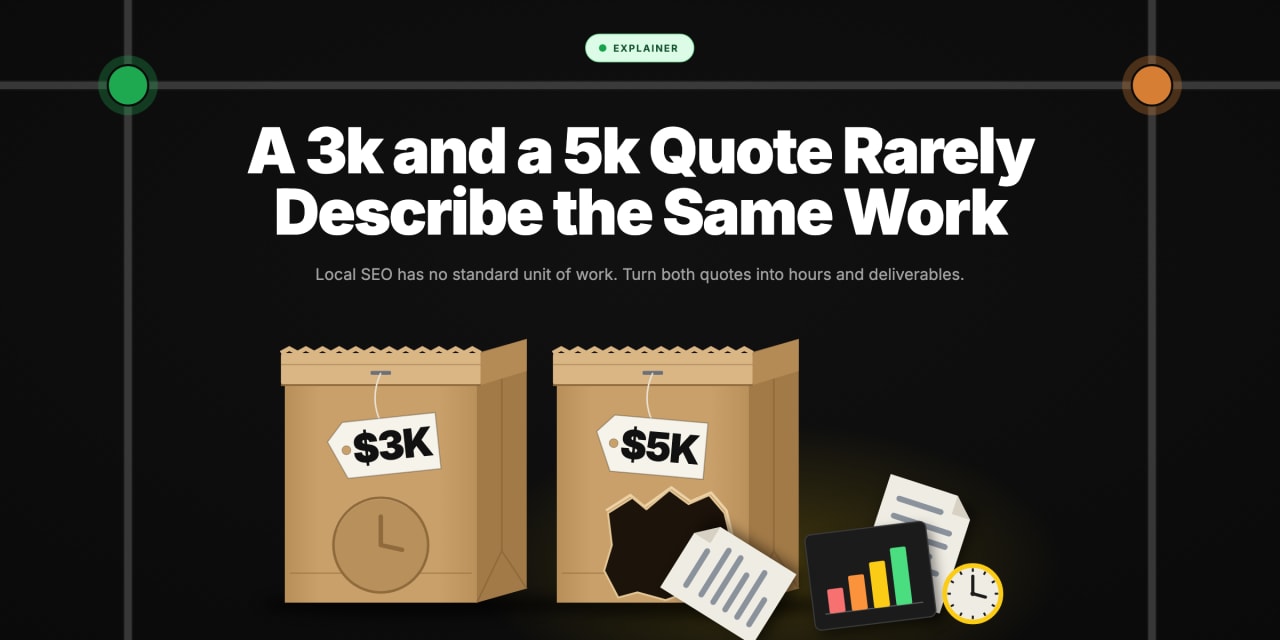
When two agencies quote $3,000 and $5,000 a month for what looks like the same local SEO work, the two scopes are usually not the same. Local SEO has no standard unit of work, so each quote is written in its own words: "optimization", "content", "reporting". The price follows what each agency charges for its time and what it plans to deliver, not a shared rate card. For a business owner, the fix is to turn both quotes into the same units first: hours, named deliverables, meetings, term, exclusions, and what gets measured in Google Maps and in booked jobs. The quote that reports jobs and map coverage is selling results you can check. This holds as of November 2026.
Quick answer
- The gap is rarely arbitrary. Two quotes usually price different hours, people, meetings and deliverables, even when the task lists look alike.
- Fees named online run very wide. In eight r/localseo threads we read, monthly fees ran from $100 to $5,000.
- Some of the higher fee is not output. Account management, meetings, senior time and overheads are priced in.
- Small clients cost more to serve. One agency owner said smaller clients expect more for their spend.
- Ask both agencies the same six questions. Hours and whose hours, deliverables, measures, meetings, term, exclusions.
- What gets measured matters most. A quote that reports calls, booked jobs and map coverage can be checked.
- One rank number is a weak measure. In our study, a business showed in the map pack in 96.4% of searches within 500 m of it and in none beyond 5 km.
- Tools are a small, checkable line. Published rank tracker prices start well under $100 a month.
- Google warns against rank guarantees. Its own guide says no one can guarantee a #1 ranking.
Why two local SEO quotes can be $2,000 apart
Two local SEO quotes can sit $2,000 apart because the market has no agreed price, and the fees people name in public run across a range far wider than $2,000. On 15 August 2026 someone asked r/localseo exactly this question in a thread titled "Is SEO agency pricing mostly arbitrary? Two agencies can quote 3k and 5k month for seemingly similar work." It drew 39 comments. The question is fair. The answer is that the gap is hard to read, not random.
We logged every monthly fee named in the posts we read. We went through the post text of eight r/localseo threads from October 2025 to August 2026 and wrote down each monthly figure. Here they are, side by side:
  MONTHLY FEES NAMED IN 8 REDDIT THREADS
  $100-150  #                solo, 6 small clients
  $200-350  #                small agency, own tiers
  $379      #                freelancer, top fee
  $600      #                freelancer, incl. a site
  $700      #                freelancer, full package
  $800-1.2k ##               agencies, as others see
  $3k-5k    ##########       agencies, as others see
  Oct 2025 to Aug 2026 · post text only
| fee named | who named it | what it covered, in their words |
|---|---|---|
| $100–150 a month | A solo practitioner with six clients | Their time, for small service businesses |
| $200 and $350 a month | A small US agency, its own two tiers | Local SEO, with and without articles |
| $379 a month | A new freelancer, their highest fee | A site, profile posting, review work, local backlinks |
| $600 a month | A freelancer, one moving company | SEO plus a new custom website |
| $700 a month | A freelancer, their standard package | Blogs, page rewrites, profile management, tracking, reports |
| $800–1,200 a month | A newcomer describing agencies | Review collection after the basics, as they saw it |
| $3,000–5,000 a month | A freelancer describing agencies | "way less actual output", in their view |
The table shows one split clearly. Every figure up to $700 came from someone describing what they charge themselves. Every figure from $800 up came from someone describing other agencies' prices. That doesn't make the high figures wrong. It means the public record shows what freelancers and small shops say they charge, and only second-hand views of what larger agencies charge. Inside a range that wide, a $2,000 gap between two quotes is not unusual. The useful question is what each quote covers.
These figures describe the people who posted, not the market as a whole. They are a sample of eight threads, not a price survey. If you are on the agency side and want to set your own fee, what to charge a small local client works it out from the client's jobs and your hours instead of from a range like this.
What the extra money usually pays for
The extra money in a higher quote often pays for things other than output. A freelancer charging $700 a month for blogs, page rewrites, profile management, rank tracking and reports put the complaint this way in April 2026:
I have seen businesses pay $3k-$5k a month for way less actual output. Like a generic audit up front and two blogs a month for 4 grand.
That is one side's view, from someone pricing against agencies. It still points at a real difference. A higher fee is often justified by costs that don't show up as a deliverable:
- Account management. Someone whose job is to answer your emails and keep the work moving.
- Meetings. A weekly call costs the agency hours every month, whether or not anything is produced in it.
- Senior time. An hour from someone with ten years of local work is priced higher than a junior's hour.
- Outsourced work. An agency that sends tasks to a contractor passes that contractor's fee on, plus its margin.
- Overheads and risk. Office, staff, insurance and the cost of clients who leave early are spread across every fee.
None of this is wrong. It is a different product from a freelancer's hours. A client who wants a weekly meeting and one named contact may be happy to pay for it. A client who only wants the work done is paying for things they don't use. The problem is a scope written in vague terms, because it hides which of these two products you are buying.
Small clients cost more to serve than their fee suggests
Some of the gap between two quotes is each agency's guess at how much of its time your account will take, priced in before the work starts. An agency owner described this in December 2025:
From my experience, the smaller the client the more they expect for their spend.
They went on to name what "more" means: frequent meetings, extra audits, a lot of input from the agency's side. Their larger clients, by contrast, sent the data and left the agency to it. The owner of a small business usually has more riding on each dollar, so they ask more questions. That is reasonable, and agencies know it.
Two quotes can price two different relationships. A quote that assumes a weekly call and a quote that assumes a monthly report are not pricing the same thing, even when the task lists match word for word. One agency may have priced in four meetings a month. The other may have priced in none. Neither will say so unless you ask.
This cuts the other way too. If you know you want to be hands-off, say so in your first call. Some agencies will price lower when they know the account won't take extra time. A freelancer in July 2026 described the opposite problem: charging $379 at most for a full scope, then realising there was no way to give six clients "the time they need". A quote that is too low for the time you expect can end with the work being rushed or the provider leaving.
Put both quotes in the same six units
The only fair way to compare two quotes is to make both agencies answer the same questions, in writing. Send each one the same list and fill in the gaps side by side.
| question to ask | why it matters | what a clear answer looks like |
|---|---|---|
| Hours per month, and whose hours? | Senior, junior and outsourced hours are priced differently | A number of hours and a named role for each |
| Which deliverables, by name, each month? | "Optimization" can mean anything | A list you can tick off: posts, pages, review requests, fixes |
| What is measured, and how? | This decides whether you can check the results | Calls, booked jobs and map coverage, from the same setup each month |
| How many meetings? | Meetings are hours you pay for | A set number, with who attends |
| Minimum term and notice period? | A long lock-in moves the risk onto you | A term in months and a notice period in days |
| What is excluded? | Ads, website work and content are often extra | A written list of what costs more |
Read the third row first. Once you have both answers, divide each fee by its named deliverables and by its hours. The cheaper quote per unit is often not the one with the lower total. A $5,000 quote with twice the senior hours may cost less per hour than a $3,000 quote run mostly by a contractor. You can only see that once the units match.
  TURN EACH QUOTE INTO THE SAME UNITS
  quote A  $3,000        quote B  $5,000
      |                      |
      v                      v
  hours, whose        hours, whose
  deliverables        deliverables
  what is measured    what is measured
      |                      |
      +----------+-----------+
                 v
  cost per hour · cost per deliverable
  · which one you can check
Google gives similar advice for picking any SEO. Its guide Do you need an SEO? lists questions to ask before hiring, including "What kind of results do you expect to see, and in what timeframe? How do you measure your success?" and "How can I expect to communicate with you?" The six units above are those questions turned into numbers.
What each quote measures matters more than the price
What a quote promises to measure tells you more than the fee does. A quote that reports calls, booked jobs and where you appear on the map is selling results you can check. A quote that reports "rankings" and "traffic" is selling activity, and you have to take its word for what that activity did.
A single rank number is the easiest measure to game. Google says local results are based on relevance, distance and prominence, and distance is measured from the person searching. So your rank is different at every point in your area. In our local pack GeoGrid study, collected in July 2026, a business appeared in the map pack in 96.4% of searches made within 500 metres of it and in none beyond 5 km. A report that says "you rank #3" without saying from where can be true from the shop door and false across town.
Map coverage is a fairer measure. A GeoGrid scan runs your keyword from a fixed grid of points across your area and records where you sit at each one. Ask both agencies whether they report coverage this way, and whether the grid, keyword and centre point stay the same every month. If the settings change, the numbers can't be compared.
Booked jobs are the measure that pays the bills. Rankings and coverage are steps on the way. The result an owner cares about is jobs from search, set against the fee. That calculation is laid out in local SEO ROI is booked jobs, not rankings or traffic. If one quote agrees to report jobs and the other doesn't, that is a bigger difference than $2,000.
Some agencies offer to tie part of the fee to results. That only works when both sides agree in advance on one result they can both count. The trade-offs of each model are covered in pay-for-results local SEO.
Which deliverables are worth paying for
Not every deliverable on a quote moves your map ranking by the same amount. When you compare two lists, look for the work that touches the signals Google names, and be wary of a list padded with work that can't be checked.
Our study gives a rough order for close rivals. In the same GeoGrid study, we compared 10,890 pairs of businesses within 100 metres of each other, same search, same point. The one with more reviews ranked higher 66.9% of the time. The one with a more complete profile won 61.9%. The one with the higher star rating won only 52.7%, close to a coin flip. The method and figures are on the study's research page.
| deliverable on a quote | what it touches | how to check it |
|---|---|---|
| A steady review request routine | Review count, the strongest edge in our pairs | Count reviews at the start and each month |
| Completing the Business Profile | Profile completeness, second in our pairs | A dated list of fields filled and photos added |
| Fixing category and service details | Relevance to the search | Before and after screenshots of the profile |
| Blog posts | Mostly the website, not the map pack directly | Published URLs, and whether they get visits |
| A one-off audit | Nothing, until someone acts on it | Which findings were fixed, and when |
The table doesn't say blogs or audits are useless. It says they are harder to tie to your map ranking, so a quote built mostly from them needs a clearer reason. A review routine and profile work are things you can count. Neither of these figures has been tested as a before-and-after on one business by us. They come from comparing close rivals at one point in time.
What tools add to a quote
The software in a quote is usually a small and checkable part of the fee. Most local rank tracking tools publish their prices, so you can see roughly what an agency pays for them.
| tool | published price, November 2026 | what it bills for |
|---|---|---|
| BrightLocal | $41, $54 or $65 a month for a single location | Plans by location, with more features at each step |
| Local Falcon Starter | $24.99 a month, with 100 free credits on sign-up | Credits, used per grid point |
| Whitespark Rank Tracker | $14 to $200 a month | Plans by the amount of tracking |
Most agencies spread a tool's cost across many clients, so your share is often a fraction of these numbers. If a quote names a large "software" or "platform" line, ask which tools it covers. If the tool cost is a small part of the gap between two quotes, the gap is mostly in hours, people and meetings. These prices are from the vendors' own pages. We have not tested these tools side by side for this page.
How to compare two quotes, step by step
Comparing two quotes takes one email and an hour with a spreadsheet. Do it before the first call where someone asks you to sign.
- Send both agencies the six questions and ask for written answers, not a call.
- Fill in one table with both answers side by side.
- Divide each fee by hours and by named deliverables. Note which is cheaper per unit.
- Check who does the work. Ask whether any of it is outsourced, and to whom.
- Prefer the quote that reports calls, jobs and map coverage. Ask to see a sample report.
- Write down your starting point. A dated map scan, your review count and your jobs from search.
- Agree a review date. Month four is a common point, judged against the same numbers.
Step six matters more than it looks. Without a written start, both sides will remember the starting point differently by month four. How that conversation usually goes wrong is covered in four months in, the client is reading the wrong numbers.
Warning signs in a local SEO quote
Some lines in a quote should make you ask more questions, whatever the price. Watch for these:
- A rank guarantee. Google's guide says "No one can guarantee a #1 ranking on Google." It adds that if an SEO guarantees first place, "find someone else."
- No named deliverables. "Ongoing optimization" with no list can't be checked.
- No hours or no names. You can't tell who does the work or how much of it.
- Reports that only show rank and traffic. Nothing ties the work to calls or jobs.
- A long minimum term with no review point. The risk sits with you if it goes badly.
- Paid or filtered reviews. Google's content policy bans offering rewards for reviews and asking only happy customers.
None of these on their own means the agency is bad. Each one means you are being asked to trust something you could have been shown.
Bottom line
Two local SEO quotes of $3,000 and $5,000 rarely describe the same work. Fees named in public run from $100 to $5,000 a month, and the higher end often prices meetings, senior time and overheads as well as output. Turn both quotes into the same units: hours and whose hours, named deliverables, meetings, term, exclusions, and what gets measured. Then prefer the quote that reports calls, booked jobs and map coverage from the same setup each month, because that is the one whose results you can check.
RankMap is building a way to see your ranking as a map you can re-run month after month. We're pre-launch. Join the waitlist to hear when it opens.
Frequently asked questions
- 01Why do SEO agencies quote such different prices for the same work?
- Usually the work isn't the same. Local SEO has no standard unit, so two quotes can differ in hours, who does the work, meetings, deliverables and what gets measured, even when the task lists look alike. Some of the higher fee pays for account management, senior time and overheads. Ask both agencies the same written questions and compare the answers side by side.
- 02How much does local SEO cost per month?
- There is no agreed price. In eight r/localseo threads from October 2025 to August 2026, the monthly fees people named ran from $100 to $5,000. The figures up to $700 came from freelancers and small shops naming their own fees. The figures from $800 up came from people describing other agencies. Treat these as examples from those posts, not market rates.
- 03How do I compare two local SEO quotes?
- Ask both for hours and whose hours, named monthly deliverables, what is measured, the number of meetings, the minimum term and what is excluded. Put the answers in one table. Divide each fee by hours and by deliverables. Then prefer the quote that reports calls, booked jobs and map coverage, because those are results you can check yourself.
- 04Is the cheaper local SEO quote a false economy?
- Not always, but check whether it is cheap per hour or just smaller. A low fee can mean fewer hours, no meetings, or work that is outsourced. One freelancer charging $379 at most said they couldn't give six clients the time they need. Compare cost per hour and per named deliverable, not only the monthly total.
- 05Should a local SEO agency guarantee a #1 ranking?
- No. Google's own guide for hiring an SEO says no one can guarantee a #1 ranking on Google, and that if someone guarantees first place you should find someone else. In map results, rank also changes with where the searcher stands, so a single position means little unless the agency says where it was checked from.
- 06What should a monthly local SEO report show?
- It should show calls and booked jobs from search, your review count, and where you appear across your area, measured the same way every month. A map scan with a fixed grid, keyword and centre point lets you compare one month to the next. A report showing one rank number and website traffic can't tell you whether the work brought in jobs.
Sources
Primary data, collected by us
- Local pack GeoGrid study
- collected July 2026. Appearance by distance: 96.4% of searches within 500 m, 0% beyond 5 km. Matched pairs within 100 m: review count won 66.9%, profile completeness 61.9%, star rating 52.7% of 10,890. Published on our research page, linked twice in the body above.
- Local SEO fee log
- every monthly fee named in the post text of the eight r/localseo threads listed below, October 2025 to August 2026. Lowest $100, highest $5,000. Re-read from our saved copies on 10 November 2026.
Cited Accessed November 2026.
- r/localseo, 15 August 2026, is agency pricing arbitrary? reddit.com. Supports the $3k vs $5k question; 39 comments.
- r/localseo, 16 April 2026, is my pricing fair? reddit.com. Supports $700 scope; $3–5k agencies; the quoted line.
- r/localseo, 12 May 2026, my stack for 6 small businesses reddit.com. Supports $100–150 a month.
- r/localseo, 8 January 2026, repricing local SEO reddit.com. Supports $200 and $350 tiers.
- r/localseo, 22 July 2026, charging way too little reddit.com. Supports $379 top fee; six clients; time they need.
- r/localseo, 16 May 2026, charging more for a moving company? reddit.com. Supports $600 a month including a new site.
- r/localseo, 16 October 2025, recurring fees reddit.com. Supports $800–1,200 as described.
- r/localseo, 13 December 2025, small retainers reddit.com. Supports smaller clients expect more for their spend; the quoted line.
- Google Search Central, Do you need an SEO? developers.google.com. Supports questions to ask an SEO; no one can guarantee a #1 ranking.
- Google Business Profile Help, tips to improve your local ranking support.google.com. Supports relevance, distance and prominence.
- Google Maps prohibited and restricted content policy support.google.com. Supports bans on rewarded and selectively requested reviews.
- BrightLocal pricing brightlocal.com. Supports $41, $54 and $65 a month for a single location.
- Local Falcon pricing localfalcon.com. Supports starter $24.99; 100 free credits on sign-up.
- Whitespark pricing whitespark.ca. Supports rank Tracker $14 to $200 a month.
Explore with AI
Share this
Map your real rank across the city.
Free for the first 50 scans. No credit card.
Join the waitlist