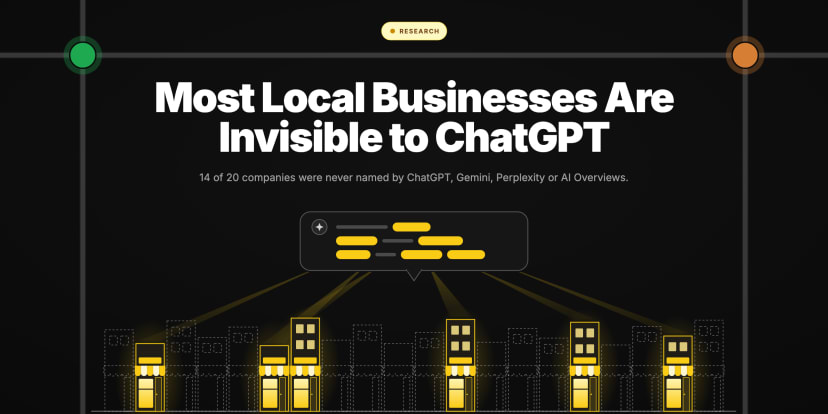
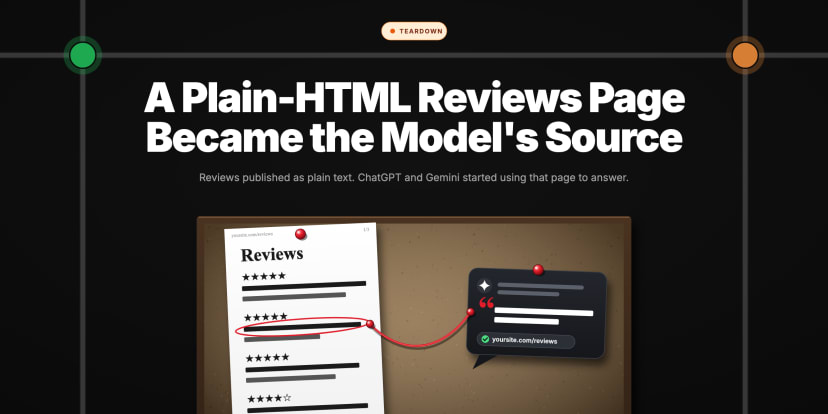
Why AI Recommends a Competitor Instead of Your Business
AI assistants name the business whose pages and reviews match the rewritten question. Loyal regulars leave no text, so a newer rival gets named.
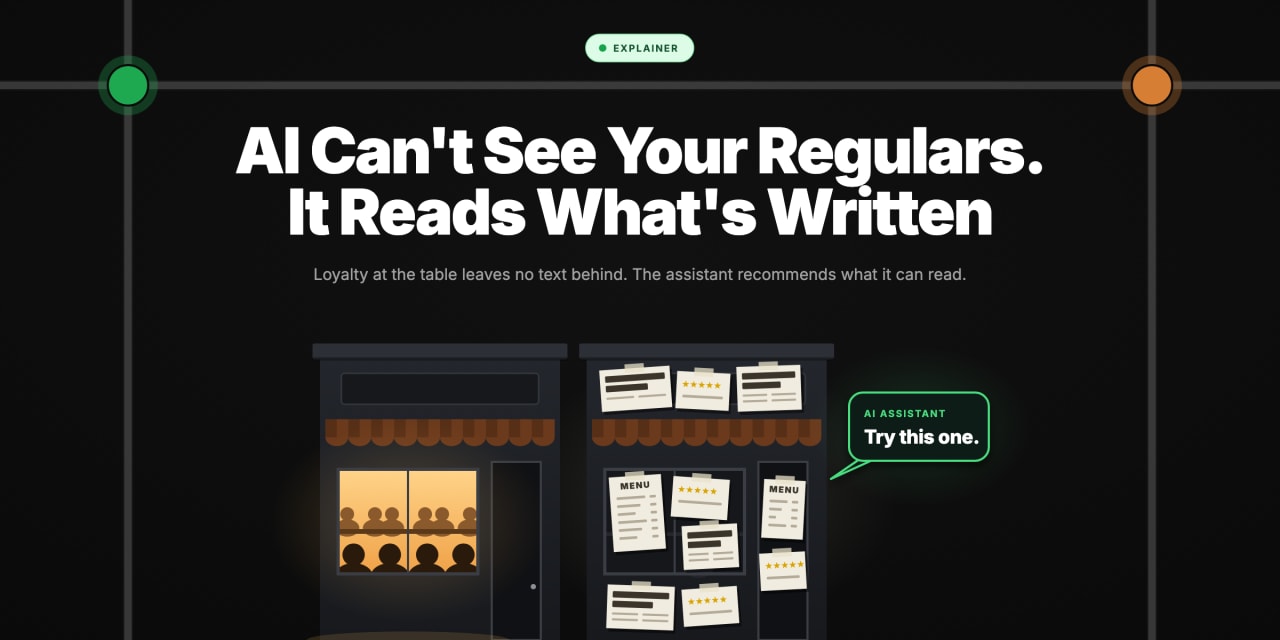
An AI assistant usually recommends a competitor because more readable text describes that competitor in the words the question used. Loyal customers who never write anything leave nothing for it to quote. The assistant rewrites the question, searches the web, and names the businesses its search results describe. Your Google Maps rank and your years of repeat trade are not things it can see unless someone wrote them down. In 140 recorded ChatGPT questions we checked, not one was searched exactly as typed, and 22 had a year added. For a business owner, the fix is text: the dish or service, the town, and recent reviews that name both. This holds as of November 2026.
Quick answer
- The assistant names what it can read. Pages, listings and reviews that its search finds, not the loyalty you see at the counter.
- Regulars are invisible to it. A customer who comes every week but never writes a review adds nothing it can quote.
- The question gets rewritten first. In our 140 recorded ChatGPT questions, 0 were searched word for word.
- Rewrites often add a year. 22 of the 140 did, which tilts the search toward recent pages.
- Newer rivals often have more recent text. Opening reviews, launch posts and food-blog visits pile up in the first months.
- Specific questions need specific words. "Naengsam in Singapore" needs pages that say "naengsam" and "Singapore" next to a business name.
- The live Maps profile is not reliably read. A practitioner reported assistants pulling reviews from other sources, with a time lag.
- Map pack levers are a separate system. Distance and review count decide the map pack in our study. Their effect on AI answers is not tested by us.
- llms.txt won't fix it. On our own blog, GPTBot and PerplexityBot never requested the file in 82 days.
- You can check it yourself. Ask the customer's question several times, log who gets named, and read the sources it shows.
A restaurant with weekly regulars that AI never names
The clearest version of this problem came from a restaurant owner, not an SEO. On 14 August 2026 the owner of a Korean restaurant in Singapore posted on r/localseo. They had served naengsam, thin-sliced frozen pork belly, for more than a year. Their regulars were loyal:
Many Korean customers come back regularly. Some customers come almost every week.
Yet when they asked Google or an AI assistant "Where can I eat good naengsam in Singapore?", newer restaurants came up and theirs didn't. The owner said plainly that they didn't understand SEO or AI search. The thread drew 30 replies.
The owner's evidence is real, but it is the wrong kind of evidence for an assistant. Weekly visits happen at the table. Nothing about them reaches a web page unless a customer writes a review, a blogger writes a post, or the restaurant writes it on its own site.
  WHAT THE OWNER HAS         CAN THE ASSISTANT READ IT?
  weekly regulars            no, unless they write
  a year of naengsam         only if text says so
  a Business Profile         not reliably, not live
  newer rivals' reviews      yes, if they name the dish
| what the owner knows | where it lives | can an assistant quote it? |
|---|---|---|
| Regulars come every week | In the owner's memory and the till | No, there is no text |
| The dish has been on the menu a year | Possibly a menu photo | Only if the menu is written as text |
| The food is better than the new places | In customers' heads | Only through reviews that say so |
| Rivals are newer | On their opening reviews and posts | Yes, and that is what gets read |
Read the last column and the gap is plain. Almost everything that makes this restaurant good is stored somewhere an assistant can't look. The same is true for a plumber with ten years of repeat callouts or a dentist whose patients never post. A wider view of why local businesses go unnamed sits in why ChatGPT doesn't name your local business.
The assistant rewrites the question before it searches
When an assistant answers with web search, it does not search the customer's sentence. It turns the question into one or more search queries of its own, reads the results, and writes the answer from them.
We counted the rewrites ourselves. On 20 September 2026 we pulled recorded ChatGPT questions on Google Business Profile, the map pack and local marketing from the DataForSEO AI optimisation archive, US English. That gave 140 distinct questions with the searches ChatGPT ran for them. We recounted them on 9 November 2026.
- None was searched as typed. In 0 of 140 questions did ChatGPT run the customer's own sentence.
- A year was often added. 22 rewrites added a year, such as 2026, that the question never had.
- Trade words were added. In 50 questions the rewrite added "Google Business Profile" though the customer never said it.
- Some questions became two searches. 35 of the 140 led to more than one search.
One real pair shows the pattern. The question "does local seo still work?" became the search "does local SEO still work 2026 google business profile local search trends". The year and the trade words were the assistant's, not the customer's.
  CUSTOMER ASKS
  "where can I eat good naengsam in Singapore?"
           |
           v  assistant rewrites it
  IT SEARCHES (an illustration, not a record)
  "best naengsam Singapore Korean BBQ 2026"
           |
           v
  pages that say naengsam + Singapore + a
  business name get read and quoted
The naengsam search above is our illustration of the pattern, not a recorded rewrite. The pattern itself is from the 140 records. For the restaurant, it means being findable for the dish, the cuisine, the city and a current year all at once. One limit applies: we pulled these records by topic, so the counts describe our pull, not all ChatGPT traffic.
A specific question needs pages that say the specific thing
"Good naengsam in Singapore" is a narrow question. An answer to it needs sources that tie three things together: the dish, the city and a named restaurant. A broad review that says "great Korean BBQ" doesn't make that tie. Neither does a menu uploaded as an image file.
A newer place with a dozen recent reviews that literally say "the naengsam here" does make it. So does one food-blog post that names the restaurant and the dish in the same paragraph. The assistant isn't judging which naengsam is better. It is looking for text that backs up the sentence it is about to write.
Here is what tends to give an assistant that text, based on how retrieval works rather than a test of ours:
- A menu written as text. An HTML menu page that says "naengsam" and "Singapore" in plain words, not a photo of a printed menu.
- Reviews that name what was ordered. "Came for the naengsam" is quotable. "Great food, friendly staff" is not.
- Third-party mentions. Food blogs, local guides and community pages that name the business and the dish together.
- A visible date. Rewrites that add a year favour pages that show they are current.
- Owner replies that repeat the dish. A reply that says "glad you enjoyed the naengsam" adds one more line of matching text.
None of this needs a new tool. It needs the words the customer would use, written down in places a search can reach.
Assistants don't always read your live Maps profile
A strong Google Business Profile does not guarantee the assistant sees it. A practitioner building a local SEO consultancy tried for weeks to get assistants to read a gym's live reviews and reported this in April 2026:
For example if my local gym has 100 Google reviews on maps, AI usually will pull from either reviews from other sources, or it seems their is a time lag that only can show a certain amount of review from a date in the past.
That is one person's report, not a measured test, and we have not tested it ourselves. It still matches what the restaurant owner saw. If an assistant can't read your current reviews, the text that carries weight is whatever it can reach: your own site, food blogs, directories and review sites.
The map pack works differently, and that difference is why a business can win one and lose the other. In our local pack GeoGrid study, a business appeared in the map pack in 96.4% of searches made within 500 metres of it and in 0% of searches made more than 5 km away. Distance dominates the map pack. Whether the searcher's distance changes an AI answer the same way is not tested by us.
| Google map pack | AI assistant answer | |
|---|---|---|
| What it reads | Your Business Profile and where the searcher stands | Pages and listings its own search returns |
| Biggest factor we measured | Distance to the searcher | Not measured by us |
| How reviews count | Review count won 66.9% of close matchups in our study | Only as text it can find and quote |
| How to check it | A grid of searches across your area | The same question asked many times |
The rows rarely line up, so a good result in one tells you little about the other. A business can even be named often by an assistant while sitting outside the map pack, a case we cover in why AI answers and the map pack pick businesses differently.
Newer places often have more recent text
A restaurant that opened recently tends to collect a burst of fresh text. First-week reviews, opening posts, local news items and food-blog visits all land in a few months. A long-running place with a quiet, loyal crowd can have better food and a thinner, older trail.
The habits behind this are simple:
- Regulars rarely write a second review. Most customers review once, if at all, and a weekly regular wrote theirs long ago or never.
- New customers write first reviews. A new restaurant attracts a wave of first-time visitors, and some of them write.
- Openings get coverage. Bloggers and local pages write about new places far more than about places that have been there for years.
- Rewrites lean toward the current year. In our 140 records, 22 searches added a year the customer never typed.
We can't see which pages any single answer used for this restaurant. This is the pattern that fits the owner's description. It isn't a measured diagnosis of their case.
On the map pack side, review count clearly matters. In our study, among businesses within 100 metres of each other, the one with more reviews ranked higher in 66.9% of 10,890 matched pairs. Review count looked almost unrelated to rank overall, at a correlation of −0.095, but reached −0.377 once distance was held fixed, as published on our research page. That is a map pack result. Whether review count moves an AI answer is not tested by us. For the map side, see do reviews improve Google Maps ranking.
The language of your reviews may matter too
Many of this restaurant's regulars are Korean. If they review at all, some may write in Korean and call the dish 냉삼 rather than "naengsam". A question asked in English for "naengsam in Singapore" may not connect to that text.
We can't confirm how each assistant handles a question in one language and reviews in another. It is not tested by us. It is cheap to check, though. Read your last 50 reviews and count how many name your main dish or service in the language your new customers search in.
A practitioner who reads listings in the UAE raised a related point in August 2026, from the customer's side rather than the assistant's:
The reply is in the wrong language. Someone wrote in Arabic and got answered in English, or the reverse.
That post is about what prospects notice when they read reviews, not about AI. Read together with the restaurant case, the advice is the same either way: make sure some of your text uses the words new customers type.
What doesn't fix it: llms.txt and a top map rank
Two common fixes don't address the real gap. Neither adds text about your dish or service where a search can find it.
An llms.txt file doesn't add the missing text. llms.txt is a proposed text file that lists a site's key pages for AI tools. Our blog has published one since at least August 2026. From 20 August to 9 November 2026 it got 54 requests, and GPTBot and PerplexityBot never requested it once. Google's guide on its AI features says you don't need "AI text files" to appear in them. The full log is in what our bot logs show about llms.txt.
A top map pack rank doesn't carry over by itself. The map pack reads your Business Profile and the searcher's position. The assistant reads pages. A restaurant can sit first in Maps for "Korean restaurant" near its door and still be missing from an AI answer about a dish.
| fix people try | what it changes | does it give the assistant dish + city text? |
|---|---|---|
| Publish an llms.txt file | A file GPTBot and PerplexityBot never fetched on our blog | No |
| Push for a higher map pack rank | Your Business Profile position near the searcher | No, unless reviews name the dish |
| Put the menu in HTML text | Your own site | Yes |
| Ask regulars to name the dish in reviews | Reviews on Google and other sites | Yes, where the assistant can reach them |
| Get one food-blog or local-guide mention | A third-party page | Yes, and from a source that isn't you |
The last three rows are the ones that add matching text. They are also cheaper than either of the first two.
What the restaurant can do this month
Every step below adds text that names the dish, the city and the business together. None needs a paid tool.
- Put the menu on the website as text. An HTML page that says "naengsam" and "Singapore" plainly, with prices and a "last updated" date.
- Add the dish to the Business Profile. Use the menu and description fields. Restaurant-specific profile steps are in how to rank a restaurant on Google Maps.
- Ask regulars to review and name what they ordered. One sentence from a weekly customer that mentions naengsam is exactly the missing text.
- Reply to reviews using the dish name where it fits naturally, in the reviewer's language.
- Invite one or two local food writers or community pages to try the dish and write about it.
- Re-ask the question a month later. Ask it several times, in fresh chats, and count how often the restaurant appears.
Step 6 needs care, because AI answers change between runs. Use the same wording and the same settings each time, as set out in running the same AI test the same way.
Bottom line
AI assistants recommend the business they can read about, in the words the question used. A loyal crowd that never writes leaves the assistant nothing to quote, while a newer rival's fresh reviews and posts give it plenty. The question also gets rewritten before the search, often with a year added, which favours recent pages. Map pack strength and an llms.txt file don't close that gap. Text that names your dish or service, your town and your business together does.
RankMap shows the map pack side of this: your ranking as a grid you can re-run over time, next to what you learn from asking the assistants. We're pre-launch. Join the waitlist.
Frequently asked questions
- 01Why does AI recommend a newer restaurant instead of mine?
- Usually because more readable text describes the newer place in the words the question used. New restaurants collect opening reviews, launch posts and food-blog visits in their first months. Loyal regulars who never write leave nothing for the assistant to quote. Assistants also tend to add a year when they rewrite a question, which favours recent pages. Better food doesn't show up unless someone writes about it.
- 02How do I get ChatGPT to name my business for a specific dish or service?
- Make sure the dish or service name appears as text next to your business name and town. Put your menu or service list on your website as HTML, not an image. Add it to your Business Profile, and ask regular customers to name what they ordered in their reviews. A food blog or local guide mention helps too. Then re-ask the question several times a month later.
- 03Does ChatGPT read my live Google Maps reviews?
- Not reliably. A practitioner in April 2026 reported that assistants pulled reviews from other sources or showed a time lag instead of reading a gym's live Maps reviews. That is one report, and we have not tested it. Don't rely on your profile alone. Keep text about your business current on your own site and on other pages the assistant can find.
- 04Does the language of my reviews affect AI recommendations?
- It may, but we haven't tested it. If your regulars review in Korean and call the dish 냉삼, an English question for "naengsam" may not match that text. Check your last 50 reviews and count how many name your main dish or service in the language new customers search in. If very few do, ask some customers to write in that language.
- 05Can I see which pages made the AI pick my competitor?
- Often, yes. When an assistant searches the web, it usually shows the sources it used as links beside or below the answer. Open them and note what each page says about your competitor that no page says about you. It is often a dish name, a service or a recent date. That list tells you which text to add first.
- 06How often should I re-check whether AI names my business?
- Re-ask the same questions about once a month, and ask each one several times in fresh chats, because answers change between runs. Keep the wording identical so the results are comparable. Log the date, the question, whether you were named and who was named instead. A single check proves very little. A month of repeated checks shows whether your new text is being picked up.
Sources
Primary data, collected by us
- ChatGPT question-to-search pairs
- recorded ChatGPT questions on Google Business Profile, map pack and local marketing topics, with the searches ChatGPT ran for them, pulled from the DataForSEO AI optimisation archive (US, English) on 20 September 2026 and recounted on 9 November 2026. 140 distinct questions. 0 searched as typed. 22 rewrites added a year. 50 questions got "Google Business Profile" added (part of the pull selected on that phrase). 35 led to more than one search. The naengsam rewrite in the diagram is an illustration, not a record.
- Local pack GeoGrid study
- collected July 2026, 300 grid cells across 12 markets. Map pack appearance 96.4% within 500 m, 0% beyond 5 km. Matched pairs within 100 m: higher review count won 66.9% of 10,890. Review count vs rank correlation −0.095 overall, −0.377 with distance held fixed. Published on our research page, linked twice in the body above. It measures the map pack only, not AI answers.
- Bot fetch log
- every request to getrankonmap.com/blog, logged with the bot name each visitor claims, 20 August to 9 November 2026. Requests for our llms.txt files: 54 in total. GPTBot and PerplexityBot: 0. Pulled 9 November 2026.
- Search Console query pull
- no queries showed this page in Google in the 90 days to 9 November 2026. Pulled 9 November 2026.
Cited Accessed November 2026.
- r/localseo, 14 August 2026, why AI doesn't recommend my Korean restaurant in Singapore reddit.com. Supports the case; naengsam for more than a year; weekly regulars; the quoted question; newer restaurants shown; 30 replies.
- r/GoogleMyBusiness, 21 April 2026, how to connect Google Maps to AI reddit.com. Supports assistants not reading live Maps reviews; quoted passage.
- r/localseo, 6 August 2026, UAE Google listings reddit.com. Supports reviews answered in the wrong language; quoted passage.
- Google Search Central, optimizing your website for generative AI features developers.google.com. Supports no "AI text files" needed to appear in Google's AI features.
Explore with AI
Share this
Map your real rank across the city.
Free for the first 50 scans. No credit card.
Join the waitlist