What to Measure for AEO Beyond Citations: Who Gets Picked
For a local business, measure how often AI answers recommend it across repeated runs. In 524 AI Overviews we counted, 85.5% cited Google's help pages.

For a local business, the AEO number that matters is recommendation share: how often an AI answer to a buying question picks the business, out of repeated runs, asked from its own town. A citation count measures something else. We counted the sources in 524 recorded Google AI Overviews to local SEO and Business Profile questions, and Google's help pages were cited in 85.5% of them, YouTube in 57.8% and Reddit in 16.6%. Citations mostly go to platforms, not to the businesses an agency or owner is trying to get named. Report recommendation share, how stable it is, the words attached to the business and the sources behind them, next to the Google Maps map pack. This holds as of November 2026.
Quick answer
- Citations mostly measure platforms. In our 524 AI Overviews, Google's help pages, YouTube and business.google.com led. The top SEO vendor pages sat under 10% each.
- Recommendation share is the core number. It counts the runs, out of a fixed number, where the answer picks the client for a buying question.
- Named is not the same as picked. Being one of six options listed is weaker than being the one the answer tells the customer to call.
- Split questions by intent. A business can do well on how-to questions and never be picked for "best dentist near me".
- Stability comes before optimising. If the picks change every run, one check is noise, and so is a change between two checks.
- Framing shows what the answer says about you. Cheap, trusted, slow, family-run: those words often come from reviews.
- Source dependency shows where to work. It tells you which pages the answer leans on, so you know what to fix.
- Gap mapping turns a miss into a task. Missing proof, missing pages and a vague description each need a different fix.
- Put it next to the map pack. The two systems pick businesses differently, so the report needs both.
Citations mostly measure platforms, not businesses
A citation count tells you which pages an AI system trusts, not which business it sends customers to. That is the problem with reporting "was the client cited" as the main AEO number for a local business.
We counted the sources in our own archive. We took the recorded AI answers to local SEO and Google Business Profile questions in a cached DataForSEO archive, pulled on 20 September 2026 (US, English). For each answer we noted which domains it cited, then counted the share of answers that cited each one.
| domain | Google AI Overviews (524) | ChatGPT (114) |
|---|---|---|
| support.google.com | 85.5% | 37.7% |
| youtube.com | 57.8% | not in the top four |
| business.google.com | 38.9% | 14.0% |
| reddit.com | 16.6% | 7.9% |
| Most-cited SEO vendor | semrush.com, 9.4% | birdeye.com, 4.4% |
Read down the AI Overview column and the pattern is plain. Google's own help pages appeared in most answers, and the most-cited SEO vendor page appeared in fewer than one in ten. ChatGPT cited a source at all in 88 of its 114 answers, or 77%, and leaned on Google's help pages far less than Google's own AI did.
The scope matters, so here it is. These were mostly how-to questions, such as how to verify a profile or why reviews disappear. Only 3 of the matched questions asked for a recommendation. So this archive does not show how an AI picks a dentist or a plumber. It does show where citations pile up. An agency counting "citations of our client" is counting the rare cases where a small business page gets into a list dominated by platforms.
Six measures that go further than citations
The useful AEO measures for a local client are about who gets picked, how reliably, and why. On 4 August 2026 a practitioner on r/bigseo set out the problem in a thread that drew 14 replies:
AEO/GEO reporting is getting messy because a lot of tools seem to collapse the whole problem into "was the brand cited or not." That feels too shallow for actual SEO strategy.
They proposed six measures instead. Their list was written for brands in general. Here is how each one reads for a local business:
| measure | what it records | local version |
|---|---|---|
| Prompt intent coverage | Questions split by type | How-to vs "best X near me" vs "X open now" |
| Recommendation share | Who is recommended for buying questions | Picked in how many runs, asked from the town |
| Framing | Words the answer attaches to a business | Cheap, trusted, slow, family-run |
| Source dependency | Pages that shape the answer | Reviews, directories, the business's own site |
| Stability | Same answer across repeated runs | Same picks run after run, or noise |
| Gap mapping | Why a business is missing | Proof, pages, or an unclear description |
The thread's closing question was how to make this useful "without turning it into another vanity dashboard". For a local client, the answer is to keep each measure tied to something the client can act on. The sections below take them one at a time.
Recommendation share is the number a client can follow
Recommendation share is the share of runs in which the AI answer picks the client for a buying question. It is the AEO version of "points in the top three" on a map grid: one number that can be tracked month to month and that names the rivals.
Count two things on every run, because they are not the same:
- Named: the business appears anywhere in the answer, even as one of six options.
- Picked: the answer recommends it, puts it first, or tells the customer to call it.
A report with both looks like this:
RECOMMENDATION SHARE, ONE QUESTION
"best physio near me" · client's suburb · 10 runs
                 named      picked
client           6 / 10     4 / 10
competitor A     9 / 10     7 / 10
competitor B     7 / 10     5 / 10
illustrative: the format, not a result
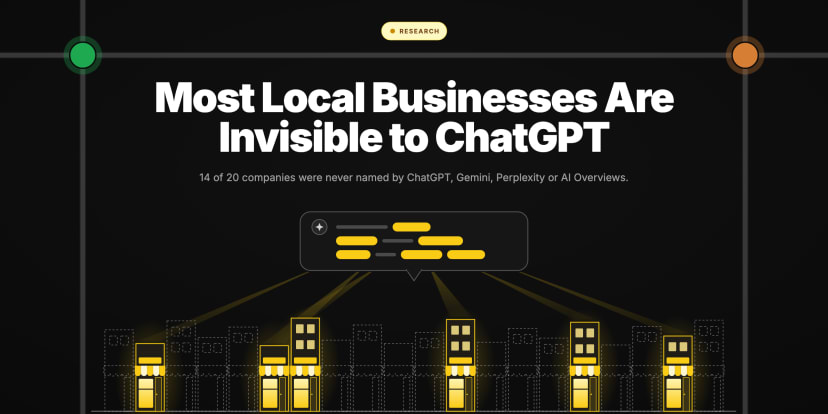
The gap between named and picked is often the useful part. A client named in 6 runs but picked in 4 is known to the system but not preferred. A client never named at all has a more basic problem, covered in why local businesses are invisible to ChatGPT.
The share only means something if every round uses the same questions, the same number of runs and the same location. The full setup, including how many runs a share needs, is in how to standardise an LLM citation test. This page is about what to count. That one is about how to count it the same way every time.
Intent coverage keeps the report honest
Split the questions by intent, or the report will look better than the business is doing. A dental practice can be cited for "how long does a root canal take?" and never be picked for "best dentist near me". Blend the two into one visibility score and the part that brings in patients disappears.
For a local business, four groups cover most of what customers ask:
- Buying questions. "Best emergency plumber in Leeds", "dentist near me open Saturday". These carry the weight in the report.
- Comparison questions. "Is X or Y better for a kitchen refit?" These show who the answer sets you against.
- Brand questions. "Is X any good?", "X reviews". These show framing, the words attached to your name.
- How-to questions. "How do I fix a dripping tap?" Being cited here is nice to have and rarely brings a booking.
Report each group on its own line. Weight the summary towards buying questions, and say so in the report.
Stability decides whether a result is worth acting on
Stability is how often the same businesses come back when the same question is asked again. If the picks change on most runs, one check is noise, and a change between two single checks is noise too. Most reports skip this measure, and it is the one that tells you whether anything else is worth reading.
A separate r/bigseo thread in August 2026 described the problem from the testing side:
Running manual prompts is fine for a quick check, but the outputs change and I have no systematic way to log what the model retrieved versus what it ignored.
What stability tells you:
- High stability, client not picked. The answer is settled against you. Look at framing and sources.
- High stability, client picked. Protect it. Watch for a rival gaining reviews or new pages.
- Low stability. The answer is still loose. A small change on your side may tip it, but no single run proves that it did.
- A sudden change. Check whether the model or your setup changed before you credit or blame the client's work.
We check our own measuring setup the same way. Before we trusted our map grid, we ran a calibration check that cost $0.13. It compared how much neighbouring grid points agreed at two map zoom levels: 0.698 at zoom 13 against 0.405 at zoom 16. We adopted zoom 16, and the full method is in our local pack GeoGrid study. The lesson carries over. Know how much your measurement moves on its own before you report a change as real.
Framing and source dependency point to the fix
Framing and source dependency are the two measures that tell you what to change. Framing records the words an answer attaches to the business. Source dependency records which pages it seems to lean on. For a local business, both often lead back to reviews and directory listings rather than to the business's own site.
A dental practice shows how this plays out. In March 2026 an agency on r/localseo described a client with four locations, all in the map pack top three, averaging 4.4 stars from about 600 reviews. An AI Overview on the practice's branded search summarised two one-star reviews as "some patients report long wait times and billing issues". By the agency's own count, branded clicks fell from about 3,200 a month to under 2,000 in five weeks. The map pack position had not changed. The words above it had.
The agency's first step was to answer every negative review with specifics of what had changed. That fits what the framing measure would have flagged: the problem sat in review text, not on the website.
What to record for each answer:
- The framing words. Copy the adjectives used about the client and each rival, word for word.
- The visible sources. Note the pages or domains the answer links to, where the platform shows them.
- Old or wrong facts. Prices, hours or services the business no longer offers point to a stale listing.
Sources shown by an assistant are only part of what it read, so treat this list as a lead, not a full record.
Gap mapping turns a miss into a task
Gap mapping asks why the client was not picked, and each answer points to different work. A report that only says "not recommended" leaves the client with nothing to do.
| what the answer shows | likely gap | where to work |
|---|---|---|
| Rivals picked for a service the client also offers | No page or review text names that service | A page per service, reviews that mention it |
| Client named but described wrongly | Old listings or pages | Directory listings, the profile, old pages |
| Client named but not picked | Weaker proof than rivals | Review count and recency, specific details |
| Client never named in any run | The system has little readable text about it | Basic listings and a clear description first |
These are working guesses from what an answer shows, not tested causes. They are still more useful than a citation count, because each row ends in a job. The case where a rival with fewer regulars keeps getting picked is covered in why AI recommends a competitor.
Put the AI numbers next to the map pack
An AEO report for a local client should sit next to a map pack report for the same service, because the two pick businesses differently. Google's help page on improving your local ranking says local results are mainly based on relevance, distance and prominence. The page's summary now calls the third one popularity. When a search names no place, distance is worked out from what Google knows about the searcher's location.
Distance does a lot of the work. In our GeoGrid study of the local pack, collected July 2026, a business appeared in 96.4% of searches made within 500 metres of it and in none beyond 5 km. That measures the map pack only. How much the searcher's location moves an AI answer is not tested by us, which is one more reason to ask from the client's town and record it.
ONE SERVICE, TWO READINGS, SAME MONTH
  map pack                AI answers
  grid over the area      fixed buying questions
  top-3 points / total    picked in N of 10 runs
        │                       │
        └──────────┬────────────┘
                   ▾
  one report line per service
  pack strong, AI weak  → text and reviews
  AI strong, pack weak  → distance, profile
A business can do well in one and badly in the other. Why that happens, and how to read each combination, is in AI answers and the map pack pick businesses differently. For the map side, a GeoGrid scan gives the coverage number in the same "how many out of how many" form.
A local AEO report in six steps
The whole report fits on one page per client. The order matters, because each step depends on the one before it.
- Pick 5 to 10 buying questions in customers' words, plus a few comparison and brand questions. Freeze the list.
- Run each question several times from the client's town, the same number of times every round, and record every business named.
- Mark named and picked separately for the client and each rival. That gives recommendation share.
- Record stability: how often the same top pick came back.
- Copy the framing words and visible sources for the client and the main rival.
- Put it next to the map pack grid for the same service, and write one gap and one task per question group.
Bottom line
For a local business, counting citations mostly counts platforms. In the 524 AI Overviews we counted, Google's help pages were cited in 85.5% of answers and the most-cited SEO vendor in under 10%. The measures that help a client are recommendation share for buying questions, the stability of that share, the words attached to the business, the sources behind them, and a reason for every miss. Report them next to the map pack, because the two systems pick businesses differently.
RankMap shows the map pack side of that report: your Google Maps ranking as a grid you can re-run with the same settings every month. We're pre-launch. Join the waitlist.
Frequently asked questions
- 01What should I measure for AEO besides citations?
- For a local business, measure recommendation share: how often an AI answer picks the business for a buying question, out of repeated runs from its town. Add stability across runs, the framing words attached to the business, and the sources the answer leans on. Then note why the business was missed. Citation counts mostly measure platforms such as Google's help pages, YouTube and Reddit, not the business.
- 02Which sites do AI Overviews cite for local SEO questions?
- In our cached archive of 524 Google AI Overview answers to local SEO and Business Profile questions, Google's help pages appeared in 85.5%, YouTube in 57.8%, business.google.com in 38.9% and Reddit in 16.6%. The most-cited SEO vendor, Semrush, appeared in 9.4%. These were mostly how-to questions, so they show where citations go, not how a business gets recommended.
- 03What is the difference between being named and being recommended by AI?
- Being named means the business appears somewhere in the answer, perhaps as one of several options. Being recommended means the answer picks it, puts it first or tells the customer to choose it. Count both on every run. A business that is often named but rarely picked is known to the system but not preferred, which usually points to weaker proof than its rivals.
- 04How do I report AI visibility to a local client?
- Use 5 to 10 buying questions in customers' words, asked several times from the client's town. Record every business named and which one was picked. Report the client's recommendation share, how stable it was, and the words used about the client. Put it next to a map pack grid for the same service, and end each section with one gap and one task.
- 05Why does stability matter in an AEO report?
- Because a result that changes on most runs can't be acted on. If the same question gives a different set of businesses each time, one check is noise, and a change between two checks may be noise too. Stability tells you whether the answer is settled. If it is settled against the client, look at framing and sources. If it is loose, keep measuring.
- 06Should AEO reporting replace map pack tracking for a local business?
- No. AI answers and the map pack pick businesses differently, and a business can be strong in one and weak in the other. Distance drives the map pack: in our GeoGrid study, a business appeared in 96.4% of searches within 500 metres and none beyond 5 km. Report both for the same service, side by side, so the client sees each picture.
Sources
Primary data, collected by us
- AI source ledger
- recorded answers to local SEO and Google Business Profile questions (US, English) from the DataForSEO AI optimisation archive, pulled 20 September 2026 and counted 21 September 2026. Google AI Overviews: 524 answers, August 2025 to September 2026. Share of answers citing support.google.com 85.5%, youtube.com 57.8%, business.google.com 38.9%, reddit.com 16.6%, semrush.com 9.4%, brightlocal.com 9.2%. ChatGPT: 114 answers, October 2025 to September 2026, 88 with a source (77%). support.google.com 37.7%, business.google.com 14.0%, reddit.com 7.9%, birdeye.com 4.4%. Mostly informational questions; only 3 were recommendation-style.
- Local pack GeoGrid study
- collected July 2026. 300 grid cells (5×5, 1 km spacing) across 12 markets. Map pack appearance 96.4% within 500 m, 0% beyond 5 km. Zoom calibration: mean neighbour overlap 0.698 at zoom 13 vs 0.405 at zoom 16, a $0.13 check, zoom 16 adopted. Published on our research page, linked twice in the body above. It measures the map pack only, not AI answers.
- Search Console query pull
- no queries recorded for this page in the 90 days to 9 November 2026. Pulled 9 November 2026.
Cited Accessed November 2026.
- r/bigseo, 4 August 2026, what signals are you actually measuring for AEO/GEO beyond citations? reddit.com. Supports the six measures; quoted passage; "vanity dashboard"; 14 replies.
- r/bigseo, 15 August 2026, how are you standardizing your tests for LLM citations? reddit.com. Supports outputs changing between runs; quoted passage.
- r/localseo, 12 March 2026, AI Overviews showing a client's 1-star reviews reddit.com. Supports 4 locations in the top three; 4.4 from about 600 reviews; the quoted summary; about 3,200 to under 2,000 branded clicks in five weeks; replying to negative reviews.
- Google Business Profile Help, tips to improve your local ranking support.google.com. Supports relevance, distance and prominence as local ranking factors; distance from the searcher.
Explore with AI
Share this
Map your real rank across the city.
Free for the first 50 scans. No credit card.
Join the waitlist