Expanding Your Service Area Doesn't Widen Your Map Ranking
A wider Google Business Profile service area doesn't widen where you rank. Distance is measured from your pin. In our study, 0% appeared beyond 5 km.
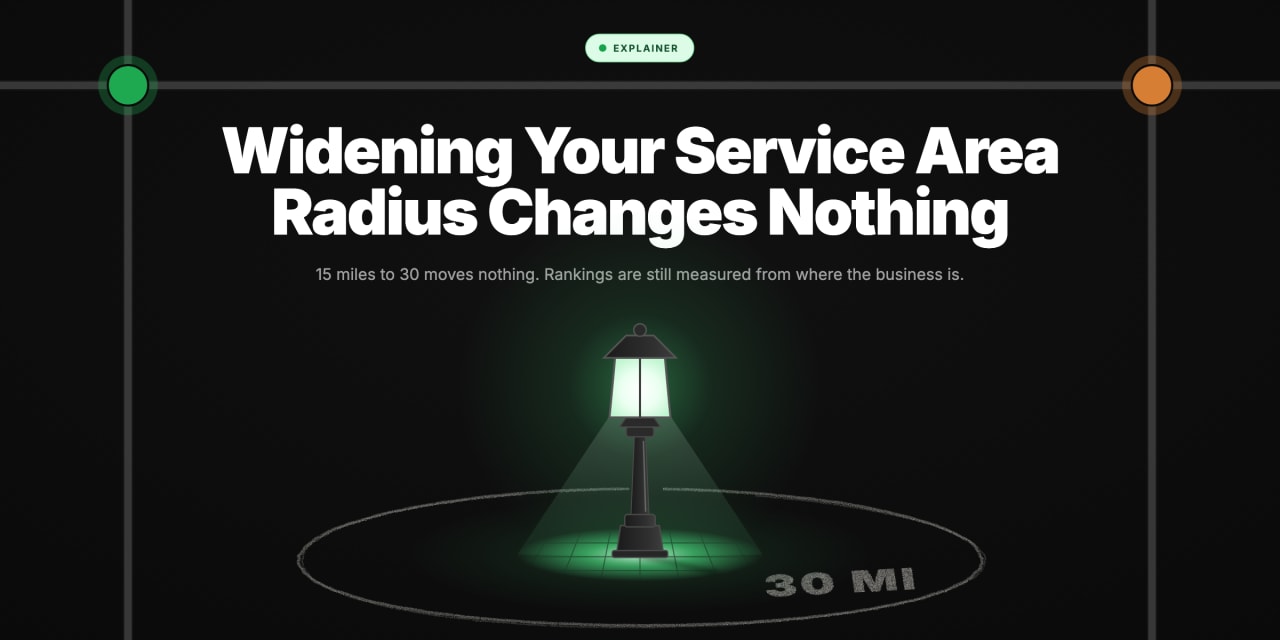
Expanding a Google Business Profile service area from 15 miles to 30 does not extend where the business ranks in the map pack. The service area tells customers where you travel. Ranking distance is still measured from the business's own location, the pin on the map. In our own study of 300 grid cells across 12 markets, a business appeared in 96.4% of searches made within 500 metres of it and in none beyond 5 km. A 15-mile radius is already about 24 km, far past that edge. For an owner or agency, widening the setting changes the label on the profile, not the map. As of November 2026, nothing Google publishes says otherwise.
Quick answer
- No, a bigger service area does not lift rankings. It changes what customers see on the profile, not where you rank.
- Distance is measured from the business. Google names distance as one of three local ranking signals, and the starting point is where you are.
- Hiding your address changes nothing here. It hides the pin from customers, not from Google.
- Your real reach is short. In our study, appearance fell from 96.4% under 500 m to 11.1% at 1 to 2 km, and to 0% beyond 5 km.
- Google caps the setting. Up to 20 service areas, within about 2 hours' drive of where you are based.
- An oversized area can draw attention. Agencies list a huge radius as a thing to check after a suspension.
- What moves outer areas is relevance and prominence. Real local proof and reviews, measured over weeks.
- Measure before and after. A grid scan of the target town is the only way to see if anything changed.
What a service area setting actually changes
A service area is a label for customers, not a ranking lever. Google's own help page says it plainly: "Your service area shows customers where you can provide your products and services." That sentence is about display. Nothing on the page links a larger area to a wider ranking.
  WHAT A SERVICE AREA CHANGE MOVES
  ┌──────────────────────────────┬────────────────┐
  │ towns listed on the profile  │ yes            │
  │ where distance is measured   │ no             │
  │ map pack spots you win       │ no             │
  │ attention after a suspension │ can increase   │
  └──────────────────────────────┴────────────────┘
  the setting is shown to customers, not ranked
The question comes up because the setting looks like a reach control. You draw a bigger circle, and it feels like Google should show you inside it. On 17 August 2026 a post on r/localseo described exactly that habit: owners, and even agencies, widen the area, "e.g., from 15 miles to 30 miles", and expect the top 3 to follow them into the next town. It doesn't.
Here is what the setting does and doesn't touch:
| what you might expect | does a wider area change it? | what actually decides it |
|---|---|---|
| Towns shown on your profile | Yes | The service area you set |
| Where your distance is measured from | No | Your verified business location |
| Map pack spots in the next town | No | Distance, then relevance and prominence |
| Risk in a suspension review | It can go up | Whether the area is honest and within limits |
Read down the right-hand column. Only the first row is controlled by the setting. Every ranking row is decided by something else.
Distance is measured from your pin, not your radius
Google ranks local results on relevance, distance and prominence. It says so in its local ranking help page, and distance means how far each business is from the person searching. The searcher's end of that line moves with every search. Your end is fixed at your business location.
For a service-area business with a hidden address, the address is hidden from customers, not from Google. The same August post on r/localseo made that point directly:
Whether your address is displayed (Storefront) or hidden (Service Area Business), the local algorithm still calculates proximity from the exact physical coordinates verified during initial setup.
r/localseo, August 2026
That post is a practitioner's claim, not a Google statement. Google doesn't publish the exact point it measures from. But it matches what our data shows about distance, and it matches the rule that a service area is for display.
The same post also claimed a "0.0% correlation" from testing "hundreds of SAB listings", credited to industry studies it didn't link. We couldn't trace that figure, so we don't use it. Our own evidence is below.
Why this matters in practice:
- The radius never enters the distance sum. A searcher 20 km away is 20 km away whether your area says 15 miles or 30.
- Rivals near the searcher win the close slots. At 20 km out, dozens of businesses are closer to that searcher than you are.
- Moving the pin is not a fix either. The pin has to sit where the business really is, or the profile itself is at risk.
The wider explanation of why rank changes street by street is in why your Google Maps ranking varies by location.
How far a business actually reaches
Our study measured reach directly, and it is far shorter than most service areas. We ran the same searches from every point of a 5×5 grid, 1 km apart, around 2,590 businesses in 12 markets, for 64,750 observations. Each business stayed the same at every point. Only the search location changed. The results are in our local pack GeoGrid study.
  HOW OFTEN A BUSINESS APPEARED, BY DISTANCE
  under 0.5 km   ####################  96.4%
  0.5 - 1 km     ########              40.5%
  1 - 2 km       ##                    11.1%
  2 - 3 km       #                      3.2%
  3 - 5 km                              0.9%
  5 km +                                0.0%
  ------------------------------------------
  15 miles = about 24 km · 30 miles = about 48 km
  both sit far past the 5 km line
Beyond 5 km, businesses appeared 0 times in 3,258 chances. Not rarely. Never. A 15-mile setting already reaches about five times past that line. Doubling it to 30 miles adds a ring where, in our data, the business had no presence at all.
What we did not test: we did not change a service area setting on a live profile and re-scan it. That experiment is not tested by us. What we measured is the thing the setting can't touch, which is how appearance falls with distance from the business.
What this means for a service-area business:
- Your strong zone is small. In our data it was about 500 m around the business.
- Your fringe is where the work pays. At 0.5 to 2 km, appearance was partial, and that's where better relevance and prominence can tip you in.
- Far towns are a different problem. Past a few kilometres you aren't losing a close race. You aren't in it.
How to find your own edge is covered in how far a Google Maps ranking reaches.
What Google allows in a service area
Google limits the setting to what you really serve. Its service area help page sets the rules, checked November 2026.
| rule | what Google says | what it means for you |
|---|---|---|
| Number of areas | Up to 20 service areas | Listing more is not possible, and stuffing 20 isn't a goal |
| Overall size | About 2 hours' driving from where you're based | A huge radius is outside the guideline |
| Who can use it | Service-area or hybrid businesses | A shop customers only visit shouldn't add one |
| Hidden address | Remove it if you don't serve customers there | Hiding it is about display, not reach |
| One profile | Service-area businesses get one profile for the whole area | No extra profiles per town |
The limits are about honesty, not reach. They stop a business from claiming places it doesn't serve. None of the rows promises a ranking in return.
A storefront owner raised the storefront side of this in December 2025:
Google's guidelines say service areas are only for businesses that travel to the customer.
r/localseo, December 2025
So for a business that customers only visit, adding towns it doesn't travel to is outside the rules, and it does nothing for rankings either.
A bigger area can become a suspension check
An oversized service area is one of the first things agencies look at after a suspension. In July 2026 a separate r/localseo post listed what to check when a service-area profile is suspended. Service-area settings came up twice:
Is the profile covering some absurdly huge radius?
r/localseo, July 2026
The same checklist flagged "20+ service areas". That is a practitioner's list, not a Google rule, and we haven't measured how often a large area leads to a suspension. But the trade is lopsided. Stretching the setting doesn't win new towns, and it gives a reviewer one more thing to question.
If a profile has already gone quiet, first check whether it's a suspension or a ranking problem. Suspension vs a ranking drop walks through the signs.
What does move rankings in a nearby town
Relevance and prominence are the levers left once distance is fixed. Our GeoGrid study shows how much they matter when businesses are close to each other. Across 10,890 matched pairs of businesses within 100 m of each other, the one with more reviews ranked higher 66.9% of the time. A more complete profile won 61.9%. A higher star rating won 52.7%, barely better than a coin flip.
Distance also hides that effect. Across every observation, review count barely correlated with rank (−0.095). Once we held distance fixed, the correlation rose to −0.377. Reviews matter, but only inside the zone where you are already close enough to compete.
| lever | what it does | what it can't do |
|---|---|---|
| A real page for the target town | Shows you work there, with jobs and photos | Overcome being 20 km away |
| Reviews that mention the town | Lift you among nearby rivals | Put you in the pack far past your reach |
| Local links and mentions from there | Add prominence in that area | Replace a real address |
| Accurate categories and services | Keep you in the running for the search | Widen how far you reach on their own |
Read the right-hand column before promising a client anything. Each lever helps at the fringe. None turns a distant town into a near one.
What to build for the target town:
- One real page per town you serve. Jobs done there, photos, the streets you cover. Not a page that only swaps the city name.
- Reviews from customers there. Ask every customer the same way, so the town shows up in reviews naturally.
- Local mentions. Suppliers, associations, local news, sponsorships from that town.
- A realistic target. Expect stronger results near the address than 20 miles out, even after all of this.
The full playbook for service-area businesses is in local SEO for service-area businesses. If the real ask is a whole city the business isn't in, read when a client wants to rank in a city they're not in.
What to do before touching the service area
- Grid the main search across the town you want. Save it as the baseline before changing anything.
- Set the service area honestly. Places you really serve, within Google's limits. Then leave it alone.
- Build proof for the target town. One real page, real reviews, real local mentions.
- Re-grid the same points after 6 to 8 weeks. Same keyword, same centre, same spacing.
- Read the outer cells. If they haven't moved, the gap is distance. The honest answer may be ads or a real second location.
That order keeps the cause and the result apart. If you change the service area and build a page in the same week, you can't tell which one did anything. In our reading, it won't be the setting.
Bottom line
A Google Business Profile service area tells customers where you travel. It doesn't move where you rank, because distance is measured from the business, and the radius never enters that sum. In our study, appearance fell to 11.1% at 1 to 2 km and to zero beyond 5 km, well inside any 15-mile setting. The work that widens coverage is local proof and reviews, checked with the same grid before and after.
RankMap is built to show that grid: where you rank across every neighbourhood you serve. We're pre-launch. Join the waitlist for free early access.
Frequently asked questions
- 01Does increasing my Google Business Profile service area improve rankings?
- No. The service area tells customers where you travel or deliver. Map pack rankings are still measured from the business's own location, so a wider area doesn't win spots in the next town. In our study of 300 grid cells, businesses appeared in 96.4% of searches within 500 metres and in none beyond 5 km, a distance any 15-mile service area already passes.
- 02Should a storefront business add service areas?
- Only if it also travels to customers or delivers. Google allows service areas for service-area and hybrid businesses, meaning ones that visit or deliver to customers. A shop that customers only visit shouldn't add towns it doesn't serve. That breaks the guidelines and does nothing for rankings, so the change carries risk with no upside.
- 03Does hiding my address change where I rank?
- No. Hiding the address removes it from what customers see, but Google still knows where the business is. Practitioners on r/localseo report that proximity is still measured from the location verified at setup. Google doesn't publish the exact point it measures from, but nothing it publishes says hiding the address widens your reach.
- 04How many service areas can I add, and how far can they reach?
- Google allows up to 20 service areas, set by city, postal code or another area. The whole area shouldn't reach more than about two hours' driving from where the business is based. These limits stop businesses from claiming places they don't serve. Staying within them is about following the rules, not about ranking further out.
- 05Can an oversized service area get my profile suspended?
- We haven't measured it, and Google doesn't publish a rule tying size to suspensions. But agencies do treat it as a warning sign. A July 2026 suspension checklist on r/localseo asked whether the profile covered an absurdly huge radius and flagged 20 or more service areas. A large area wins nothing, so it isn't worth the extra scrutiny.
- 06How do I rank in a nearby town without an address there?
- Build relevance and prominence for that town: a real page with local jobs and photos, reviews from customers there, and local links and mentions. Then re-check the same grid points after six to eight weeks. Expect weaker results far from the address. If the outer cells still don't move, the gap is distance, and ads or a real location may be the answer.
Sources
Primary data, collected by us
- Local pack GeoGrid study
- 300 grid cells (5×5, 1 km spacing) across 12 markets, 2,590 businesses, 64,750 observations. Appearance by distance: 96.4% under 0.5 km, 40.5% at 0.5–1 km, 11.1% at 1–2 km, 3.2% at 2–3 km, 0.9% at 3–5 km, 0.0% beyond 5 km (0 of 3,258). Matched pairs within 100 m: review count 66.9%, completeness 61.9%, star rating 52.7% of 10,890. Review count vs rank correlation −0.095 overall, −0.377 with distance held fixed. Published on our research page, linked in the body above. We did not test changing a service area setting.
- Search Console query pull
- queries that showed this page in Google, 90 days to 9 November 2026: "expand search area" 1 impression at position 62.0. Pulled 9 November 2026.
Cited Accessed November 2026.
- r/localseo, 17 August 2026, expanding the service area has zero impact on the map pack reddit.com. Supports the 15 → 30 miles example; proximity measured from the verified location; the "0.0%" claim, noted and NOT used as evidence.
- r/localseo, 21 December 2025, punished for having service areas? reddit.com. Supports storefronts adding service areas; the quoted guideline reading.
- r/localseo, 10 July 2026, GBP suspension checklist reddit.com. Supports huge radius and 20+ service areas as suspension checks.
- Google Business Profile Help, manage your service areas support.google.com. Supports service area shows customers where you serve; up to 20; about 2 hours' drive; service-area and hybrid only; one profile per service-area business.
- Google Business Profile Help, tips to improve your local ranking support.google.com. Supports relevance, distance and prominence as the named local signals.
Explore with AI
Share this
Map your real rank across the city.
Free for the first 50 scans. No credit card.
Join the waitlist